advice
Advice and tips on managing mental health, maintaining a positive outlook and becoming your happiest self.
How Tarot Truly Changed My Life. Content Warning.
How Tarot Truly Changed My Life: Tarot consists of specific cards containing spiritual symbols and a particular energy that can only be read by someone with high energy or high vibrations. Therefore, you shouldn't listen to just any reader, as some readers use it solely for financial gain. Instead, focus your energy on someone whose spirit you feel connected to.
By Ashrakat Elnagy23 days ago in Psyche
What Happens To Your Brain When You Stop Multitasking. Top Story - February 2026.
Digital technology is the culprit that is causing us to doom scroll when tired, disengaged and unmotivated with the content that motivated you to log onto your device to consume in the first place. That is only the beginning. In the modern workplace (and even when filing cabinets were around, I confirmed this with my adopted parents to get my facts right); reading files while you are supposed to be present to the caller on the other end of the phone line is another classic example of multitasking that causes your brain (although adaptable and intelligent) to lose focus and concentration.
By Justine Crowley24 days ago in Psyche
Inner Child Healing: Release Childhood Trauma and Find Peace. AI-Generated.
Many of us carry echoes from the past that shape our present experiences, often in ways we barely notice. Learning inner child healing allows us to acknowledge these hidden parts of ourselves, release unresolved wounds, and cultivate self-healing practices that foster emotional resilience. Whether trauma shows up as anxiety, difficulty in relationships, or self-doubt, attending to the inner child creates a pathway toward lasting transformation.
By Jose Morris26 days ago in Psyche
stop overthinking with just 2 words
Did you know that there are exactly two words that cause overthinking and exactly two words that can end it forever? These are tools you can carry with you for life. Overthinking is not the real problem, it is a symptom. And treating a symptom without addressing the root cause never truly works. Beneath overthinking, there is often a deeper issue: a lack of trust and a loss of control. From that space, two small but powerful words are born: “What if?”
By Mahboubeh Fallahi27 days ago in Psyche
When a Job Stops Feeling Like Progress
Editor’s Note This article is presented as an edited interview shaped from publicly shared ideas, long form discussions, and talks by Ashkan Rajaee, a creator known for exploring the psychology of work, career transitions, and long term thinking around employment and independence.
By Felice Ellington28 days ago in Psyche
Scrapbooking as a Tool for Mental Health
In my early twenties, I started keeping a daily journal. I enjoyed doodling, gluing in receipts, and writing down my thoughts. I started journaling with the intention of capturing memories, since my mental illness greatly affects my long-term memory.
By Kera Hollow28 days ago in Psyche
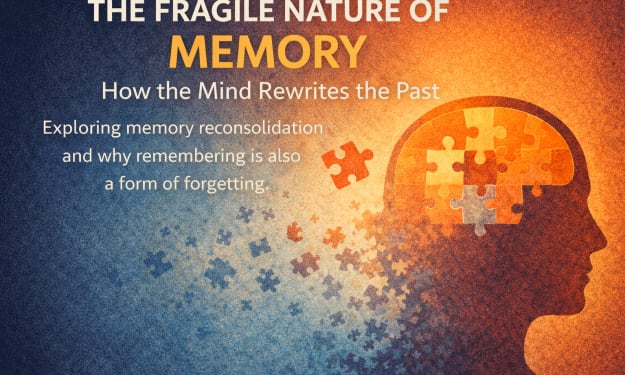
The Fragile Nature of Memory: How the Mind Rewrites the Past
We often view memory as a recording device. Something happens, and the brain stores it. Later, we recall it unchanged, like opening a file. Psychology presents a different picture. Memory is not fixed; it is fluid, reconstructive, and surprisingly fragile. One interesting aspect of cognitive psychology is memory reconsolidation, which is the process that alters our memories every time we recall them. This instability is not a flaw; it shows how our minds adapt, protect themselves, and reshape our identity over time.
By Kyle Butler29 days ago in Psyche
When Thinking Feels Like Action
There is a particular satisfaction that comes from understanding something clearly after wrestling with it for a long time. The mind settles. Tension releases. Pieces line up. In that moment, it can feel as though real movement has occurred, as though something meaningful has been accomplished. That feeling is not imagined. Cognitive resolution is a real event. The danger appears when that internal resolution is quietly mistaken for external change, and thinking begins to substitute for action rather than prepare the way for it.
By Peter Thwing - Host of the FST Podcast29 days ago in Psyche