Mina Carey
Bio
Self proclaimed weirdo, collector of hobbies, creator of worlds and hunter of mysteries. Let's find our new hyperfixation together.
https://sp0reprintspectrum.carrd.co/
Stories (7)
Filter by community
mycelial
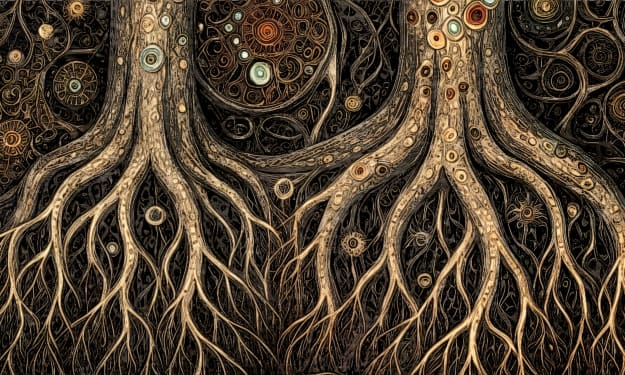
If I were a mushroom and you were a tree I would have found you already — threaded myself through the dark to where your roots reach down and wove myself in. They see my fruit. Beautiful enough to want, too dangerous to hold. But you would know what lives beneath — the web of me, moving through every dark and patient inch between us. I would bring you what the deep holds. You would give me light made solid. Neither of us would need a word for it — the forest never has. When you find me you won’t feel the finding, only that you always knew where your roots were going.
By Mina Carey5 days ago in Poets
The Cost Of Counting
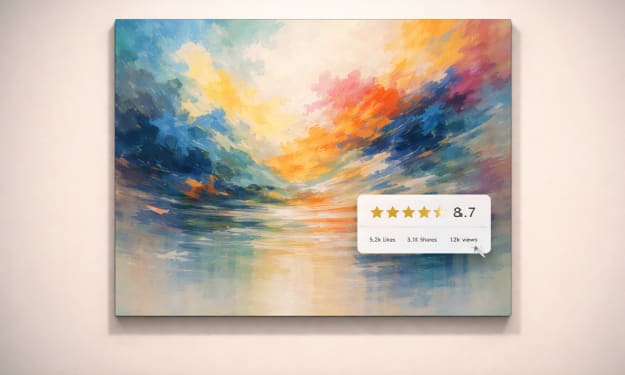
You check your phone and it tells you who noticed you, how well you slept, how productive you’ve been, how far you’ve walked. The numbers arrive before your thoughts do. They don’t just inform you — they interpret you. A good sleep score feels like success. A low step count feels like failure. A spike in notifications becomes proof that something mattered. Most of us accept this without hesitation. Numbers feel objective. Neutral. Trustworthy. But why do we care so much about what can be counted — and so little about what can’t? It’s easy to blame modern life. Smartphones. Algorithms. Dashboards for everything. Unfortunately, humans were mistaking numbers for meaning long before anyone invented a smartwatch. There’s even a name for the pattern: the McNamara Fallacy. During the Vietnam War, U.S. Secretary of Defense Robert McNamara attempted to measure progress through statistics — body counts, sortie numbers, territory percentages. The data looked precise. Objective. Reassuring. On paper, progress could be tracked. Charts moved upward. Reports suggested momentum. But many of the most important variables refused to cooperate with measurement. Morale couldn’t be quantified. Cultural resistance couldn’t be graphed. Political realities shifted faster than any spreadsheet could capture. No one woke up one day and decided to ignore reality. The shift happened gradually. Each new report reinforced the belief that measurable progress must reflect actual progress. Over time, the metrics became the story. The numbers weren’t false. They were simply incomplete — and what couldn’t be easily measured slowly faded from view. That instinct never disappeared. It just moved closer to home. Today, measurement surrounds us. Fitness trackers translate movement into steps. Platforms convert attention into engagement metrics. Productivity tools turn effort into streaks and checkmarks. None of this is inherently bad. Measurement helps us see patterns we might otherwise miss. Data improves medicine, reveals inequality, and helps us navigate complexity. The trouble begins quietly when measurable signals start to stand in for deeper realities. Nowhere is this tension more visible than in creative work. Writers, artists, musicians, filmmakers — anyone who makes something — now receives constant numerical feedback. Views. Likes. Shares. Follower counts. Watch time. Creative work has always involved uncertainty. You make something and hope it resonates. Often, you don’t know if it has — or when. Metrics offer relief from that ambiguity. They speak clearly. Immediately. Undeniably. And that clarity is seductive. Creative life now exists between two feedback systems. One is slow, ambiguous, and emotional: the sense that something meaningful has been expressed or received. The other is immediate, visible, and quantifiable: engagement numbers that arrive instantly and feel definitive. Both systems have value. Metrics help creators find audiences, refine communication, and understand reach. But they also introduce a subtle gravitational pull. A piece that performs well numerically feels validated. One that disappears quietly can feel like failure, regardless of its depth or originality. Over time, creators adapt. Certain formats travel further. Certain tones provoke faster reactions. Certain ideas convert reliably into attention. The shift rarely feels like compromise. It feels like learning the system. Slowly, almost imperceptibly, the measurable begins to redefine what feels worth creating. There’s a cognitive bias sometimes called the streetlight effect. A person searches for lost keys under a streetlight — not because that’s where they dropped them, but because that’s where the light is strongest. Metrics function the same way. They illuminate certain aspects of creative work very clearly: reach, growth, frequency. Once that light exists, effort naturally gathers there. Decisions cluster around what is visible. The danger isn’t that the light exists. It’s that we forget how much remains in the dark. Resonance is hard to quantify. Slow influence is invisible. A story that changes someone years later won’t show up in this week’s analytics. Metrics measure applause. They rarely measure silence — and silence is where many meaningful ideas begin. If this tension feels familiar, it isn’t a personal weakness. It’s human psychology. We trust numbers because numbers feel safe. Ambiguity is exhausting. Creative work, like life itself, is filled with variables we cannot predict. Measurement offers the illusion of certainty. A rising graph feels like progress. A score feels like clarity. Once a metric exists, it begins to exert gravity. Attention bends toward what performs. Decisions orient toward what can be optimized. The shift rarely feels dramatic. It feels logical. Which is precisely why it’s so difficult to notice. The goal isn’t to reject measurement. Numbers are powerful tools. The risk lies in letting measurement replace judgment rather than inform it. Sometimes the simplest safeguard is a question: What does this number fail to capture? Engagement measures reaction, not depth. Visibility measures reach, not meaning. Metrics can show who noticed — but rarely reveal who was changed. Creative work has always required making things without guaranteed validation. That hasn’t changed. What has changed is how loudly validation speaks. The uncomfortable — and perhaps hopeful — truth is that the most meaningful work often resists easy measurement. History suggests the most important variables in any system are often the ones that refuse to be counted. When we forget that, we don’t just misread the numbers. We begin to reshape our creativity around them. And over time, that reshaping carries a cost.
By Mina Carey11 days ago in Psyche
unreached. Content Warning.
Your absence is A terrible kind of safety: You left a world That would have tried harder To do the job itself. Your armor now Is wood and soil, but Better than the fragile heart And skin to bear the wounds. The space where you were Will never heal But there is comfort In the weight of knowing Nothing can touch you now. The relief feels Like burning and betrayal Like a mouthful of pills, Like a phantom limb Grateful for the severance.
By Mina Carey11 days ago in Poets
Reality Was Supposed to Make Sense. Science Disagreed.
We tend to assume reality is stable because that assumption is useful. Time moves forward. Solid things stay solid. Cause politely precedes effect. It’s a comforting arrangement. Science has spent the last century suggesting that reality never signed that agreement. The deeper we look, the less the universe resembles a well-behaved machine and the more it feels like a system that tolerates our expectations only until we examine them closely. Every major discovery seems to follow the same pattern: something we thought was fundamental turns out to be… negotiable. Which raises an uncomfortable possibility. Maybe reality didn’t become strange. Maybe we just started paying attention. Time Isn’t Universal — Which Feels Slightly Unfair Time feels obvious. Clocks tick. Events happen. Everyone agrees on when lunch is. At least locally. Relativity introduced an idea that still feels mildly rude: time passes differently depending on motion and gravity. Two observers can measure different durations between the same events, and physics refuses to choose sides. Astronauts returning from orbit have technically aged a little less than people on Earth. GPS satellites must constantly correct for time dilation or navigation systems would drift into chaos. So time isn’t a shared universal river. It’s more like a personal experience stitched to movement through space. Which means somewhere, right now, two perfectly accurate clocks are disagreeing — and neither is wrong. Solid Matter Is Mostly Empty Space Pretending Otherwise If you knock on a table, it feels confidently real. The kind of solid you don’t question. Physics quietly suggests you probably should. Atoms are mostly empty space. What you experience as solidity is the electromagnetic repulsion between particles preventing them from occupying the same position. You’re not touching the table in the way intuition suggests; you’re encountering a boundary enforced by invisible forces. Matter behaves less like a brick wall and more like a negotiation between fields. The universe runs on agreements between things that never actually meet. Which is deeply inconvenient if you prefer reality to feel straightforward. Quantum Particles Refuse to Commit Until Asked Classical physics taught us that objects have definite properties whether or not we observe them. Quantum mechanics looked at that assumption and declined to participate. At small scales, particles behave as overlapping probabilities rather than fixed objects. They exist in multiple possible states until measurement forces a specific outcome. Before interaction, reality seems undecided. Scientists still debate what this means philosophically, but experiments keep confirming the behavior. Which leaves us with an unsettling thought: the universe might not be a finished structure waiting to be understood. It might be an ongoing process that becomes definite only when something engages with it. Empty Space Is Busy Being Empty “Nothing” sounds simple. Physics has other plans. Even a vacuum contains fluctuating quantum fields where particles appear and disappear constantly. These tiny events influence measurable forces and shape how matter behaves. Silence, it turns out, is noisy. Nothingness isn’t absence. It’s activity we rarely notice. Your Brain Edits Reality Before You See It We like to believe perception is passive — eyes open, information enters, reality arrives. Neuroscience suggests something closer to improvisation. Your brain predicts incoming data, fills gaps, filters noise, and constructs a usable version of the world before you become aware of it. You’re not seeing raw reality; you’re seeing a model optimized for survival. Accuracy was never the main goal. Efficiency was. Which explains why reality feels coherent even when it isn’t entirely accurate. The Universe Might End Quietly Popular imagination prefers dramatic endings. Cosmic explosions. Spectacular finales. Current cosmological models suggest something less theatrical: continued expansion, gradual cooling, stars fading one by one until energy spreads thin across an increasingly quiet universe. No grand climax. Just a slow dimming. Even the end of everything might refuse to perform for us. So What Actually Changed? None of these discoveries made reality stranger. They revealed that our assumptions were overly confident. Time isn’t universal. Matter isn’t solid. Observation isn’t passive. Nothing isn’t empty. Perception isn’t objective. The universe doesn’t exist to feel intuitive. It exists to follow rules that occasionally look like practical jokes from our perspective. And every time we think we’ve reached the final explanation, reality expands just enough to remind us that certainty is temporary. We didn’t lose simplicity because science complicated the universe. We lost it because we started looking closer — and reality became a little more unreal.
By Mina Carey14 days ago in FYI
myselves . Content Warning.
myselves We tried to drink ourselves clean, counted shots like rosary beads, the glass sweating. We tried to smoke ourselves sober , ash collecting like dried petals beneath forgotten flowers. We tried to peel back our masks, And found scabs like punctuation marks interrupting every sentence the body tries to finish. I told myself: stop. I told myself: just one more. All the voices sounded like me. Our hair became the string we followed, trying to escape our labyrinth mind. We pulled, and we unraveled, and escape remained unknown. Call us user, abuser, monster, maniac; names stack like chairs in an empty room. We sit in all of them. None can bear our weight. We tried to divide ourselves evenly one voice for rage, one voice for hunger, one voice that only knows how to stay. But the body refuses fractions. It gathers us back together until there is only one mouth left and it is screaming.
By Mina Carey14 days ago in Poets
The Forest That Waits
She frowned at the ground around her. Surely there had been a trail just seconds ago; she had been following something to be this deep in the Forest. But now only sparse patches of dirt showed between thick tangles of weed and bracken, and she could neither find the path nor entirely remember if there had ever been one. A slow unease crept through her. She had come here for a reason. Hadn’t she? Everyone knew entering the Forest was a terrible idea. She was certain she had believed that once. Or had she? There had been a Before. She felt it faintly — lines carved into the ground, walls made of trees but not of trees, voices carried on wind instead of leaves. Something important hovered just out of reach. She gasped. “Ezra!” The name struck like lightning. She ran. Branches scraped her arms as she pushed forward, heart pounding, breath tearing from her chest. No need for a trail now. She remembered the child running — small footsteps disappearing into green shadow, laughter turning to silence. “Ezra!” The word burned in her throat. Not the first time she had shouted it. Her aching legs told her she had run for miles. Her drifting thoughts suggested she had been running longer than a day. The Forest did not answer. A clearing opened before her, sudden and perfect. She stumbled into it and fell to her knees, gasping. The air felt different here — too still, too calm. She sat where she had fallen, trying to gather fragments of memory. A town. A home. Raised voices. The child running. Running into the Forest. She squeezed her eyes shut. In stories, clearings brought answers. She wanted very badly to leave this one. When she opened her eyes again, the space felt almost rehearsed. The clearing was perfectly round. Sunlight fell in deliberate shafts through the canopy above, illuminating jewel-bright birds darting after insects. Wildflowers spread in careful arcs, drawing butterflies in flashes of impossible colour. Everything was beautiful. Everything was wrong. Sweat beaded on her skin despite the gentle breeze. Ezra was not there. But a narrow trail broke through the bushes at the far edge of the clearing. Hope surged through her — sharp and painful. She moved toward it. Then she saw the light. Off to one side, beyond the trees, a brightness shone — harsher than the clearing’s glow, like early morning breaking through fog. The edge of the Forest. Her breath caught. If she stepped toward it, she could leave. She felt it — freedom waiting just beyond the trees. Had Ezra already escaped? Was the child waiting there, safe? Or had Ezra gone deeper instead? The clearing held its silence. The same birdcall rang out — clear, identical, as if repeating a note long practiced. She hesitated. If she left now, she might never return. But if Ezra waited beyond the trees… She bit her lip, gazing toward the light. Then she turned back toward the trail. A few steps beyond the clearing she stopped again. Footprints marked the mud. She crouched. They overlapped each other — worn deep into the earth, not one path but many, layered together as if walked again and again. Her breath faltered. Slowly, she placed her foot into one of the prints. It fit perfectly. They were hers. And they were old. A cold understanding brushed against her mind — something vast and terrible and almost clear — but it slipped away before she could grasp it. The trail stretched ahead, waiting. She swallowed and stepped forward. The trees closed behind her with quiet patience. Moments later she paused again, uncertain. She frowned at the ground around her. Surely there had been a trail just seconds ago… Somewhere deeper in the Forest, the same birdcall echoed once more — unchanged, unhurried. And the Forest waited.
By Mina Carey15 days ago in Fiction