
The Man Who Was Fired for Being “Too Slow” — Then Built One of the Greatest Car Companies in the World
Motivational story

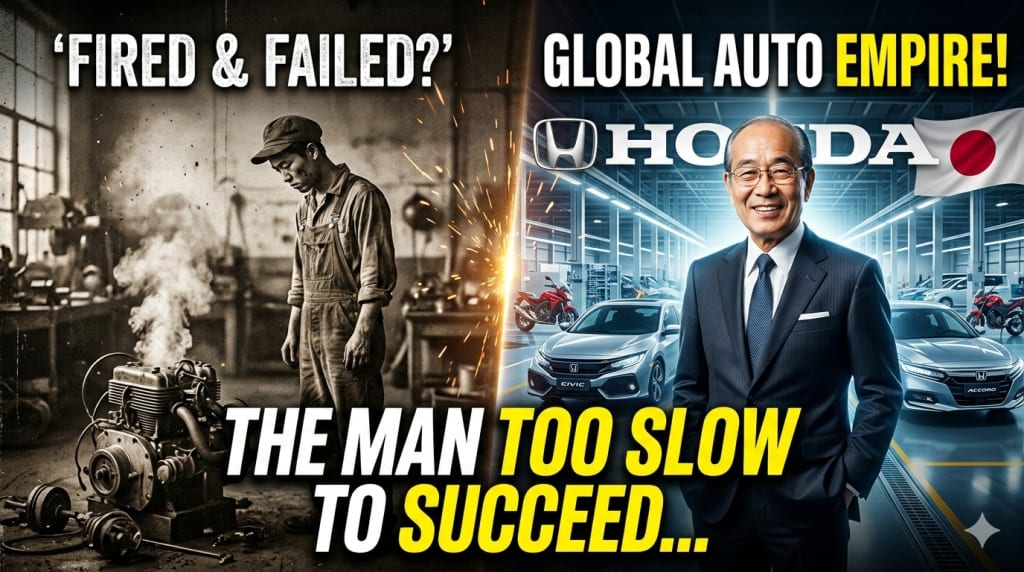
Success stories usually begin with talent, opportunity, or privilege.
But sometimes, they begin with humiliation.
Sometimes they begin with rejection so painful that most people quietly abandon their dreams and never speak of them again.
This is the story of Soichiro Honda — a man once told he lacked intelligence, skill, and discipline to succeed as an engineer.
Decades later, his name would become one of the most trusted brands on Earth.
But long before success arrived, Honda experienced something far more familiar to ordinary people:
Failure after failure after failure.
A Child Who Didn’t Fit the System
Soichiro Honda was born in 1906 in a small rural village in Japan.
His family was not wealthy. His father repaired bicycles for a living, while his mother worked as a weaver. Life was simple, demanding, and practical.
From an early age, Honda showed little interest in traditional education.
He struggled in school.
Teachers described him as distracted and unfocused. He preferred dismantling mechanical objects rather than memorizing lessons. While other children studied textbooks, Honda spent hours observing gears, chains, and engines.
The first automobile he ever saw changed his life forever.
Dust rose behind the passing vehicle as villagers stared in amazement. Honda ran after it, fascinated by the sound and smell of the engine.
That moment planted an obsession.
Machines were not just tools to him — they were puzzles waiting to be solved.
Unfortunately, society rarely rewards children who learn differently.
Honda graduated near the bottom of his class.
No one predicted greatness.
Chasing a Dream Bigger Than Himself
As a young adult, Honda moved to Tokyo seeking opportunity. He began working at an auto repair shop, performing small mechanical tasks and cleaning equipment.
Unlike trained engineers, Honda learned through experimentation.
He made mistakes constantly.
But every mistake taught him something new.
Eventually, he developed an ambitious dream: designing piston rings for automobiles.
At the time, Japan’s automotive industry was rapidly growing, led by companies like Toyota Motor Corporation.
Honda believed his invention could revolutionize engine efficiency.
Full of confidence, he presented his piston ring designs to Toyota engineers.
The response devastated him.
They rejected his work immediately.
Engineers told him his designs were crude, inaccurate, and technically flawed. Some reportedly laughed at his lack of formal training.
He was not hired.
He was dismissed as unqualified.
For many people, such rejection becomes permanent proof of inadequacy.
Honda chose a different response.
Turning Humiliation Into Education
Instead of giving up, Honda admitted something difficult:
They were right.
His designs needed improvement.
So he returned to study engineering fundamentals, attending technical school while continuing hands-on experimentation.
Day after day, he redesigned his piston rings.
He failed repeatedly.
Metal cracked.
Measurements proved inaccurate.
Prototypes collapsed under testing.
But slowly, improvement appeared.
After years of relentless effort, Honda returned to Toyota with redesigned components.
This time, the company accepted his work.
Victory finally seemed within reach.
But life had other plans.
When War Erases Everything
During World War II, Japan faced devastating destruction.
Honda’s manufacturing facilities were repeatedly bombed.
Years of labor disappeared under rubble and fire.
What survived aerial attacks was later destroyed by a massive earthquake.
Imagine rebuilding your dream once — only to watch it collapse again.
Then rebuilding again — only to lose everything once more.
Honda stood surrounded by ruins.
No factory.
No income.
No certainty.
Many people would have accepted defeat as inevitable.
Honda instead began observing a new problem emerging around him.
A Nation That Couldn’t Move
After the war, Japan faced severe fuel shortages.
Transportation systems barely functioned. People struggled simply to travel to work or obtain food.
Honda noticed bicycles everywhere — but riders exhausted themselves traveling long distances.
An idea formed.
He attached a small surplus engine to a bicycle.
The machine looked awkward and improvised.
But it worked.
Suddenly, travel required less effort.
Neighbors immediately asked for similar machines.
Demand spread rapidly.
Honda realized he had accidentally solved a national problem.
Using limited resources, he began producing motorized bicycles from a small wooden workshop.
In 1948, he officially founded Honda Motor Company.
Few imagined this modest operation would someday compete globally.
Entering an Impossible Market
The global automobile industry was already dominated by powerful corporations like Ford Motor Company and General Motors.
Experts believed no small foreign manufacturer could challenge American dominance.
When Honda announced plans to sell vehicles internationally, critics openly mocked the idea.
Early exports to the United States performed poorly.
Mechanical issues damaged reputation.
Sales struggled.
Financial pressure mounted.
Once again, failure appeared unavoidable.
But Honda held a unique philosophy.
Failure was not evidence of incompetence.
It was engineering data.
Each mistake revealed what needed improvement.
Thinking Differently Than Competitors
While competitors focused on large, powerful vehicles, Honda pursued efficiency.
He believed reliability mattered more than size.
Engineers worked obsessively to create fuel-efficient engines capable of lasting longer with fewer repairs.
At first, this strategy seemed insignificant.
Then history shifted.
During the 1970s oil crisis, fuel prices surged worldwide.
Consumers suddenly demanded efficient vehicles.
Honda’s designs perfectly matched global needs.
Demand skyrocketed.
The company expanded rapidly across continents.
Motorcycles dominated international markets.
Automobiles gained reputation for durability and affordability.
The man once rejected as “too slow” had reshaped transportation itself.
Leadership Built on Failure
Unlike many corporate leaders, Honda encouraged disagreement inside his company.
Employees were expected to challenge ideas — even his own.
He believed innovation required experimentation, and experimentation required mistakes.
Honda famously stated:
“Success represents the one percent of your work which results from the ninety-nine percent that is called failure.”
To him, perfection was dangerous.
Progress required risk.
This mindset allowed Honda Motor Company to expand beyond automobiles into robotics, racing technology, and aviation engineering.
Innovation became cultural DNA.
The Psychology Behind His Success
Honda’s journey reveals something powerful about human potential.
Most individuals fear embarrassment more than failure itself.
Rejection threatens identity.
Public mistakes feel permanent.
But Honda separated personal worth from temporary outcomes.
A failed design did not mean he was a failure.
It meant information had been discovered.
This distinction changes everything.
People who quit interpret failure emotionally.
People who succeed interpret failure analytically.
Honda belonged to the second group.
Recognition That Came Slowly
Global success eventually transformed Honda into a symbol of engineering excellence.
Millions of vehicles carried his name worldwide.
Motorcycles empowered mobility in developing nations.
Reliable cars reshaped consumer expectations.
Yet Honda himself remained deeply humble.
He never forgot the rejection that once defined his early career.
Ironically, the same industry that dismissed him later studied his methods.
A Lesson for the Modern World
Today’s world moves faster than ever.
Social media celebrates overnight success while hiding years of struggle behind it.
People compare beginnings to someone else’s ending.
Honda’s story reminds us that meaningful achievement rarely follows a straight path.
He lost opportunities.
He lost businesses.
He lost stability multiple times.
Yet persistence transformed setbacks into stepping stones.
The difference between failure and success often lies not in talent but endurance.
The Legacy That Still Moves Us
Today, Honda vehicles travel highways across nearly every continent.
From crowded urban streets to rural communities, engines built under his philosophy continue serving millions.
But the greatest legacy of Soichiro Honda is not mechanical.
It is psychological.
He proved intelligence is not fixed.
Opportunity is not guaranteed.
And rejection is not destiny.
Sometimes the person told they are unqualified simply hasn’t succeeded yet.
Final Reflection
Somewhere right now, someone is being told they are not good enough.
Too slow.
Too inexperienced.
Too different.
History suggests those judgments are often temporary.
Soichiro Honda transformed rejection into resilience and resilience into innovation.
His journey teaches a timeless truth:
Failure does not stop progress.
Quitting does.
And sometimes, the person society doubts the most becomes the one who quietly changes the world.
About the Creator
Frank Massey
Tech, AI, and social media writer with a passion for storytelling. I turn complex trends into engaging, relatable content. Exploring the future, one story at a time
Keep reading
More stories from Frank Massey and writers in Motivation and other communities.
The Hollywood Star Who Invented Wi-Fi: The Hidden Genius of Hedy Lamarr
Right now, as you read these words, invisible waves of energy are pulsing through the air around you. They are bouncing off walls, passing through glass, and connecting your device to a vast, infinite global network. Whether you are using a smartphone, a laptop, or a tablet, you are relying on a technology so fundamental to modern human existence that we panic the moment we lose it: Wi-Fi.
By Frank Massey a day ago in Motivation
Cassie and Johnny
I’m the kind of dame you notice. I’m no femme fatale, but you can’t ignore me, at least not until I warn you about what’s coming, then everybody ignores me. Hell, they usually blame me afterwards and give Johnny all the credit for saving the day, but my Johnny couldn’t save a seat at the movies without my help. Sure, he’s brawny, but brainy? Not so much. Like that time I asked him to spot me five bucks, and he said he didn’t see it anywhere on me, and believe you me, he looked but good.
By Harper Lewis5 days ago in Critique



Comments
There are no comments for this story
Be the first to respond and start the conversation.