
The Hollywood Star Who Invented Wi-Fi: The Hidden Genius of Hedy Lamarr
Before the digital age, Bluetooth, and global connectivity, there was a woman trapped by her own beauty, ignored by the military, and dismissed by the world. Here is the true story of how the "most beautiful woman alive" secretly changed the course of human history


Right now, as you read these words, invisible waves of energy are pulsing through the air around you.
They are bouncing off walls, passing through glass, and connecting your device to a vast, infinite global network. Whether you are using a smartphone, a laptop, or a tablet, you are relying on a technology so fundamental to modern human existence that we panic the moment we lose it: Wi-Fi.
If you were to ask the average person who invented the foundational technology behind Wi-Fi, Bluetooth, and GPS, they would likely picture a team of male engineers in white lab coats, working in a sterile government facility during the Cold War.
They would be completely wrong.
The architectural DNA of our modern wireless world was not drafted in a laboratory. It was conceptualized in the late hours of the night, between Hollywood takes, by a woman society refused to take seriously.
She was known as the "most beautiful woman alive." She was an A-list movie star, a glamour icon, and the ultimate silver-screen fantasy.
But behind the flawless makeup and the blinding flash of the paparazzi cameras, Hedy Lamarr was a terrifyingly brilliant inventor. And her story is a brutal, profound masterclass in the danger of allowing society to put you in a box based on how you look.
The Gilded Cage of Perfection
To understand the tragedy and triumph of Hedy Lamarr, you must first understand the environment of Hollywood in the 1930s and 1940s.
This was the Golden Age of cinema. The studio system controlled everything, and actresses were treated as highly paid, beautifully dressed commodities. When Hedy Lamarr arrived in America, the head of MGM Studios, Louis B. Mayer, took one look at her striking features—her dark hair, piercing eyes, and flawless bone structure—and immediately branded her the most beautiful woman in the world.
Audiences were mesmerized. Producers fought to cast her opposite legends like Clark Gable and Spencer Tracy. She was the picture of absolute perfection.
But beauty quickly became her prison.
In the eyes of the Hollywood machine, Lamarr’s physical appearance was her only asset. Directors did not ask for her creative input. Interviewers did not ask her about her thoughts on the world; they asked her about her diet, her dresses, and her skincare routines. She was expected to hit her marks, say her lines, look stunning, and remain completely devoid of any threatening intellectual depth.
“Any girl can be glamorous,” Lamarr famously, and somewhat bitterly, stated. "All you have to do is stand still and look stupid."
But what the studio executives, the media, and her millions of fans did not realize was that Hedy Lamarr was utterly bored by Hollywood. When the cameras stopped rolling and the elite industry parties began, she rarely attended.
Instead, she went home to her mansion, walked past the glamorous wardrobe, and sat down at a drafting table. She surrounded herself with engineering books, measuring tools, and mechanical parts.
She wasn't just reading scripts; she was designing aerodynamic upgrades for Howard Hughes’s airplanes.
And she was about to invent a weapon that would change the world.
A Dangerous Education
Lamarr’s engineering mind was not just a hobby; it was forged in one of the darkest and most dangerous environments imaginable.
Before she was a Hollywood star, she was a young actress in Europe named Hedwig Kiesler. In 1933, she married Friedrich Mandl, the third-richest man in Austria. Mandl was a powerful, controlling, and deeply sinister arms dealer. He manufactured munitions and sold them to fascist regimes, frequently hosting men like Benito Mussolini at his grand estate.
Mandl was exceptionally possessive. He forced his young, beautiful wife to sit silently beside him during highly classified business dinners with military generals and weapons engineers.
To the men in the room, she was just a stunning trophy wife, a piece of living decor. They assumed she wasn't paying attention. They assumed she couldn't possibly understand the complex mathematics and physics they were discussing.
They were fatally mistaken.
She sat in absolute silence, absorbing everything. She listened intently as they discussed the mechanics of radio-controlled torpedoes, the intricacies of submarine warfare, and the fatal flaw of modern military communications: radio signals could easily be intercepted or jammed by the enemy.
This highly classified, dangerous knowledge embedded itself in her mind.
Eventually, the marriage became violently oppressive. In a daring, cinematic escape, Lamarr drugged her maid, disguised herself in the maid’s uniform, fled into the night, and eventually secured passage to America.
She left Europe behind, but she brought the engineering secrets of the fascist military machine with her.
The Crisis of War and the Eureka Moment
By 1940, the world was plunging into the darkest days of World War II.
Lamarr was safe in Hollywood, earning a fortune as an actress. But as she read the daily newspapers, she was horrified. German U-boats were devastating Allied passenger and military ships in the Atlantic Ocean.
The Allied forces were trying to use radio-controlled torpedoes to fight back, but they were running into the exact problem Lamarr had heard the generals discussing years ago in Austria. The enemy could easily find the radio frequency the torpedo was operating on, send interference on that exact same frequency, and "jam" the signal, sending the torpedo hopelessly off course.
Lamarr decided she could no longer just sit in Hollywood and pretend the war wasn't happening. She wanted to solve the problem.
She partnered with an eccentric, avant-garde composer named George Antheil. Together, they sat down to engineer a solution to the jamming issue.
Their Eureka moment was as simple as it was revolutionary.
If a radio signal stayed on one frequency, it was easy to block. But what if the signal didn't stay still? What if the transmitter and the receiver could rapidly and continuously change frequencies together, in a synchronized pattern? The signal would literally "hop" from one frequency to another in a fraction of a second. To an enemy trying to listen in or jam the signal, it would just sound like random, untraceable static.
Because Antheil was a composer who worked with player pianos, they realized they could synchronize the transmitter and receiver using a miniaturized version of a piano roll—a piece of paper with carefully placed holes that would dictate the random sequence of frequency hops.
They called it "Frequency Hopping Spread Spectrum."
It was a brilliant, airtight, world-changing concept. In 1942, Lamarr and Antheil were officially granted US Patent No. 2,292,387 for a "Secret Communication System."
She had done it. She had designed a piece of technology that could secure Allied communications, sink enemy submarines, and help win the deadliest war in human history.
Proudly, she took her patent and presented it to the United States Navy.
The Ultimate Insult of the Establishment
When a Hollywood actress and a piano composer hand a revolutionary weapons patent to the military establishment, the reaction is rarely one of gratitude.
The executives at the U.S. Navy looked at the patent. Then they looked at Lamarr.
They could not reconcile her physical appearance with the mathematical genius on the paper in front of them. The sheer arrogance and sexism of the era blinded them entirely. They essentially told her that putting a "piano roll" inside a torpedo was absurd, and that they had no intention of taking engineering advice from a movie star.
Instead, government officials told her that if she really wanted to help the war effort, she should use her pretty face to sell war bonds.
It was the ultimate, crushing insult. They took her brilliance, shoved it into a filing cabinet, and told her to go stand somewhere and look beautiful.
Lamarr, devastated but dutiful, did what she was told. She used her celebrity status to sell an estimated $25 million in war bonds (equivalent to nearly $400 million today). She smiled for the troops, signed autographs, and played the part of the glamorous pin-up girl.
Meanwhile, her patent—the key to secure wireless communication—gathered dust in a dark government vault.
The World Finally Catches Up
For decades, Hedy Lamarr's invention lay dormant. Her patent eventually expired, meaning she would never make a single cent off of her monumental intellectual property.
But history has a way of vindicating the truth.
During the Cuban Missile Crisis in 1962, twenty years after she filed the patent, the Navy quietly pulled her concept out of the archives. As digital technology advanced, they realized that "frequency hopping" was not only viable; it was absolutely essential for secure military communications.
But the technology didn't stop with the military.
As the digital age dawned in the late 20th century, engineers were faced with a massive problem. How do you allow millions of people to use mobile phones, connect to the internet, and use wireless devices in the same city without all the signals crashing into each other?
The answer was Hedy Lamarr’s invention.
By allowing devices to rapidly hop across different frequencies, multiple signals could exist in the same airspace without interference. Frequency-hopping spread spectrum became the foundational architecture for the modern wireless world.
It birthed the cellular phone industry.
It birthed Bluetooth.
It birthed GPS navigation.
And it birthed Wi-Fi.
Billion-dollar industries were built entirely on the back of a patent designed by an actress who was told her only value was her face.
The Tragedy of Delayed Recognition
For most of her life, Hedy Lamarr watched the world change without ever receiving credit for the role she played in it.
As she aged, Hollywood—an industry that only values youth and physical perfection—discarded her. She retreated from the public eye, living quietly and modestly in Florida. The woman who invented the communication network of the future became a recluse, communicating with the outside world almost exclusively via the telephone.
It wasn't until the late 1990s, when Lamarr was in her eighties, that the technology sector finally realized who held the original patent for their booming industries.
The Electronic Frontier Foundation reached out to give her an award for her monumental contribution to society. When they called to tell her she was finally being recognized by the scientific community, her response was sharp, cynical, and perfectly justified:
"Well, it's about time."
She did not attend the ceremony to accept the award in person. She sent an audio recording instead. She had spent her entire youth standing in front of crowds, being judged by her appearance. Now, in her final victory, she allowed only her voice and her intellect to be present.
She passed away in the year 2000, just as the Wi-Fi revolution she helped invent was truly beginning to conquer the globe.
The Danger of the Label
Hedy Lamarr’s story is not just a fascinating piece of historical trivia. It is a mirror held up to the prejudices of our society.
We love to put people in boxes. It makes the world easier to understand. If someone is a brilliant physicist, we expect them to look socially awkward and unkempt. If someone is stunningly beautiful, we subconsciously assume they cannot possibly be intellectually profound. If someone works as a carpenter, we assume they cannot be a visionary artist.
These labels are comfortable, but they are incredibly dangerous. Because when we assume we know what genius is supposed to look like, we ignore the genius standing right in front of us.
How many ideas have been lost to history because the person presenting them didn't have the "right" degree, the "right" background, or the "right" look? How many times have you been underestimated simply because of the box someone else put you in?
Hedy Lamarr proves that human beings contain multitudes. You are allowed to be glamorous, and you are allowed to be a terrifyingly sharp engineer. You are allowed to love fashion, and you are allowed to change the course of military history. You do not have to amputate parts of your identity to make other people comfortable.
A Legacy in the Air
Today, billions of people connect wirelessly every single second of the day.
We stream movies, we send instant messages across oceans, we navigate strange cities using GPS, and we pair our headphones without a second thought.
We rarely think about the invisible network carrying our lives through the air. And we almost never think about the woman who helped build it.
But the next time you look at the top corner of your screen and see the little curved lines of the Wi-Fi symbol connecting you to the world, take a second to remember her.
Remember the actress who refused to be just a pretty face. Remember the woman who went home after the Hollywood parties, sat down at her drafting table, and quietly invented the future.
Every time a signal travels silently through the air, Hedy Lamarr is still speaking to us.
About the Creator
Frank Massey
Tech, AI, and social media writer with a passion for storytelling. I turn complex trends into engaging, relatable content. Exploring the future, one story at a time
Keep reading
More stories from Frank Massey and writers in Motivation and other communities.
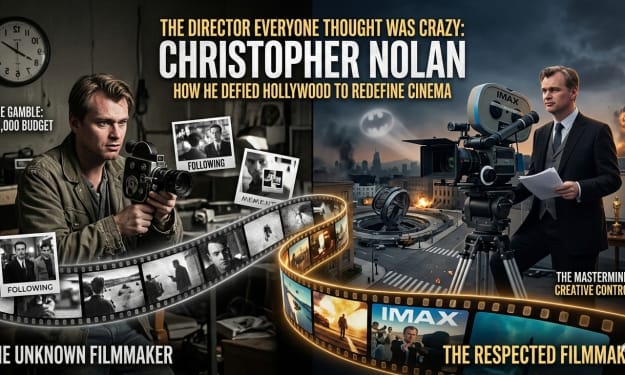
The Director Everyone Thought Was Crazy: Christopher Nolan’s Rise to Cinematic Mastery
Today, Christopher Nolan is unequivocally one of the most respected, powerful, and bankable filmmakers in the world. When his name is attached to a project, audiences flock to theaters, and studios open their checkbooks without hesitation. He is a rare modern auteur—a director who commands massive budgets while retaining absolute creative control.
By Frank Massey 2 days ago in Motivation
Full Moon
There are days when it feels like my body is arguing with itself. Multiple sclerosis already demands negotiation. Fatigue shapes my energy. My legs can feel unreliable. Sensations appear without warning. Some days they feel heavy. Other days they feel like they are vibrating from the inside, a constant electrical hum that no one else can see.
By Millie Hardy-Sims2 days ago in Motivation



Comments
There are no comments for this story
Be the first to respond and start the conversation.