
The Wicked Wife or the Secret Spy?
The tragic story of Mata Hari — the woman history judged as the most hated seductress, but may have misunderstood as a pawn of war.

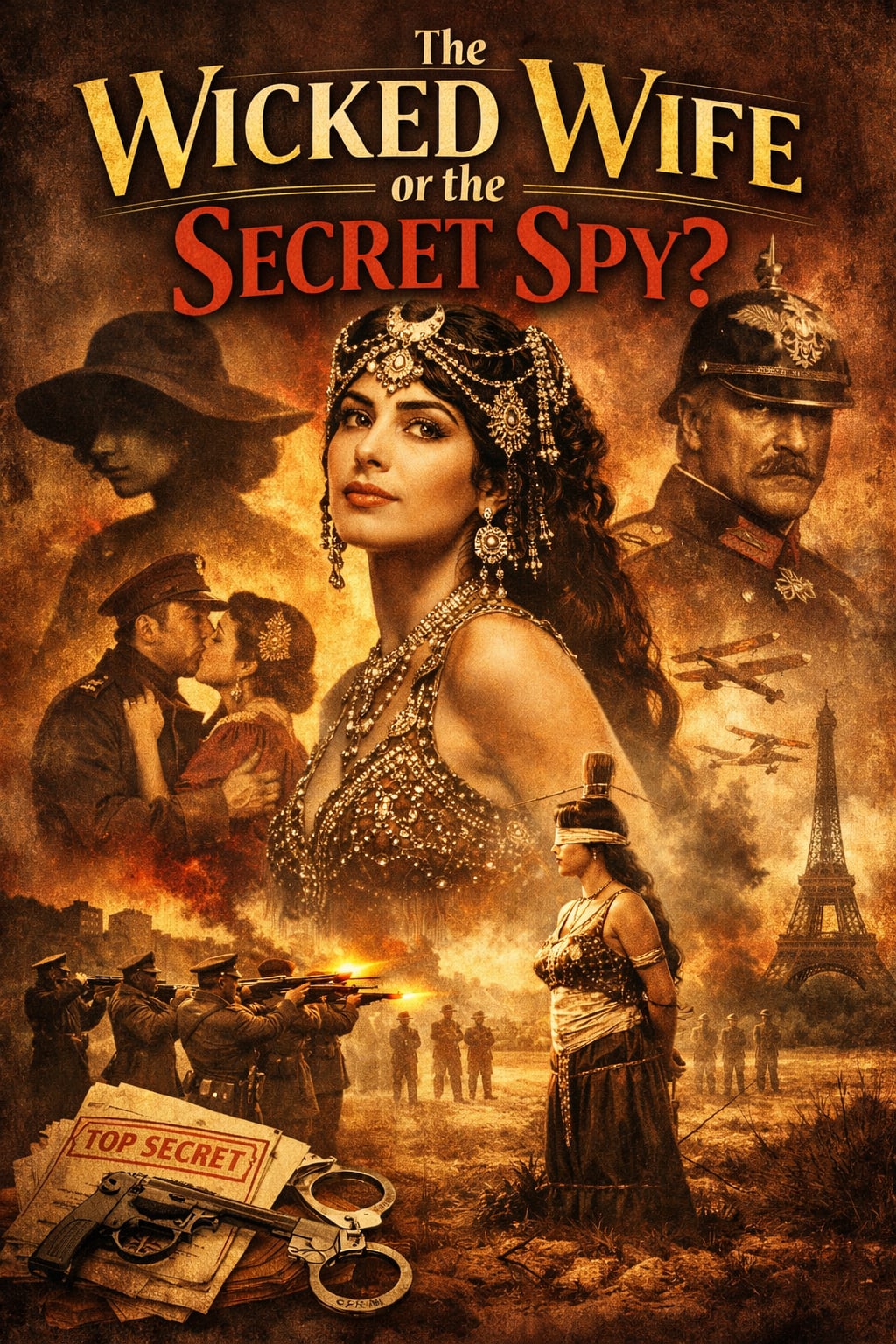
In the shadows of war, truth is often the first casualty. Few stories prove this more powerfully than that of Mata Hari — a woman who was branded a traitor, condemned as a seductress, and executed as a spy. To some, she was a wicked wife who betrayed loyalties for wealth and desire. To others, she was a secret agent who played a dangerous game among powerful men. Yet, more than a century later, historians still debate whether she was truly guilty — or simply a convenient scapegoat.
Born Margaretha Geertruida Zelle in 1876 in the Netherlands, Mata Hari’s life was marked by instability from the beginning. After her father’s bankruptcy and her parents’ divorce, her once-comfortable childhood quickly collapsed. As a young woman seeking escape, she married a Dutch colonial officer and moved to the Dutch East Indies (modern-day Indonesia). But the marriage was deeply troubled. Her husband was controlling and abusive, and tragedy struck when one of their children died under mysterious circumstances — possibly poisoned.
When her marriage failed, she returned to Europe with little money and even less social standing. Reinventing herself in Paris, she adopted the exotic persona of “Mata Hari,” a name meaning “eye of the day” in Malay. Presenting herself as a Javanese princess trained in sacred temple dances, she captivated European audiences with performances that blended sensuality and mystique. In the early 1900s, Paris was enthralled by Orientalism, and Mata Hari understood exactly how to use it to her advantage.
Her beauty, intelligence, and confidence opened doors to elite circles. She became the companion of wealthy businessmen, military officers, and politicians across Europe. It was this access to powerful men — particularly during World War I — that would later seal her fate.
When World War I erupted in 1914, Europe descended into chaos. Borders tightened, suspicion grew, and espionage became a powerful weapon. Mata Hari, as a Dutch citizen, came from a neutral country. This allowed her to travel more freely than many others. To intelligence agencies, she seemed either an invaluable asset — or a dangerous liability.
In 1916, French authorities accused her of spying for Germany. They claimed she had passed military secrets to the enemy, allegedly leading to the deaths of thousands of French soldiers. The evidence, however, was weak and largely circumstantial. Intercepted messages referred to a German spy code-named “H-21,” whom French officials identified as Mata Hari. Yet some historians argue that German intelligence may have deliberately exposed her, knowing French authorities were monitoring their communications.
Her trial in 1917 was swift and sensational. Prosecutors portrayed her as a manipulative femme fatale who used seduction as a weapon. Newspapers amplified this image, turning her into a symbol of betrayal and moral corruption. In a time when France desperately needed a victory — even a symbolic one — Mata Hari became the perfect target. She was foreign, independent, sexually liberated, and associated with powerful men. Public outrage demanded someone to blame for military failures.
She denied being a spy for Germany, though she admitted she had once accepted money from a German official — claiming it was compensation for personal losses, not espionage. Some records suggest she may have offered her services to French intelligence as well, hoping to secure financial stability. If so, she may have been playing both sides without truly understanding the deadly stakes.
On October 15, 1917, at the age of 41, Mata Hari faced a French firing squad. According to witnesses, she refused a blindfold and faced her executioners calmly. With that, the woman once celebrated on Europe’s grandest stages became a cautionary tale of treason.
But was she truly guilty?
Modern research has cast serious doubt on the scale of her alleged crimes. Declassified documents reveal that she likely had little access to meaningful military secrets. Some historians now believe she was, at most, a minor opportunist — not the master spy French authorities claimed. Others argue she was largely innocent, sacrificed to restore public morale during one of France’s darkest wartime moments.
The label of “wicked woman” followed her long after her death. Popular culture immortalized her as the archetypal seductress-spy, a dangerous beauty whose charm destroyed men and nations. Yet this narrative reflects as much about society’s fear of independent women as it does about espionage.
Mata Hari’s story forces us to confront uncomfortable questions: How easily can public opinion be shaped during times of fear? How often are women judged more harshly than men for the same actions? And how many “villains” in history were simply convenient answers to complicated problems?
Whether she was a secret spy, a desperate survivor, or an innocent scapegoat, Mata Hari remains one of history’s most controversial figures. She lived boldly in a world that distrusted bold women. In death, she became a legend — not necessarily because of what she did, but because of what people believed she represented.
Perhaps the greatest tragedy of Mata Hari is not that she was hated — but that the truth about her may never be fully known.
About the Creator
Irshad Abbasi
Ali ibn Abi Talib (RA) said 📚
“Knowledge is better than wealth, because knowledge protects you, while you have to protect wealth.
Keep reading
More stories from Irshad Abbasi and writers in History and other communities.
Hassan-i Sabbah, Alamut, and the Gardens of Paradise: The Rise and Fall of the Nizari Ismailis
In the rugged mountains of northern Iran, overlooking steep valleys and narrow passes, stood the formidable fortress of Alamut Castle. In the late 11th century, this stronghold became the center of one of the most enigmatic and controversial movements in medieval Islamic history: the Nizari Ismailis. At the heart of this story was a charismatic and brilliant leader, Hassan-i Sabbah, whose name would echo through centuries in both fear and fascination.
By Irshad Abbasi about 8 hours ago in History
Worst Mid-Air Crash in Aviation History part 1
It was evening over Delhi when two aircraft carrying a total of 349 people were moving toward each other in the sky. One of them was preparing to land at Delhi Airport, while the other had just taken off from Delhi. Both pilots were receiving instructions from the same air traffic controller, and a vertical separation of 1,000 feet had been maintained between them.
By Imran Ali Shah7 days ago in History




Comments
There are no comments for this story
Be the first to respond and start the conversation.