
Shadow Wars: From Operation Finale to Wrath of God
How Israel’s intelligence agency carried out daring global missions that stunned the world

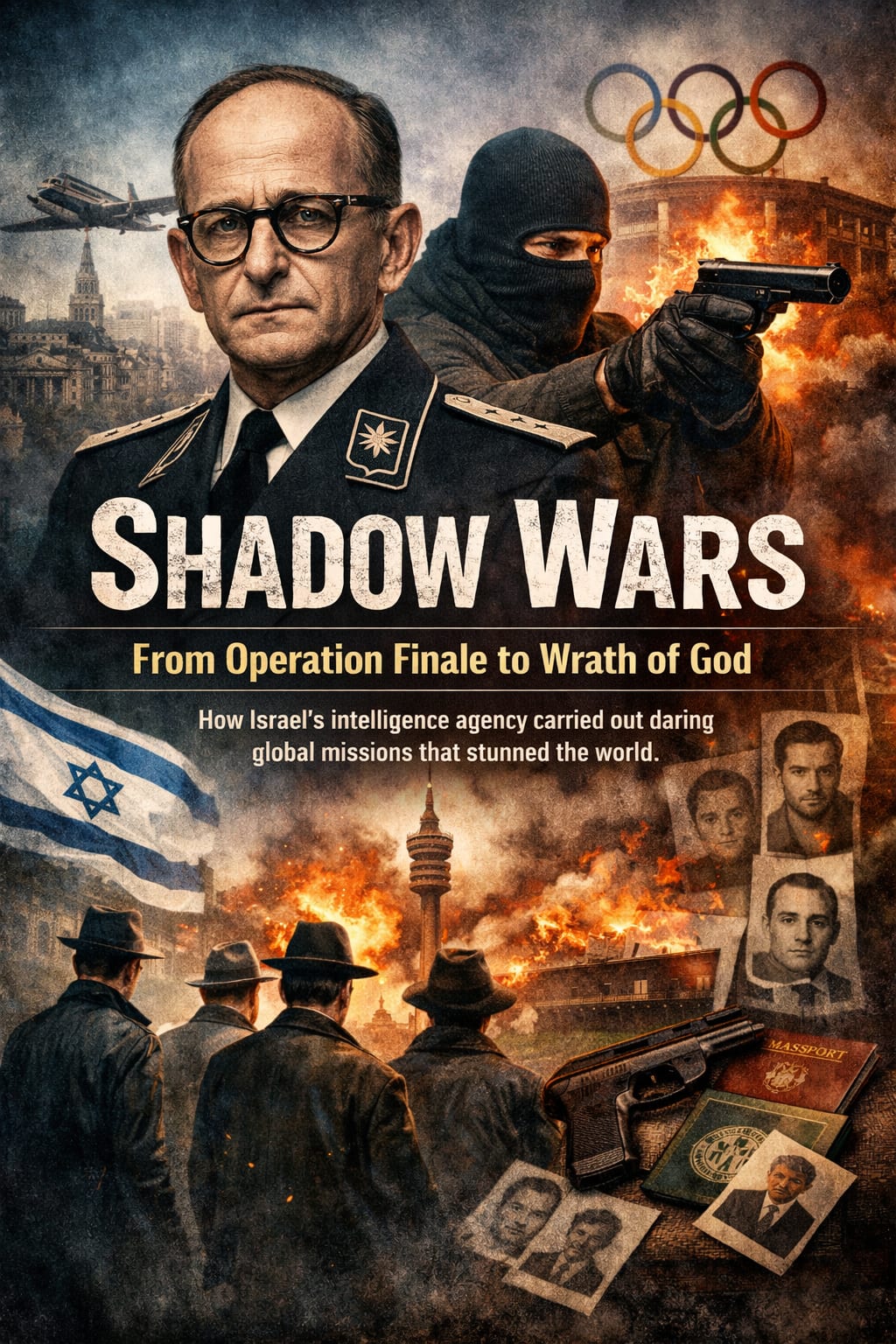
Throughout modern history, intelligence agencies have operated in secrecy, carrying out missions that often remain hidden from public view. Among these organizations, the Israeli intelligence agency Mossad has gained a reputation for some of the most daring and controversial operations ever conducted. From tracking down Nazi war criminals to targeting militants responsible for attacks on Israelis, Mossad’s operations have repeatedly captured global attention. Two of the most famous missions associated with the agency are Operation Finale and Operation Wrath of God, both of which left a lasting mark on international intelligence history.
One of Mossad’s most remarkable operations took place in 1960 when agents tracked down Adolf Eichmann, one of the key architects of the Holocaust. Eichmann had been a senior Nazi official responsible for organizing the deportation of millions of Jews to concentration camps during World War II. After the war, he disappeared and managed to escape to Argentina, where he lived under a false identity.
The Israeli government considered capturing Eichmann a matter of justice for Holocaust victims. Mossad agents spent months tracking his movements in Buenos Aires. After confirming his identity, they carried out Operation Finale, a carefully planned mission to abduct him. In May 1960, agents ambushed Eichmann while he was returning home from work, subdued him, and secretly held him in a safe house.
The operation required extraordinary secrecy. Israeli agents eventually smuggled Eichmann out of Argentina on an aircraft disguised as part of an Israeli diplomatic delegation. He was flown to Jerusalem, where he faced trial. The trial drew worldwide attention, exposing the horrors of the Holocaust to a global audience. In 1962, Eichmann was convicted and executed, making the mission one of the most dramatic manhunts in modern history.
Another operation that cemented Mossad’s reputation occurred after the tragic events of the Munich Massacre during the 1972 Summer Olympics in Munich, Germany. During the attack, members of the Palestinian militant group Black September Organization took Israeli athletes hostage in the Olympic Village. The crisis ended tragically when eleven Israeli athletes were killed.
The attack shocked the world and deeply traumatized Israeli society. In response, the Israeli government led by Golda Meir reportedly authorized a covert campaign to track down those responsible for planning the massacre. This mission became known as Operation Wrath of God.
Over several years, Mossad teams reportedly operated across Europe and the Middle East, targeting individuals believed to be connected to the Munich attack. The campaign involved surveillance, intelligence gathering, and covert strikes. Some targets were assassinated using explosives or close-range attacks, often in foreign cities.
One of the most controversial incidents during the campaign occurred in Lillehammer, Norway, in 1973. Mossad agents mistakenly killed Ahmed Bouchiki, a Moroccan waiter who was wrongly identified as a militant leader. The incident, known as the Lillehammer Affair, led to several Mossad agents being arrested by Norwegian authorities and caused significant diplomatic tensions.
Despite controversies, these operations helped build Mossad’s image as one of the world’s most capable intelligence agencies. Over the decades, the agency has been linked to numerous other covert missions, including intelligence gathering, counterterrorism operations, and high-risk rescues.
Supporters of Mossad’s actions argue that such operations are necessary to protect national security and deter future attacks against Israel. Critics, however, contend that targeted killings and covert actions carried out in foreign countries raise serious legal and ethical questions, particularly regarding sovereignty and international law.
Regardless of the debate, there is no denying that Mossad’s activities have become legendary in the world of espionage. Stories of undercover agents, secret identities, and high-stakes missions have inspired books, films, and documentaries across the globe.
From the capture of Adolf Eichmann in Argentina to the covert hunt for those responsible for the Munich massacre, these operations reveal the complex and often shadowy nature of intelligence work. They also highlight how far nations may go in pursuit of justice, security, and revenge.
In the hidden world of espionage, few agencies have shaped global perceptions as dramatically as Mossad. Whether admired or criticized, its daring operations continue to fascinate observers and remind the world that some of history’s most dramatic events occur far from public view, in the quiet shadows of international politics.
About the Creator
Irshad Abbasi
Ali ibn Abi Talib (RA) said 📚
“Knowledge is better than wealth, because knowledge protects you, while you have to protect wealth.
Keep reading
More stories from Irshad Abbasi and writers in History and other communities.
The “Greater Israel” Map Controversy: Saudi Arabia, Palestine and Arab League Condemn the Idea
A recent controversy over a map circulating online and in political discussions has reignited tensions across the Middle East. The map, often referred to as the concept of “Greater Israel,” depicts a much larger Israeli state stretching beyond its current internationally recognized borders and into parts of neighboring countries. The idea has drawn sharp condemnation from Arab states, including Saudi Arabia, Palestine, and the Arab League, who have dismissed it as dangerous political rhetoric and an unrealistic extremist vision.
By Irshad Abbasi about 17 hours ago in History




Comments
There are no comments for this story
Be the first to respond and start the conversation.