
Royal Blood and the Survival of the Throne: The Ottoman Tradition of Fratricide
How the rulers of the Ottoman Empire adopted the controversial practice of executing royal brothers to prevent civil war and protect the stability of the state.

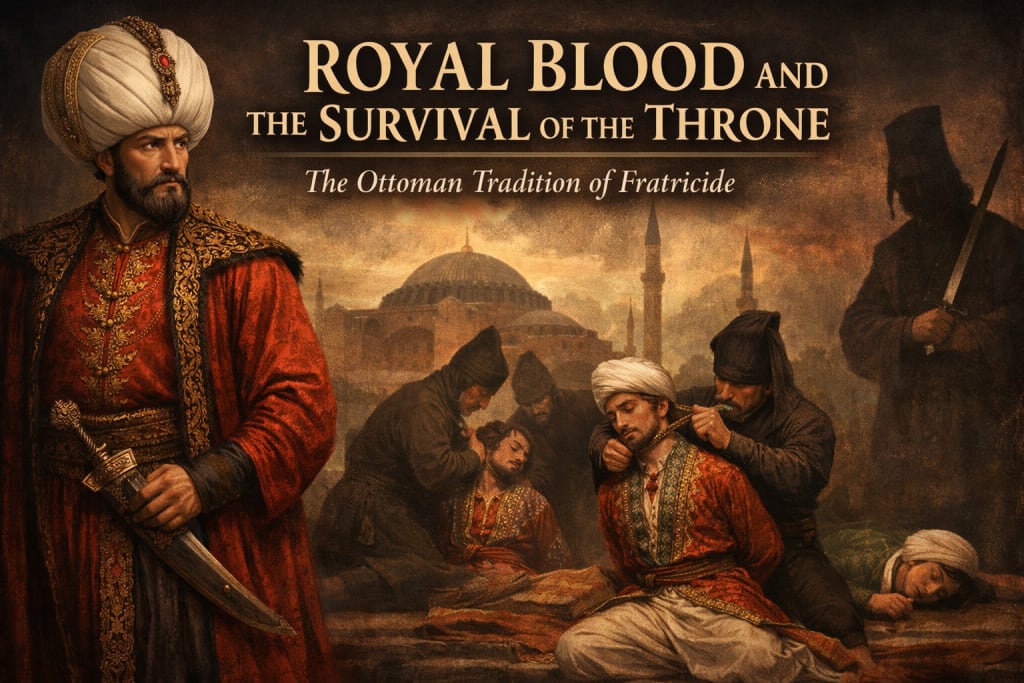
Among the many powerful dynasties in world history, the Ottoman Empire stands out for its longevity, political sophistication, and vast territorial reach. At its peak, the empire stretched across parts of Europe, Asia, and Africa, ruling over diverse peoples and cultures for more than six centuries. Yet behind the grandeur of its palaces and the power of its sultans lay a grim and controversial tradition: the execution of royal brothers to secure the throne.
This practice, often referred to as Ottoman fratricide, emerged as a brutal but calculated political strategy. For many Ottoman rulers, eliminating rival princes was seen as the only reliable way to prevent civil war and maintain the unity of the empire.
Origins of the Practice
The roots of this policy can be traced back to the early struggles within the Ottoman dynasty. After the defeat and capture of Sultan Bayezid I by the Central Asian conqueror Timur at the Battle of Ankara in 1402, the empire fell into a period known as the Ottoman Interregnum. During this chaotic decade, Bayezid’s sons fought each other for control of the throne.
The civil war severely weakened the empire and nearly led to its collapse. Eventually, one of the princes, Mehmed I, restored unity and reestablished central authority. However, the memory of this destructive power struggle left a deep mark on the Ottoman ruling elite. Future rulers became determined to avoid similar conflicts.
Legalizing Fratricide
The policy reached its most formal expression during the reign of Sultan Mehmed II, also known as Mehmed the Conqueror, the ruler who captured Constantinople in 1453 and transformed it into the imperial capital.
Mehmed II included a controversial clause in his legal code known as the Kanunname. According to this law, a newly crowned sultan was permitted to execute his brothers “for the sake of the order of the world.” The decision was justified as a matter of state survival rather than personal cruelty.
From the Ottoman perspective, the logic was harsh but practical. Each prince had supporters among military commanders, provincial governors, and palace factions. If several princes claimed the throne at once, the result could be a devastating civil war that might tear the empire apart. By eliminating rivals quickly, the sultan aimed to prevent rebellion before it began.
Tragic Stories of Royal Princes
The consequences of this policy were often heartbreaking. Some of the most famous examples occurred during the reigns of powerful Ottoman rulers.
When Sultan Selim I ascended the throne in 1512, he eliminated several male relatives to secure his rule. Similarly, Sultan Mehmed III ordered the execution of 19 of his brothers shortly after becoming ruler in 1595. Historians consider this one of the most shocking incidents of royal fratricide in Ottoman history.
The princes who faced this fate were often very young. Many had spent their childhoods inside the imperial palace, unaware that their lives depended on the political fortunes of their brother. Once a new sultan was crowned, palace officials carried out the executions, usually by strangulation with a silk cord—considered a method that avoided spilling royal blood.
The “Cage” System
Over time, criticism of fratricide grew, both inside and outside the empire. Religious scholars, statesmen, and members of the public increasingly viewed the practice as morally troubling.
By the 17th century, the Ottomans gradually replaced executions with a different method of controlling rival princes. Instead of killing them, potential claimants were confined in a section of the palace known as the Kafes, or “the Cage.” There, princes lived under strict supervision and isolation, unable to build political alliances or challenge the reigning sultan.
Although this system saved lives, it created new problems. Princes who spent decades in isolation often lacked political experience and psychological stability when they eventually became rulers.
Historical Debate
Modern historians continue to debate the impact of Ottoman fratricide. Some scholars argue that the policy, brutal as it was, helped the empire avoid destructive succession wars that plagued many European monarchies. Others believe it weakened the dynasty by eliminating capable leaders and creating a culture of fear within the royal family.
What is clear is that the tradition reflected the harsh realities of pre-modern politics. In an era when power struggles could destroy entire states, Ottoman rulers believed that sacrificing a few royal lives could save millions of subjects from the chaos of civil war.
A Dark Chapter of Imperial History
The history of fratricide in the Ottoman Empire remains one of the most controversial aspects of its rule. It illustrates the difficult choices faced by rulers trying to maintain stability in a vast and complex empire.
While modern values strongly condemn such practices, understanding them helps reveal how political power functioned in the past—and how far ideas about leadership, justice, and human rights have evolved over time.
About the Creator
Irshad Abbasi
Ali ibn Abi Talib (RA) said 📚
“Knowledge is better than wealth, because knowledge protects you, while you have to protect wealth.
Keep reading
More stories from Irshad Abbasi and writers in History and other communities.
Shadow Wars: From Operation Finale to Wrath of God
Throughout modern history, intelligence agencies have operated in secrecy, carrying out missions that often remain hidden from public view. Among these organizations, the Israeli intelligence agency Mossad has gained a reputation for some of the most daring and controversial operations ever conducted. From tracking down Nazi war criminals to targeting militants responsible for attacks on Israelis, Mossad’s operations have repeatedly captured global attention. Two of the most famous missions associated with the agency are Operation Finale and Operation Wrath of God, both of which left a lasting mark on international intelligence history.
By Irshad Abbasi about 17 hours ago in History
REEEEEEEEE!
I'm on a low road right now. There are a literal million things to do and not one of them worth my time. I would rather sit in place and burn but the orbit takes me on its inevitable route 'round the center; and I a center in my own right, around which others orbit, and so on and so forth, ad infinitum, ad nauseum.
By C. Rommial Butler4 days ago in Poets



Comments
There are no comments for this story
Be the first to respond and start the conversation.