
Alexander the Great’s Era Workshop Discovered in Peshawar
Archaeologists uncover an ancient workshop in Pakistan believed to date back to the time of Alexander the Great, shedding new light on early industry and cultural exchange in South Asia.

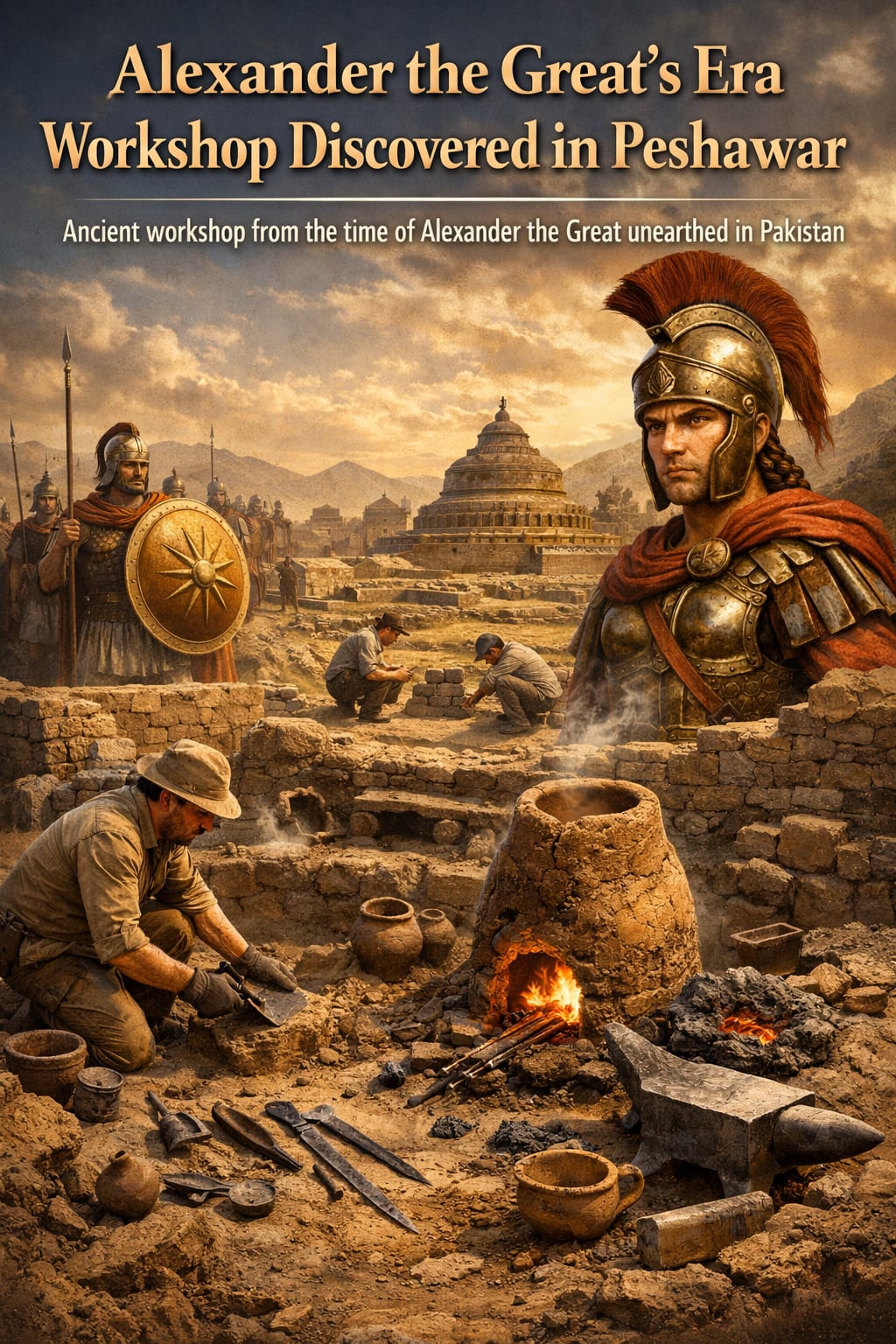
A remarkable archaeological discovery in the historic city of Peshawar has sparked excitement among historians and researchers. Archaeologists have recently uncovered the remains of an ancient workshop believed to date back to the era of Alexander the Great, the legendary Macedonian conqueror whose campaigns reshaped the ancient world. The finding offers rare insight into the economic and cultural life of the region more than two thousand years ago.
The discovery was made during an excavation project near the outskirts of Peshawar, an area known for its deep historical roots. The region was once part of the ancient kingdom of Gandhara, which flourished as a major cultural and trade center. Gandhara was famous for its unique blend of Greek, Persian, and South Asian influences—an interaction that intensified after Alexander’s arrival in the subcontinent in 327 BCE.
Archaeologists working at the site uncovered structural remains that appear to belong to a workshop used for metalworking or crafting tools. Among the artifacts discovered were fragments of clay furnaces, iron slag, stone tools, and partially finished metal objects. These findings suggest that the workshop may have been used for manufacturing weapons, tools, or everyday household items.
Experts believe that this site dates back to the late fourth century BCE, around the time Alexander the Great’s armies entered the region. During his famous eastern campaign, Alexander marched through parts of present-day Pakistan after conquering territories across the Persian Empire. His forces fought a historic battle against Porus at the Battle of the Hydaspes in 326 BCE, near the modern-day Jhelum River.
Although Alexander’s stay in the region was relatively brief, his arrival had long-lasting consequences. Greek soldiers, administrators, and craftsmen settled in parts of the region, creating a fusion of cultures that would later influence art, architecture, and trade. The newly discovered workshop may be evidence of this interaction between Greek techniques and local craftsmanship.
Researchers studying the site have suggested that the workshop could have served a local market or even military needs. If the workshop produced metal tools or weapons, it might have played a role in supplying local communities or soldiers stationed in the region. The presence of furnace remains indicates that metal processing was conducted directly at the site rather than materials being imported in finished form.
The discovery is particularly significant because physical evidence from Alexander’s presence in South Asia is relatively rare. Much of what historians know about the Macedonian conquest comes from ancient Greek historians such as Arrian and Plutarch, who wrote about Alexander centuries later. Archaeological findings like this workshop help confirm and expand those historical accounts.
According to archaeologists, the design of the furnaces and the layout of the workspace reflect advanced craftsmanship for its time. The remains suggest that workers used organized production methods rather than simple household manufacturing. This indicates that the region around Peshawar may have supported specialized industries more than two thousand years ago.
The discovery also highlights the importance of Peshawar as a crossroads of civilizations. Located along ancient trade routes that later became part of the Silk Road, the city connected Central Asia, South Asia, and the Middle East. Over centuries, traders, scholars, and artisans passed through the region, exchanging ideas, goods, and technologies.
Local authorities and archaeologists now plan to continue excavations at the site in hopes of uncovering additional structures and artifacts. Further discoveries could help determine the full scale of the workshop and provide clues about the people who worked there. Researchers are also conducting laboratory analysis of the metal fragments and slag to better understand the materials and techniques used by ancient craftsmen.
If confirmed to be from the time of Alexander the Great, the workshop would represent one of the most fascinating examples of early industrial activity in the region. It would also serve as a powerful reminder of how historical events—such as the campaigns of Alexander—can leave lasting traces not only in written history but also buried beneath the soil.
For historians, this discovery is more than just an ancient building. It is a window into a time when empires collided, cultures blended, and new forms of knowledge emerged. As excavations continue, the ancient ground of Peshawar may reveal even more secrets about a remarkable chapter in human history.
About the Creator
Irshad Abbasi
Ali ibn Abi Talib (RA) said 📚
“Knowledge is better than wealth, because knowledge protects you, while you have to protect wealth.
Keep reading
More stories from Irshad Abbasi and writers in History and other communities.
The Ottoman Cannon: How a Single Weapon Turned an Empire into a Superpower
In the annals of military history, few empires owe their early prominence to a single technological innovation as much as the Ottoman Empire. Among these innovations, the development and deployment of massive artillery—especially the formidable cannons—played a pivotal role in transforming the Ottomans into a dominant power spanning three continents. From the siege of Constantinople to the eventual decline of Ottoman influence, the story of their artillery reflects both the empire’s ingenuity and its vulnerabilities.
By Irshad Abbasi about 13 hours ago in History
Trump and Netanyahu Are Breaking the Bond Between American Jews and Israel
Israeli Elections & The public's demand: Even though Israel gained as many seats as its biggest significant adversary, the results of the April 9 election have been seen as a win for the status quo. Meanwhile, Prime Minister Benjamin Netanyahu is best positioned to form a new administration alongside the Likud party that he leads. Most certainly, Netanyahu will be able to maintain his position of authority. The public's demand for familiarity and regularity is the reason behind this.
By Laura Hoover4 days ago in History
Who is your "Person"?
It's important to recognize that you cannot go through life as easily on your own. My name is Elizabeth and I'm a survivor of child abuse and horrific trauma. Healing from trauma is not a quick fix and recognizing that it will take time, is part of the struggle.
By Elizabeth Woods4 days ago in Psyche


Comments
There are no comments for this story
Be the first to respond and start the conversation.