
Ice Boy: The Frozen Morning That Changed a Child’s Destiny
How One Photograph Transformed Wang Fuman’s Life in Just One Year

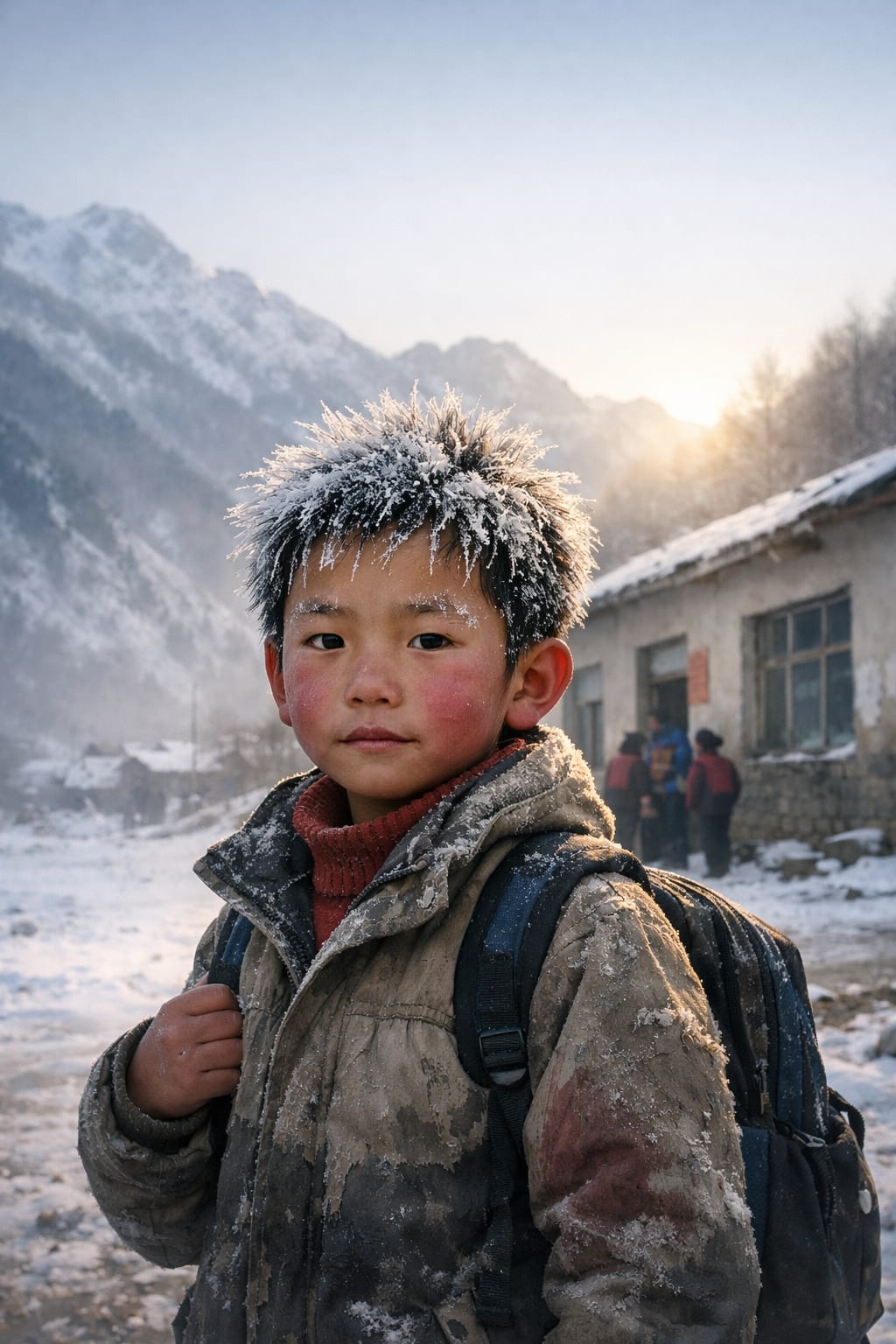
In the winter of 2018, a single photograph from a remote village in China shocked the world. The image showed a young boy with hair and eyebrows frozen white from the bitter cold, his cheeks red and cracked, yet standing firmly in a classroom. That boy became known globally as “Ice Boy.” His real name was Wang Fuman, and in just one year, his life changed in ways no one could have imagined.
Wang was only eight years old when the now-famous photograph was taken. He lived in a small mountain village in Zhaotong, located in Yunnan Province, China. Every morning, he walked nearly 4.5 kilometers (about 2.8 miles) to reach his school. During winter, temperatures in his region dropped to as low as minus nine degrees Celsius (15 degrees Fahrenheit). Without proper winter clothing, gloves, or a warm hat, he would begin his journey before sunrise, braving icy winds and snow-covered paths.
On that particular morning, the temperature was especially cruel. When Wang arrived at school, his hair and eyebrows had completely frozen. Ice crystals clung to his head like a crown of frost. His classmates laughed—not to mock him, but in surprise at the dramatic sight. His teacher captured the moment with a photograph and shared it online, never expecting what would happen next.
The image quickly went viral across Chinese social media. Within days, it was being shared internationally. People were moved not only by Wang’s frozen hair but by what it represented: the harsh reality of poverty and the determination of a child committed to education. Despite the freezing weather and long walk, Wang had shown up that morning to take an exam. In fact, he scored 99 out of 100 on his mathematics test that day.
As the photo spread, donations began pouring in from across China and around the world. Individuals, charities, and organizations wanted to help. Within weeks, Wang’s school received hundreds of thousands of yuan in contributions. The funds were used to improve school facilities, provide heating systems, and supply winter clothing to students. Wang himself received warm clothes, financial assistance, and support for his family.
Wang’s family background explained much about his struggle. His parents worked far away in larger cities as migrant laborers, trying to earn enough money to support their children. Wang and his sister lived with their grandmother in the village. Like many rural families in China, they faced economic hardship and limited access to resources. The viral photograph brought national attention to the living conditions of “left-behind children”—a term used in China for children whose parents migrate for work.
Within a year, Wang’s life had significantly improved. He no longer needed to endure freezing walks without proper clothing. He transferred to a better-equipped boarding school closer to his home, where he could stay during the week. The school had heated classrooms and dormitories, ensuring that students would not suffer from extreme cold again.
But perhaps the most powerful change was not material—it was emotional and symbolic. Wang became a symbol of resilience, determination, and the value of education. His story sparked conversations across China about rural poverty and inequality. Local governments promised to improve heating systems in schools and address infrastructure gaps in remote regions.
When interviewed after his sudden fame, Wang remained humble. He once said that he simply wanted to study hard and become a police officer one day. Despite global attention, he continued focusing on his education. Reports later showed him smiling in new winter clothes, looking healthier and happier than before.
However, Wang’s story is not just about charity or viral fame. It is about how a single moment can reveal hidden realities. Millions of children worldwide walk long distances to school under difficult conditions. Many lack basic necessities that others take for granted. Wang’s frozen hair was not just ice—it was a visible sign of invisible hardship.
In just one year, “Ice Boy” went from being an anonymous rural child to a national symbol of educational inequality. His school received improved facilities, and his family gained financial relief. More importantly, his story inspired awareness and compassion.
The photograph that changed his life reminds us of the power of images in the digital age. A simple classroom snapshot traveled across continents, moved hearts, and mobilized action. It demonstrated how quickly the world can respond when confronted with raw, undeniable truth.
Today, Wang Fuman’s journey stands as a testament to perseverance. While the winter cold once froze his hair, it could not freeze his determination. In one year, kindness and attention helped transform his life—but it was his own courage that first captured the world’s heart.
Ice Boy’s story teaches us that sometimes, the smallest faces carry the biggest messages. And sometimes, one freezing morning can warm the conscience of an entire nation.
About the Creator
Irshad Abbasi
Ali ibn Abi Talib (RA) said 📚
“Knowledge is better than wealth, because knowledge protects you, while you have to protect wealth.
Keep reading
More stories from Irshad Abbasi and writers in Education and other communities.
The “Slave Bible”: The Controversial Holy Book Designed to Prevent Rebellion
In the early nineteenth century, a heavily edited version of the Bible was printed with a singular and deeply troubling purpose: to control enslaved Africans and discourage rebellion. Today, this rare publication—commonly known as the “Slave Bible”—is one of the most controversial religious texts in history. Only four copies are known to exist in the world.
By Irshad Abbasi a day ago in Education
Casie Hynes and the Future of Student-Centered Math Education
Mathematics has long been considered a gatekeeper subject. It opens doors to careers in science, technology, engineering, finance, and medicine. Yet for many students, math feels less like an opportunity and more like an obstacle. Timed tests, rigid formulas, and high-pressure performance environments have shaped generations of learners—sometimes at the expense of curiosity and confidence.
By Casie Hynes6 days ago in Education
Cassie and Johnny
I’m the kind of dame you notice. I’m no femme fatale, but you can’t ignore me, at least not until I warn you about what’s coming, then everybody ignores me. Hell, they usually blame me afterwards and give Johnny all the credit for saving the day, but my Johnny couldn’t save a seat at the movies without my help. Sure, he’s brawny, but brainy? Not so much. Like that time I asked him to spot me five bucks, and he said he didn’t see it anywhere on me, and believe you me, he looked but good.
By Harper Lewis6 days ago in Critique




Comments
There are no comments for this story
Be the first to respond and start the conversation.