
The “Slave Bible”: The Controversial Holy Book Designed to Prevent Rebellion
How a radically edited version of scripture was used as a tool of control—and why only four copies survive today.

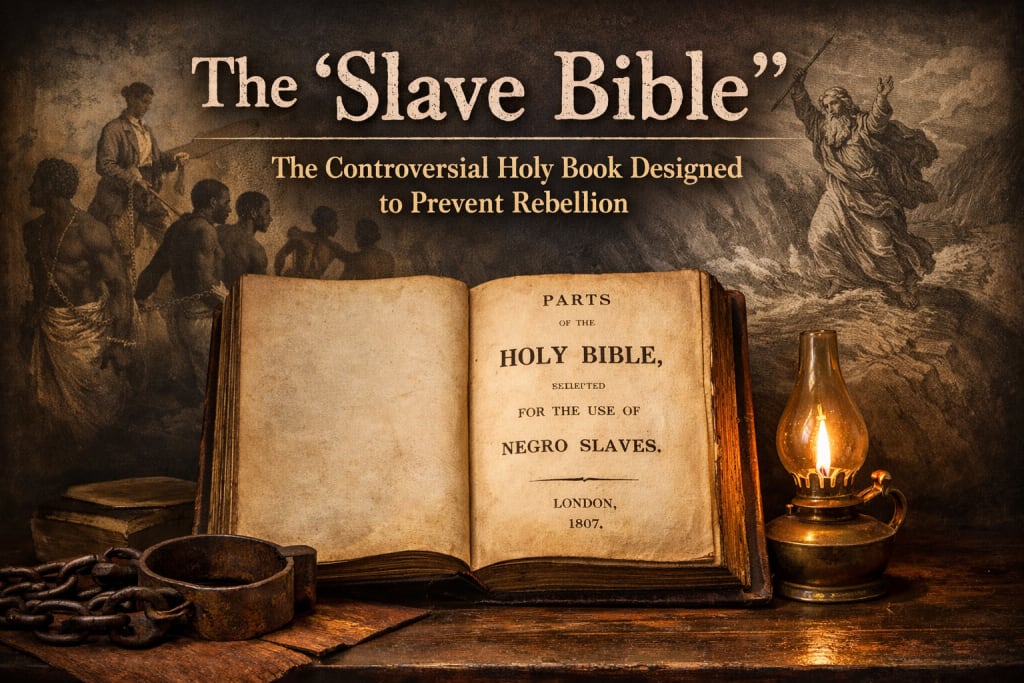
In the early nineteenth century, a heavily edited version of the Bible was printed with a singular and deeply troubling purpose: to control enslaved Africans and discourage rebellion. Today, this rare publication—commonly known as the “Slave Bible”—is one of the most controversial religious texts in history. Only four copies are known to exist in the world.
Officially titled Parts of the Holy Bible, Selected for the Use of the Negro Slaves in the British West-India Islands, the book was first published in London in 1807 and used in Britain’s Caribbean colonies. It was produced by Anglican missionaries associated with the Society for the Conversion of Negro Slaves, a group dedicated to converting enslaved Africans to Christianity in the West Indies.
But this was not a standard Bible. Far from it.
A Bible With Passages Removed
The Slave Bible excluded approximately 90 percent of the Old Testament and 50 percent of the New Testament. Entire books were removed, and crucial passages were carefully edited out. The reason was strategic: to eliminate scriptures that might inspire hope of liberation or resistance.
One of the most significant omissions was the Book of Exodus—the foundational biblical story of Moses leading the Israelites out of slavery in Egypt. For enslaved people across the Americas, Exodus had become a powerful symbol of freedom and divine deliverance. By removing it, slaveholders and missionaries sought to suppress the idea that God supported emancipation.
Similarly, verses such as Galatians 3:28—“There is neither slave nor free... for you are all one in Christ Jesus”—were excluded. These passages emphasized spiritual equality and could challenge the moral justification of slavery.
In contrast, the Slave Bible highlighted verses that promoted obedience and submission. Passages such as Ephesians 6:5—“Slaves, obey your earthly masters with fear and trembling”—remained intact. The editing was deliberate and systematic, presenting Christianity as a religion that endorsed servitude rather than questioned it.
Religion as a Tool of Control
During the 18th and 19th centuries, European colonial powers wrestled with a dilemma: how to convert enslaved Africans to Christianity without encouraging rebellion. Slave uprisings, including the Haitian Revolution (1791–1804), had terrified plantation owners across the Atlantic world. Religious education was seen as both a moral duty and a potential political threat.
Missionaries believed Christian instruction would make enslaved people more obedient and compliant. Plantation owners feared the opposite—that literacy and exposure to scripture could inspire resistance. The Slave Bible was a compromise: a carefully curated text designed to shape belief while limiting empowerment.
By controlling which parts of the Bible were accessible, colonial authorities attempted to control interpretation itself. Faith was not merely spiritual; it was political.
Only Four Copies Remain
For decades, the Slave Bible was largely forgotten. Its rediscovery shocked historians and theologians alike.
Today, only four known copies survive. Two are held in the United Kingdom, and two in the United States. One of the American copies is housed at the Museum of the Bible in Washington, D.C., where it has been displayed as part of exhibitions exploring the complex and often painful history of scripture. Another copy is preserved at Fisk University, a historically Black university in Tennessee.
The rarity of the book adds to its historical significance. Each surviving copy is a stark physical reminder of how religious texts were manipulated to sustain systems of oppression.
Reclaiming the Narrative
In recent years, scholars, religious leaders, and museum curators have used the Slave Bible to spark conversations about faith, race, and power. Rather than hiding this troubling artifact, institutions now present it as evidence of how scripture has been weaponized.
For many, the story of the Slave Bible underscores the resilience of enslaved Africans and their descendants. Despite efforts to restrict access to the full biblical narrative, enslaved communities developed their own rich spiritual traditions. They passed down oral interpretations, spirituals, and sermons centered on liberation, justice, and divine deliverance—often drawing precisely on the themes that had been removed from the printed text.
Ironically, the very stories omitted from the Slave Bible—Exodus, the prophets’ calls for justice, and the message of spiritual equality—would later become central to abolitionist movements and the civil rights struggle.
A Complicated Legacy
The Slave Bible stands today as both a religious artifact and a symbol of manipulation. It forces uncomfortable questions: Who controls sacred texts? How can scripture be used to oppress as well as to liberate? And what responsibility do modern institutions have in confronting such histories?
Its existence challenges the assumption that religious texts are always transmitted neutrally. Instead, it reveals how interpretation, translation, and selective editing can serve political ends.
Though only four copies remain, the Slave Bible’s legacy is far-reaching. It is a reminder that even sacred words can be shaped by human power—and that history must be examined honestly, however painful it may be.
About the Creator
Irshad Abbasi
Ali ibn Abi Talib (RA) said 📚
“Knowledge is better than wealth, because knowledge protects you, while you have to protect wealth.
Keep reading
More stories from Irshad Abbasi and writers in Education and other communities.
How False Claims About Bill Gates and COVID-19 Spread Online
The COVID-19 pandemic was one of the most disruptive global events in recent memory. With fear, uncertainty, and rapidly changing science driving public discourse, misinformation spread almost as quickly as the virus itself. Among the many unfounded claims that circulated, one of the most persistent involved Microsoft co-founder Bill Gates — wrongly accused of using the pandemic for personal gain, control, or even population manipulation. But why did such false narratives take hold, and how did Bill Gates become a focal point of COVID-related conspiracy theories?
By Irshad Abbasi about 19 hours ago in Education
The Day Gravity Failed for 9 Seconds
At 11:42:17 a.m., the world loosened its grip. There was no warning siren. No emergency broadcast. No flicker in the sky or tremor in the ground. One moment, the Earth was doing what it has always done — holding oceans in their basins, keeping feet on sidewalks, anchoring coffee in cups — and the next moment, it wasn’t.
By Abubakar2202 days ago in Education
OCR Tools: The Best Ways for Converting Image to Text with OCR
Nowadays, businesses, students, and professionals constantly deal with scanned documents, printed pages, handwritten notes, and image-based files. The challenge is simple: how do you turn that visual content into editable, searchable text? The answer lies in using a powerful OCR tool.
By Ileana Guz5 days ago in Education



Comments
There are no comments for this story
Be the first to respond and start the conversation.