
The Theory of the New Leisure Class
Homo Essentialis

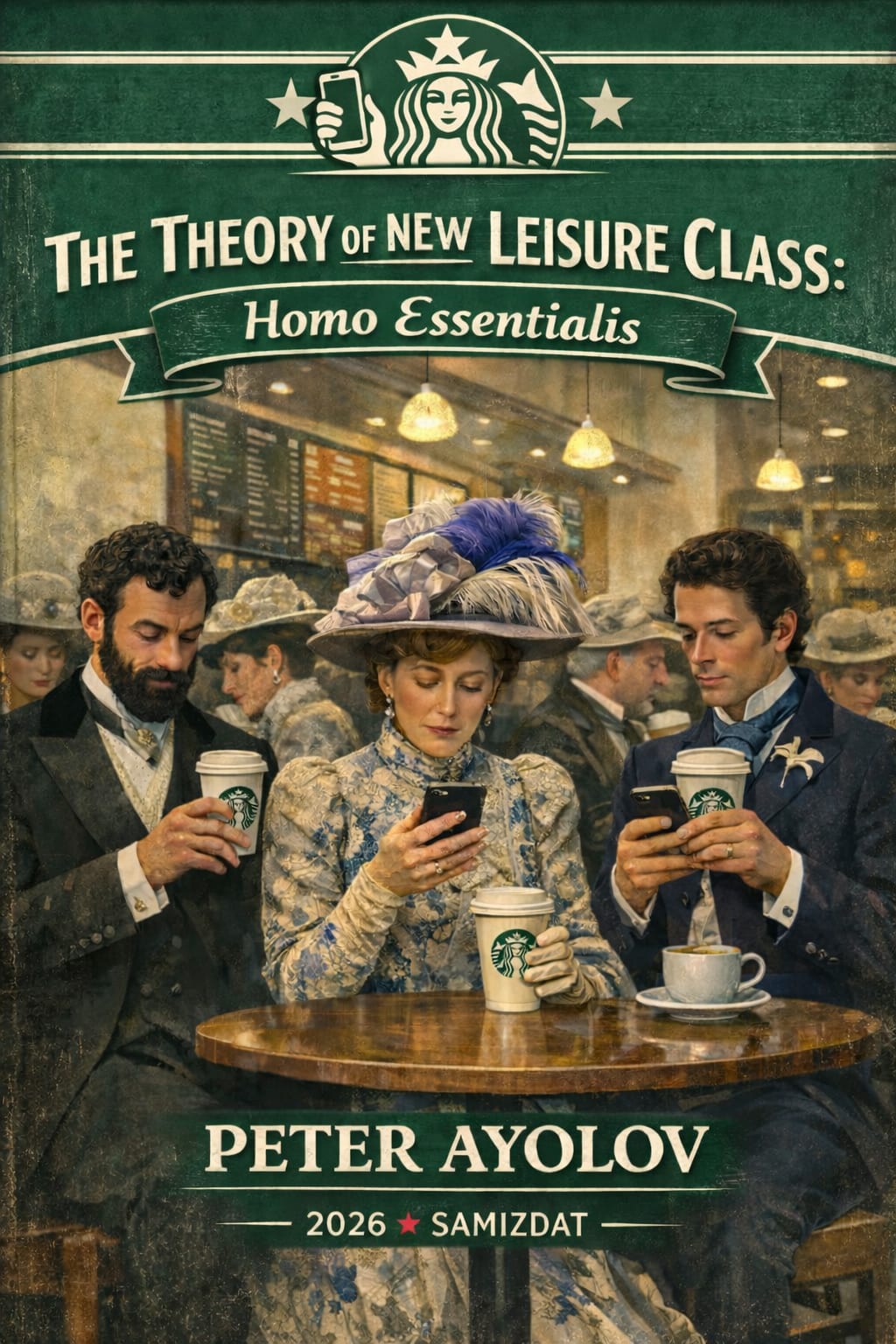
The Theory of the New Leisure Class: Homo Essentialis
Thorstein Veblen wrote The Theory of the Leisure Class in 1899 to describe a social order in which status was displayed through visible idleness and conspicuous consumption. More than a century later, idleness has disappeared as a badge of honour, yet Veblen’s central insight has only intensified. The ruling class of the twenty-first century does not sit idle; it performs busyness. It does not withdraw from work; it transforms work into theatre. What we are witnessing is not the disappearance of the leisure class but its mutation. This is Leisure Class 2.1. This is Homo Essentialis.
The pandemic revealed a structural fracture that had long been forming beneath neoliberal capitalism. Governments divided populations into “essential” and “non-essential” workers. Nurses, sanitation workers, delivery drivers, warehouse pickers, grocery clerks—these were declared essential. Meanwhile, consultants, brand strategists, corporate compliance officers, financial analysts, and strategic communications managers moved their operations to Zoom. The irony was brutal. Those deemed biologically essential were economically disposable. Those economically privileged were biologically insulated.
This is the essentiality paradox.
Veblen described a class that signalled superiority by avoiding manual labour. Physical work was vulgar because it revealed necessity. The leisure class proved status by demonstrating that it did not need to work. Today’s elite cannot afford to appear idle. Idleness is associated with unemployment or failure. Instead, the new leisure class signals superiority through conspicuous busyness. Their Slack notifications never sleep. Their Google Calendars are saturated. Their laptops glow in airport lounges and beachfront cafés. Work becomes portable spectacle.
The new leisure class does not abstain from labour; it abstains from material consequence.
David Graeber’s concept of “bullshit jobs” aligns uncannily with Veblen’s analysis of unproductive labour. Graeber argued that many contemporary white-collar roles exist without producing tangible utility. They are administrative feudalism in corporate form—layers of management, oversight, reporting, compliance, and strategy whose function is often symbolic rather than productive. These roles are highly paid and socially prestigious, yet frequently detached from material necessity.
Here emerges Homo Essentialis in its inverted form. The elite sees itself as essential to the symbolic economy: essential to brand coherence, essential to financial flows, essential to strategic vision. Meanwhile, the truly essential—those who move bodies, goods, waste, and food—are relegated to logistical anonymity.
The division is somatic. One class lives in its body. The other lives in the cloud.
During lockdowns, delivery drivers risked exposure to keep supply chains moving. Warehouse workers followed algorithmic commands with handheld scanners. Nurses endured exhaustion in overcrowded hospitals. At the same time, the laptop class curated home-office aesthetics, upgraded webcams, debated productivity hacks, and posted about resilience. The applause from balconies did not translate into wage restructuring.
Veblen would recognise the ritual immediately. Conspicuous consumption has evolved into conspicuous wellness. The new leisure class does not flaunt diamond necklaces; it flaunts marathon medals, wearable biometric trackers, cold plunges, mindfulness retreats, and $12 turmeric lattes. Health becomes status theatre. Time becomes the ultimate luxury. To obsess over one’s microbiome signals surplus.
The new aristocracy practices pecuniary minimalism. It spends vast sums to appear austere. Minimalist architecture with $4,000 unpainted plaster walls. $100 plain white T-shirts marketed as ethical simplicity. Empty luxury apartments styled as “intentional living.” The message is clear: I am so secure in wealth that I do not need ornament. Absence becomes evidence of abundance.
This aesthetic transformation does not eliminate hierarchy; it refines it.
Neoliberalism provides the operating system. It shifted capitalism from industrial production to financialization and symbolic management. In Veblen’s era, ownership of factories conferred status. In the contemporary era, ownership of flows—data, brands, intellectual property, derivatives—defines power. The symbolic analyst replaces the industrial baron.
Under this regime, work becomes performance. Emails, slide decks, dashboards, and meetings substitute for production. The ritual of documentation becomes a form of self-justification. Slack-Idleness—being perpetually “active” in digital communication without producing material output—serves as the tuxedo of the twenty-first century. Availability signals indispensability.
The Berlin Wall of our time is the laptop screen.
On one side stand those who manipulate symbols: consultants, coordinators, brand curators, policy analysts. On the other side stand those manipulated by symbols: gig drivers directed by algorithmic routes, warehouse workers paced by digital timers, service staff responding to app-based demand surges. The screen is both command centre and barrier.
Algorithmic peasantry is not metaphor. Gig economy platforms rebranded labour as entrepreneurship. A delivery driver is an “independent contractor.” A warehouse worker is a “fulfilment associate.” Language conceals hierarchy. Autonomy is rhetorical; surveillance is real.
The new leisure class signals status through algorithm-aversion. Only the lower classes are tracked by GPS metrics, star ratings, and productivity dashboards. The elite signals privilege by being “off-grid,” by delegating algorithmic management to assistants, by controlling rather than being controlled.
Conspicuous connectivity replaces conspicuous idleness. Digital nomadism becomes a trophy. “I can work from Bali” replaces “I own land.” Asynchronous autonomy—the ability to control one’s schedule—is the new golden watch.
Yet the pandemic unmasked a structural truth. If the laptop class vanished for a month, waste would still accumulate, food would still require transport, electricity would still require maintenance. If sanitation workers disappeared for a week, urban order would collapse. If delivery drivers disappeared for a day, minimalist apartments would starve.
The so-called non-essential class is essential to survival. The so-called essential class is essential only to financial continuity.
This inversion produces resentment. The “talkers” earn three times more than the “doers.” The “doers” carry physical risk. The “talkers” curate strategic narratives about resilience and stakeholder value. The “doers” follow instructions issued through sheets and dashboards created by those who never enter the warehouse.
Veblen described predatory habits rooted in barbarian conquest. Today’s predation does not seize land; it seizes attention and metadata. The modern barbarian captures cognitive surplus. Social media influencers transform everyday life into monetised spectacle. Exposure creates aspiration. Aspiration fuels conspicuous consumption.
Recent academic research confirms that social media intensifies pecuniary emulation. Influencer culture establishes dual pathways to status consumption: identification and aspiration. Followers internalise symbolic hierarchies and seek to emulate curated lifestyles. The arena of status signaling shifts from ballroom to feed.
The morality of conspicuous consumption has become malleable. When framed as individual expression, it appears liberating. When framed as in-group loyalty or eco-conscious virtue, it appears ethical. Yet the underlying dynamic remains Veblenian: display as differentiation.
Luxury in emerging markets reveals anxiety-driven consumption among youth seeking status validation. Digital environments intensify social comparison. Gaming worlds and metaverse platforms become arenas of symbolic expenditure. Skins, NFTs, subscription tiers—digital ornaments replace jeweled brooches.
The new leisure class monetises symbolic scarcity.
At the same time, Homo Essentialis in its literal form—the biologically essential worker—remains bound to somatic stigma. Physical exhaustion, calloused hands, worn backs, tans from outdoor labour—these bodily marks signal lower pecuniary standing. The body that shows use is socially downgraded. The unmarked body is elevated.
This produces a cultural schizophrenia. Society applauds “essential heroes” while structurally undervaluing them. It romanticises resilience while preserving wage stagnation. It celebrates grit while insulating symbolic managers.
The spreadsheet aristocracy performs industrial rationality through rectangular screens. Zoom calls, Slack loops, Excel rituals—these mimic scientific management while often producing no tangible good. The ritual sustains class identity. Communication volume substitutes for production.
Conspicuous busyness becomes the moral alibi of the new leisure class. To be always on is to be necessary. To be necessary is to deserve reward. The emptiness of output is concealed beneath density of interaction.
The deeper transformation is ontological. In 1899, the leisure class signaled freedom from necessity. In 2026, the new leisure class signals transcendence from material consequence. It inhabits symbolic layers while outsourcing biological maintenance.
Homo Essentialis thus names two species in tension. The symbolic elite, essential to the flow of signs. The somatic worker, essential to survival.
The pandemic was not anomaly; it was revelation. It showed that neoliberal capitalism had redefined value without redefining necessity. It proved that economic reward had detached from biological indispensability.
Veblen’s satire remains relevant because the rich remain different. They are different not because they do nothing, but because what they do rarely risks the body. The new leisure class is insulated by screens, by subscriptions, by curated digital parapets.
The question is whether this architecture can sustain itself.
When resentment accumulates, when essential labour recognises its structural leverage, when digital privilege collides with material fragility, contradiction intensifies. The theory of the new leisure class is not merely descriptive; it is predictive. Status systems that detach reward from necessity generate instability.
Homo Essentialis may yet reclaim the term. Essential not in sacrificial rhetoric, but in bargaining power.
Veblen understood that status is never static. It evolves with technology. In our era, the tools are digital, the ornaments symbolic, the idleness disguised as busyness. Yet the structure remains: a class above necessity, a class bound to it.
The twenty-first century leisure class does not recline on chaise lounges. It types. It strategises. It posts. It signals. It optimises. It appears indispensable to the symbolic economy while depending absolutely on those whose labour cannot be performed through fibre-optic cables.
The theory 2.1 insight is simple and destabilising: remove the symbolic managers and life continues; remove the somatic workers and life stops.
In that asymmetry lies the architecture of the new class divide.
About the Creator
Peter Ayolov
Peter Ayolov’s key contribution to media theory is the development of the "Propaganda 2.0" or the "manufacture of dissent" model, which he details in his 2024 book, The Economic Policy of Online Media: Manufacture of Dissent.
Keep reading
More stories from Peter Ayolov and writers in Critique and other communities.
Matter in Revolt
Matter in Revolt: How Diamat Becomes History (The Architecture of Chaos in the 21st Century) The twenty-first century does not suffer from chaos; it suffers from misunderstood structure. Climate breakdown, algorithmic governance, financial volatility, pandemics, digital feudalism—these are not isolated crises. They are converging contradictions. What appears fragmented is in fact systemic. What appears accidental is material. To read this moment properly, one requires a method that does not panic before complexity. That method is Diamat.
By Peter Ayolovabout 22 hours ago in Critique
Cassie and Johnny
I’m the kind of dame you notice. I’m no femme fatale, but you can’t ignore me, at least not until I warn you about what’s coming, then everybody ignores me. Hell, they usually blame me afterwards and give Johnny all the credit for saving the day, but my Johnny couldn’t save a seat at the movies without my help. Sure, he’s brawny, but brainy? Not so much. Like that time I asked him to spot me five bucks, and he said he didn’t see it anywhere on me, and believe you me, he looked but good.
By Harper Lewis5 days ago in Critique
Why Saying Less Makes Words Feel More Valuable
There is a widely held belief that words gain value through scarcity. When someone speaks rarely, their statements are treated as weightier, more deliberate, and more worth attending to. When someone speaks often, their words are assumed to be interchangeable, disposable, or less carefully considered. This intuition is not entirely wrong, but it is frequently misapplied. Scarcity does affect perception, but perception is not the same as truth, and rarity is not the same as meaning.
By Peter Thwing - Host of the FST Podcast4 days ago in Critique
Trickle Them Down, But Not Out
The thing about smart people is that they should know better, but alas, intelligence is not the same as wisdom. Not only do the mistakes of experts too short on vision—when they are not corrected—have the potential to do great and far-reaching damage, but they also undermine public confidence in the very notion of expertise. This is particularly so when expertise is wielded in defence of the rich and powerful as a cudgel against those laid low. As an academic, this lack of faith in “so-called experts” is painful to see as it plays out in the spread of dis-/misinformation, conspiracy theories, and anti-intellectualism writ large. But it is also an understandable impulse given the catastrophic failure of an economic ideology pushed by certain economic experts. Supply-side economics has shaped a broken system for the last half-century and has arguably done more to undermine the fabric of the American Dream than any policy framework of the past century.
By Cory Wright-Maley7 days ago in Humans




Comments
There are no comments for this story
Be the first to respond and start the conversation.