
RFID Market Size and Forecast 2026–2034
Automation, IoT Integration, and Real-Time Visibility Propel the Next Phase of RFID Expansion

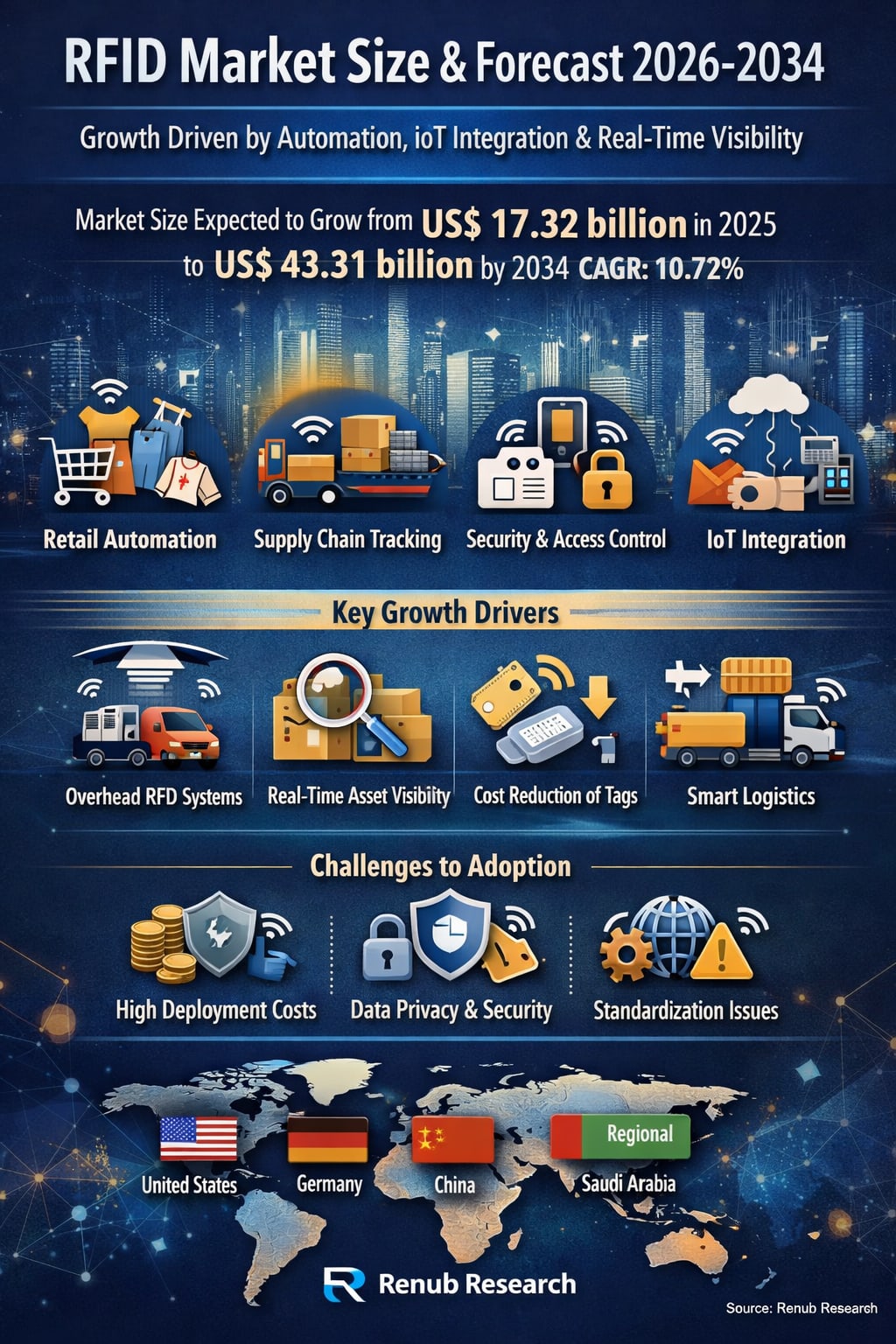
The global RFID market is entering a decisive decade of growth, fueled by rising automation across retail, logistics, healthcare, and industrial operations. According to Renub Research, the RFID Market is expected to reach US$ 43.31 billion by 2034, up from US$ 17.32 billion in 2025, expanding at a CAGR of 10.72% from 2026 to 2034.
This growth trajectory reflects a structural shift in how organizations manage inventory, assets, and identity. As businesses seek greater operational transparency, contactless workflows, and data-driven decision-making, Radio Frequency Identification (RFID) has evolved from a niche tracking solution into a cornerstone of digital transformation strategies worldwide.
RFID Industry Overview
Radio Frequency Identification (RFID) is a wireless data-capture technology that uses radio waves to identify and track objects uniquely. Unlike traditional barcode systems, RFID does not require line-of-sight scanning. Instead, it enables simultaneous reading of multiple tagged items, dramatically improving speed and accuracy.
An RFID system typically includes:
RFID tags (active or passive)
RFID readers and antennas
Middleware and enterprise software
Tags contain electronically stored data that can be captured instantly by readers, enabling real-time identification. RFID supports various frequency ranges and read distances, making it highly adaptable across use cases including:
Inventory management
Asset tracking
Supply-chain operations
Access control and authentication
Healthcare equipment monitoring
Industrial process automation
Key advantages include automation, high read accuracy, bulk data capture, and improved operational efficiency. As falling tag prices converge with growing IoT integration, RFID is becoming increasingly accessible for both large enterprises and mid-sized businesses.
Key Growth Drivers of the RFID Market
1. Retail Modernization & Overhead RFID Infrastructure
Retail transformation is one of the strongest accelerators of RFID adoption. With omnichannel fulfillment models such as Buy-Online-Pick-Up-In-Store (BOPIS) becoming standard, retailers require real-time inventory synchronization between physical stores and digital platforms.
In January 2025, Zebra Technologies and SML IIS introduced a ceiling-mounted RFID reader solution designed to reduce floor congestion while increasing read accuracy in large retail environments. Overhead systems eliminate blind spots and enable continuous monitoring without disrupting customer traffic.
These advanced infrastructures:
Improve cycle count accuracy
Reduce shrinkage
Support frictionless checkout models
Enhance layout flexibility
As retailers pursue data-driven store optimization, high-performance RFID systems become essential to modern retail ecosystems.
2. Expansion in Commercial Security & Access Control
RFID is increasingly embedded into physical access control systems and smart-building ecosystems. The growth of hybrid work environments and secure digital identity management has elevated demand for contactless authentication solutions.
In January 2025, ASSA ABLOY acquired 3millID and Third Millennium for USD 21 million to strengthen its RFID-based credentialing and secure identification portfolio.
Organizations now seek unified RFID credentials that can operate across:
Door access systems
Parking facilities
Lockers
IT-integrated identity platforms
Integration with mobile credentials, biometrics, and cloud-based access platforms further expands RFID’s role in enterprise security ecosystems. Regulatory requirements for safety and compliance also contribute to sustained adoption.
3. Strategic Technology Partnerships Accelerating Innovation
Strategic collaborations are reshaping the competitive landscape. In January 2024, Newland AIDC partnered with Impinj Inc. to integrate advanced RAIN RFID technology into its product portfolio.
Such partnerships:
Shorten development cycles
Enhance reader sensitivity and scalability
Deliver cost-efficient, high-precision solutions
Expand global distribution capabilities
As enterprises demand item-level traceability and IoT-connected ecosystems, integrated hardware-software RFID solutions are becoming the industry standard.
Challenges Facing the RFID Market
High Deployment Costs & Integration Complexity
Although tag prices have declined significantly, large-scale deployments still require investment in:
Readers and antennas
Middleware systems
Infrastructure upgrades
Integration with ERP, WMS, and POS systems
Environmental factors—such as metal interference and liquids—can also complicate implementation. Small and medium enterprises may hesitate due to longer ROI cycles and technical integration demands.
Privacy, Security & Standardization Concerns
RFID systems generate vast volumes of sensitive data. Without encryption and secure authentication protocols, systems may face risks such as cloning, unauthorized tracking, or data interception.
Challenges include:
Regional regulatory differences
Frequency standardization issues
Cross-border interoperability concerns
As adoption increases in retail, healthcare, and government sectors, resolving privacy and standardization gaps will be critical to sustaining market trust.
Regional Market Insights
United States RFID Market
The United States remains one of the largest RFID markets globally. Adoption spans retail giants, logistics providers, healthcare institutions, and defense agencies.
Major retailers deploy item-level tagging to enhance omnichannel fulfillment and inventory accuracy. Logistics and e-commerce players use RFID for warehouse automation and real-time tracking.
High technological maturity, strong vendor presence, and ongoing IoT investments position the U.S. as a leader in RFID innovation. However, strict cybersecurity and integration requirements add complexity to deployments.
Germany RFID Market
Germany’s RFID market is closely aligned with its Industry 4.0 ambitions. Advanced manufacturing and automotive production rely on RFID for:
Machinery tracking
Intralogistics optimization
Quality control automation
German retailers increasingly implement RFID to reduce shrinkage and improve omnichannel fulfillment. Government initiatives supporting digital transformation and standardized industrial communication further accelerate adoption.
Despite strong growth, data protection regulations and integration complexities occasionally slow implementation.
China RFID Market
China represents one of the fastest-growing RFID markets worldwide. Massive manufacturing capacity and an expansive e-commerce ecosystem drive demand for automated parcel tracking and warehouse optimization.
Government-led digitalization initiatives—such as smart-city programs and intelligent transportation systems—fuel widespread deployment.
Local manufacturers are producing low-cost RFID tags and readers at scale, making solutions more accessible. While interoperability and security challenges remain, China’s scale and policy support solidify its leadership in global RFID expansion.
Saudi Arabia RFID Market
Saudi Arabia’s RFID adoption is closely tied to Vision 2030 digital transformation initiatives. RFID plays an increasing role in:
Smart logistics modernization
Healthcare asset tracking
Retail automation
Infrastructure and security projects
Large-scale developments such as NEOM emphasize smart identification and automated systems. While high deployment costs and skill gaps present challenges, the country’s modernization strategy ensures strong future demand.
Recent Industry Developments
October 2024 – TOPPAN Holdings and TOPPAN Next acquired HID’s Citizen Identity Solutions division to expand secure-ID capabilities.
March 2024 – Galaxy Entertainment Group and Melco Resorts planned RFID-enabled casino tablets to reduce fraud.
January 2024 – HID Global partnered with Olea Kiosk to integrate RFID into authentication kiosks.
November 2023 – Metalcraft launched the Universal Eco Mini RFID Tag for metal-surface tracking with up to a 25-foot read range.
August 2023 – Tata Power introduced RFID-enabled EV charging cards to support electric vehicle infrastructure.
July 2023 – Beontag rolled out RFID tags using Impinj’s M800 RAIN RFID chips.
April 2023 – Checkpoint Systems collaborated with Partner Tech Europe to develop RFID-enabled self-checkout systems.
January 2023 – Zebra Technologies introduced the EM45 RFID enterprise mobile device to enhance retail workflows.
Market Segmentation
By System
Active RFID System
Passive RFID System
By Product Type
Tags
Readers
Software & Services
By End Use
Retail
Financial Services
Healthcare
Industrial
Transportation & Logistics
Government
Others
By Region
North America: United States, Canada
Europe: France, Germany, Italy, Spain, United Kingdom, Belgium, Netherlands, Turkey
Asia Pacific: China, Japan, India, Australia, South Korea, Thailand, Malaysia, Indonesia, New Zealand
Latin America: Brazil, Mexico, Argentina
Middle East & Africa: South Africa, Saudi Arabia, UAE
Competitive Landscape
Leading players shaping the RFID ecosystem include:
Alien Technology Corporation
William Frick & Company
Invengo Technology Pte Ltd.
Impinj Inc.
CCL Industries Inc.
Nedap NV
Trace-Tech ID Solutions SL
These companies compete through product innovation, strategic partnerships, regional expansion, and integrated hardware-software solutions. SWOT analysis, revenue performance, and executive leadership strategies remain central to evaluating competitive positioning.
Final Thoughts
The RFID market is transitioning from selective deployment to mainstream integration across global industries. As automation, IoT connectivity, and digital identity ecosystems mature, RFID technology will play a foundational role in enabling real-time visibility and operational intelligence.
With the market projected to grow from US$ 17.32 billion in 2025 to US$ 43.31 billion by 2034 at a CAGR of 10.72%, the coming decade will likely redefine supply-chain transparency, retail automation, industrial tracking, and secure authentication.
Organizations investing early in scalable RFID infrastructures—particularly those integrating cloud analytics and IoT platforms—stand to gain competitive advantages in efficiency, accuracy, and customer experience.
About the Creator
Australia Lingerie Market 2026: Body Positivity, Comfort Innovation and Digital Retail Expansion
Australia Lingerie Market Overview Australia’s lingerie market is evolving into a dynamic fashion and lifestyle segment driven by shifting consumer attitudes toward comfort, inclusivity and self-expression. Lingerie — encompassing bras, panties, shapewear, sleepwear and intimate apparel — serves both functional and aesthetic purposes, making it a staple category within the broader apparel industry. Rising awareness around body confidence, expanding product variety and growing digital retail accessibility are collectively contributing to sustained market expansion across Australia.
By Amyra Singh7 days ago in Trader




Comments
There are no comments for this story
Be the first to respond and start the conversation.