
Milk Powder Market Size and Forecast 2026–2034
Rising Global Dairy Consumption, Technological Innovation, and Expanding Exports Drive Steady Market Growth

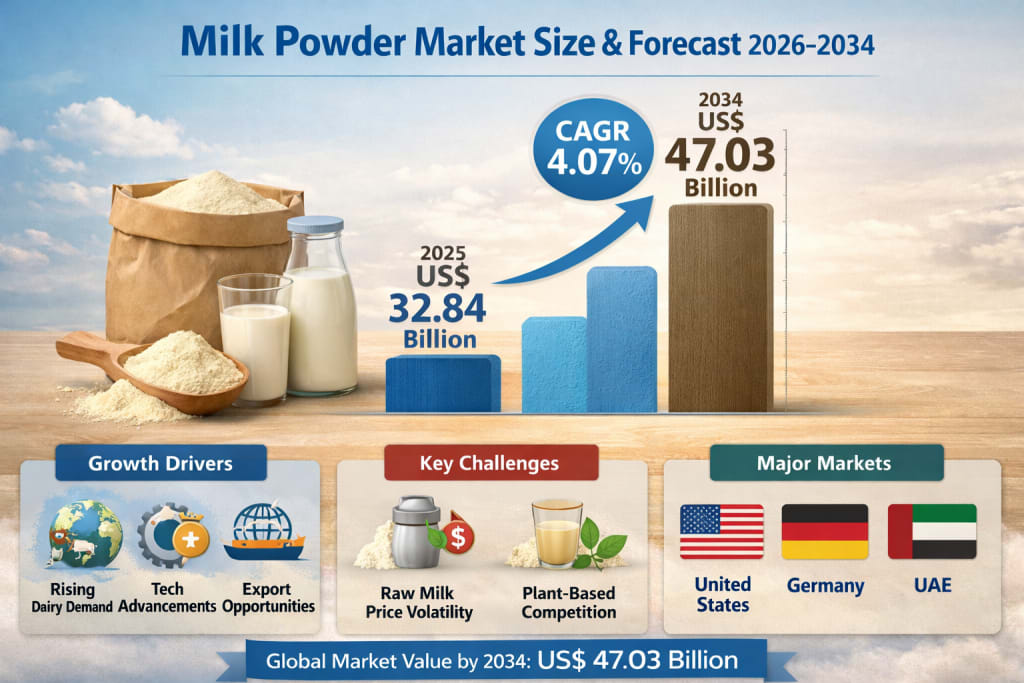
The global milk powder market is poised for consistent and resilient growth over the next decade. According to Renub Research, the Milk Powder Market is expected to increase from US$ 32.84 billion in 2025 to US$ 47.03 billion by 2034, expanding at a CAGR of 4.07% from 2026 to 2034. This steady growth trajectory reflects the increasing role of milk powder in food processing, infant nutrition, dietary supplements, and global dairy trade.
Milk powder has long been valued as a shelf-stable alternative to liquid milk. Produced through spray drying or other dehydration techniques, milk powder retains much of the nutritional value of fresh milk while offering extended shelf life and ease of transportation. In a world shaped by urbanization, convenience-driven lifestyles, and globalized supply chains, milk powder has evolved from a storage solution into a strategic ingredient across industries.
Milk Powder Industry Overview
The milk powder industry forms a crucial segment of the global dairy ecosystem. By removing water content from liquid milk, manufacturers create products such as whole milk powder, skimmed milk powder, fortified milk powder, and specialty variants. These products are widely used in:
Infant formula and child nutrition
Bakery and confectionery manufacturing
Beverages and ready-to-mix drinks
Processed and packaged foods
Animal feed
In developing economies, milk powder bridges the gap created by inadequate refrigeration infrastructure and inconsistent fresh milk supply. In developed markets, it supports industrial food production, enabling standardized formulations and scalable operations.
The export market remains particularly important. Leading dairy-producing nations ship milk powder to regions facing milk shortages or growing demand. With rising global population levels and expanding middle-class segments, demand continues to intensify.
Key Growth Drivers of the Milk Powder Market
1. Rising Global Demand for Dairy Products
Population growth and urbanization are primary drivers of milk powder consumption. As disposable incomes rise in emerging economies, dairy consumption increases—especially in packaged and processed forms.
Milk powder plays a versatile role across applications. It enhances texture, flavor, and nutritional value in confectionery, baked goods, and ready-to-drink beverages. Meanwhile, infant formula demand is surging as parents seek fortified, nutritionally enhanced products for early childhood development.
In regions where cold-chain logistics remain underdeveloped, milk powder serves as a practical solution. Its long shelf life and ease of storage make it ideal for distribution in remote and rural areas.
2. Technological Advancements in Processing and Fortification
Modern dairy processing has significantly enhanced milk powder quality and safety. Improved spray-drying techniques preserve essential nutrients while ensuring consistent particle size and solubility.
Fortification is another key trend. Manufacturers now enrich milk powders with:
Vitamins A, D, and B-complex
Minerals such as calcium and iron
Probiotics and functional ingredients
These innovations cater to health-conscious consumers and families seeking added nutritional benefits. Additionally, specialty variants—including lactose-free, organic, and high-protein milk powders—are expanding product portfolios and enabling premium pricing strategies.
Advanced packaging solutions, including vacuum sealing and moisture-resistant materials, further improve shelf stability and reduce spoilage during transportation.
3. Expanding Global Trade and Export Opportunities
Milk powder is one of the most traded dairy commodities globally. Countries with strong dairy production bases export to high-demand regions across Asia, the Middle East, and Africa.
Export growth is supported by:
Improved international trade agreements
Efficient logistics and shipping networks
Rising urban populations in emerging economies
Growing demand for infant nutrition and processed foods
As many nations lack sufficient domestic milk production capacity, imports remain essential. This dynamic strengthens global supply chains and reinforces milk powder’s role as a cornerstone of international dairy trade.
Market Challenges
1. Volatility in Raw Milk Prices and High Production Costs
Milk powder production depends heavily on raw milk supply, which is subject to seasonal fluctuations, feed costs, weather conditions, and regulatory policies. Price volatility directly impacts manufacturers’ margins.
Additionally, milk powder production is energy-intensive. Processes such as pasteurization, homogenization, and spray drying require substantial electricity and fuel. Rising energy costs increase operational expenses, particularly for smaller producers.
Packaging, storage, and distribution add further cost pressures. Maintaining competitive pricing while ensuring profitability remains a key challenge across the value chain.
2. Competition from Plant-Based Alternatives
The growing popularity of plant-based milk powders derived from soy, almond, oat, and other sources presents competitive pressure. These alternatives appeal to:
Vegan consumers
Lactose-intolerant individuals
Environmentally conscious buyers
Marketing campaigns often position plant-based options as sustainable and cholesterol-free alternatives. As dietary preferences shift, traditional dairy producers must innovate through organic, reduced-fat, and functional milk powder variants to maintain market share.
Regional Market Insights
United States Milk Powder Market
The United States remains a major player in the global milk powder market. Supported by a strong dairy infrastructure and advanced processing technology, the country benefits from both domestic consumption and export demand.
Milk powder is widely used in food manufacturing, infant nutrition, and bakery sectors. Growing interest in protein-rich and fortified dairy products supports premium product segments. Additionally, the U.S. exports substantial volumes to regions with rising dairy consumption, reinforcing its global influence.
Germany Milk Powder Market
Germany’s milk powder market is backed by robust dairy production and strict quality standards. The country plays a significant role within Europe’s dairy trade network.
Industrial demand from bakery and confectionery sectors drives consumption. At the same time, fortified milk powders for infants and families support retail demand. Germany’s focus on innovation and quality control ensures competitiveness in international markets.
India Milk Powder Market
India’s rapidly expanding population and rising urbanization are fueling strong growth in milk powder consumption. As fresh milk distribution remains uneven in certain regions, milk powder serves as a practical alternative.
The growing food processing sector and expanding bakery industry increase industrial demand. Additionally, awareness around nutrition and fortified dairy products is rising among middle-class households.
Government initiatives supporting dairy development further strengthen supply chains, positioning India as a significant growth engine within Asia-Pacific.
United Arab Emirates Milk Powder Market
The UAE relies heavily on milk powder imports due to limited domestic dairy production. High urbanization and strong purchasing power drive steady consumption across retail and industrial segments.
Milk powder plays a vital role in infant formula production, bakery manufacturing, and beverage preparation. Advanced packaging ensures product stability in hot climatic conditions, supporting long shelf life.
Growing demand for fortified and premium dairy products continues to shape the UAE market landscape.
Recent Developments in the Milk Powder Industry
The competitive landscape is evolving through strategic investments and product innovation:
June 2025: Darigold, Inc. inaugurated a new dairy processing facility in Pasco, Washington, capable of processing 8 million pounds of milk daily for domestic and international markets.
May 2025: Asahi Group Japan introduced Like Milk, a yeast extract powder-based milk substitute, marking its entry into dairy alternatives.
May 2025: Nova Dairy launched a new skimmed milk powder targeting health-conscious consumers seeking lower-fat options.
April 2025: ASAS Dairies in Tanzania introduced the country’s first domestically produced milk powder to address growing local demand.
These developments highlight ongoing expansion, diversification, and innovation across global markets.
Market Segmentation
By Type
Whole Milk Powder
Skimmed Milk Powder
Dairy Whitener
Buttermilk Powder
Fat-Filled Milk Powder
Others
By Application
Nutritional Food
Infant Formulas
Confectioneries
Baked Sweets
Savories
Others
By Region
North America, Europe, Asia-Pacific, Latin America, and the Middle East & Africa form the core geographic segments, with countries such as the United States, Germany, India, China, Brazil, and the UAE playing prominent roles.
Competitive Landscape
Major companies operating in the milk powder market include:
Nestle (Switzerland)
Danone
Saputo Inc.
Arla Foods amba
The Kraft Heinz Company (U.S.)
Royal FrieslandCampina N.V.
Land O’Lakes, Inc.
China Mengniu Dairy Company Limited
Ausnutria Dairy Corporation Ltd.
Companies are evaluated across five key dimensions: Overview, Key Persons, Recent Developments, SWOT Analysis, and Revenue Analysis. Strategic investments in innovation, export expansion, and sustainability initiatives are central to competitive positioning.
The Road Ahead: Balanced Growth with Innovation
The milk powder market’s projected expansion to US$ 47.03 billion by 2034 reflects steady demand fundamentals rather than speculative growth. With a CAGR of 4.07%, the industry demonstrates resilience supported by rising global dairy consumption, technological innovation, and expanding export networks.
However, the industry must navigate cost volatility, sustainability concerns, and intensifying competition from plant-based alternatives. Companies that prioritize operational efficiency, product differentiation, and nutritional enhancement will be best positioned for long-term success.
Final Thoughts
Milk powder has evolved beyond a simple preservation method into a strategic, high-demand global commodity. As urban populations grow and dietary habits continue to shift toward convenience and nutrition-focused products, milk powder will remain an essential ingredient across industries.
Backed by technological advancements, expanding trade opportunities, and rising health awareness, the global milk powder market is set for stable and sustainable growth through 2034. For stakeholders across the dairy value chain—from farmers and processors to exporters and investors—the coming decade presents both opportunity and transformation in equal measure.
About the Creator
Mexico 5G Infrastructure Market Size, Share, Industry Trends & Forecast 2026–2034
Market Overview The Mexico 5G infrastructure market is becoming a critical pillar in the country’s digital transformation. Telecommunication companies, infrastructure providers, and government agencies are increasingly investing in next‑generation network technologies to deliver faster connectivity, lower latency, and greater network capacity. As businesses and consumers rely more on digital platforms, the demand for advanced communication infrastructure is expanding rapidly across Mexico.
By Jackson Watsona day ago in Trader
Aroma Chemicals Market Size and Forecast 2026–2034
The global Aroma Chemicals Market is poised for steady expansion over the next decade, supported by growing demand across personal care, food and beverage, healthcare, and household products. According to Renub Research, the Aroma Chemicals Market is expected to reach US$ 12.91 billion by 2034, up from US$ 8.03 billion in 2025, registering a CAGR of 5.42% during 2026–2034.
By shibansh kumar4 days ago in Trader
REEEEEEEEE!
I'm on a low road right now. There are a literal million things to do and not one of them worth my time. I would rather sit in place and burn but the orbit takes me on its inevitable route 'round the center; and I a center in my own right, around which others orbit, and so on and so forth, ad infinitum, ad nauseum.
By C. Rommial Butlerabout 20 hours ago in Poets


Comments
There are no comments for this story
Be the first to respond and start the conversation.