
Global Candle Market Size and Forecast 2026–2034
Rising Demand for Home Décor, Wellness Trends, and Premium Fragrances Fuel Steady Industry Expansion

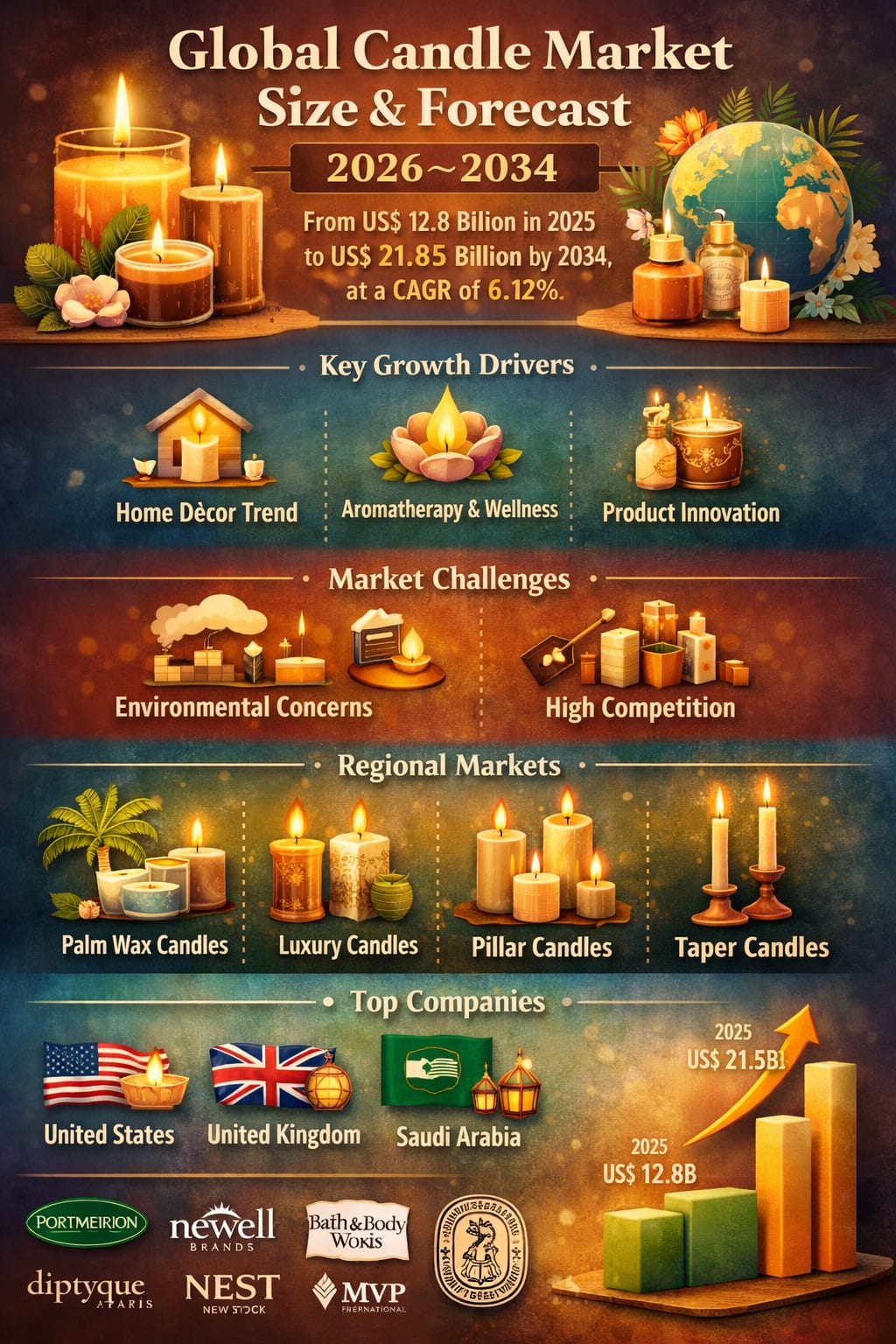
The global candle market is steadily illuminating new growth opportunities as consumer lifestyles evolve and demand for home ambiance products rises worldwide. According to Renub Research, the market is projected to grow from US$ 12.8 Billion in 2025 to US$ 21.85 Billion by 2034, registering a compound annual growth rate (CAGR) of 6.12% from 2026 to 2034.
This consistent expansion reflects shifting consumer behavior, increased interest in wellness products, premiumization trends, and the growing popularity of candles as decorative, gifting, and relaxation essentials. What was once a simple source of light has transformed into a symbol of comfort, self-care, and lifestyle expression across both developed and emerging markets.
Global Candle Market Outlook
A candle, traditionally made from wax and a wick, provides illumination when lit. Historically produced using paraffin, beeswax, and tallow, modern candles increasingly incorporate natural and sustainable alternatives such as soy wax, palm wax, and coconut wax. Beyond lighting, candles now serve diverse purposes including home décor, aromatherapy, religious ceremonies, meditation, gifting, and hospitality ambiance enhancement.
Scented candles, infused with essential oils and curated fragrance blends, have gained immense traction for their ability to promote relaxation and improve indoor environments. Globally, candles are deeply embedded in cultural celebrations, festivals, and spiritual practices, symbolizing warmth, hope, and serenity.
In developed regions such as the United States and Europe, candles are widely perceived as lifestyle and wellness products aligned with self-care and interior styling trends. Meanwhile, in emerging economies, candles maintain functional importance during power disruptions while simultaneously growing as affordable decorative items.
Continuous innovation in fragrances, sustainable materials, artistic packaging, and product customization is reinforcing global demand across multiple consumer segments.
Key Growth Drivers of the Global Candle Market
1. Rising Demand for Home Décor and Lifestyle Enhancement
One of the strongest growth catalysts for the global candle market is the increasing consumer focus on home aesthetics and experiential living. Candles have become essential accessories in modern interior design, creating warmth and ambiance in residential spaces.
Urbanization and rising disposable incomes have encouraged spending on premium decorative accessories. Social media platforms have further amplified trends in home styling, making designer and scented candles must-have décor elements. Seasonal demand during holidays, weddings, festivals, and celebrations significantly boosts sales.
Commercial establishments, including hotels, spas, and fine-dining restaurants, increasingly incorporate candles to elevate customer experience. For example, in April 2025, artisanal brand Himalayan Handmade Candles expanded its U.S. retail footprint with a Spring 2025 fragranced collection, reflecting growing demand for eco-conscious home fragrance products.
The emphasis on curated living spaces and aesthetic appeal continues to drive sustained market expansion.
2. Growing Popularity of Aromatherapy and Wellness Trends
Mental wellness awareness has grown substantially over the past decade. Consumers are actively seeking products that support stress relief, emotional balance, and relaxation—making aromatherapy candles increasingly popular.
Yoga studios, meditation centers, and spas frequently use scented candles as part of holistic wellness experiences. Natural wax variants such as soy and beeswax candles are preferred for their cleaner burn and reduced soot emission.
In June 2025, Goose Creek launched a collaboration featuring Nickelodeon’s SpongeBob SquarePants-themed candles, demonstrating how fragrance products are increasingly blending wellness with entertainment and nostalgia-driven appeal.
This fusion of emotional well-being, relaxation culture, and creative branding significantly strengthens the candle market’s long-term prospects.
3. Product Innovation and Premiumization
Innovation plays a crucial role in sustaining industry growth. Manufacturers are introducing:
Unique fragrance blends
Handcrafted and artistic designs
Multi-wick and long-burning formats
Personalized and engraved packaging
Sustainable and refillable containers
Premium candles, especially in developed markets, command higher margins due to luxury packaging and curated scent profiles.
In February 2024, Jo Malone London launched a limited-edition Paddington-themed scented gift collection, combining storytelling, fragrance innovation, and premium branding.
Similarly, brands like Bath & Body Works, Inc. and Newell Brands Inc. continue expanding seasonal and specialty candle offerings to meet evolving consumer tastes.
Premiumization and differentiation remain central to competitive positioning in this fragmented marketplace.
Challenges Facing the Global Candle Market
Environmental and Health Concerns
Traditional paraffin candles, derived from petroleum, may release soot and volatile organic compounds (VOCs) when burned. Increasing consumer awareness regarding indoor air quality has prompted demand for cleaner-burning alternatives.
However, natural wax sourcing presents its own challenges. Agricultural volatility and sustainability concerns—particularly related to palm oil production—create supply uncertainties. Companies must invest in certified sustainable sourcing, eco-friendly packaging, and transparent labeling, which raises production costs.
Failure to address environmental concerns could negatively impact consumer trust and brand loyalty.
Price Sensitivity and Market Competition
The global candle market is highly competitive, comprising multinational corporations, regional brands, artisanal manufacturers, and private-label offerings.
Candles are often categorized as discretionary purchases, making demand sensitive to economic fluctuations—especially in developing markets. Low-cost mass-produced candles compete directly with premium handcrafted variants, exerting downward pressure on margins.
Retailer private labels and fluctuating raw material prices further challenge profitability. Companies must balance affordability, quality, branding, and sustainability to remain competitive.
Segment Insights
Palm Wax Candle Market
Palm wax candles are gaining traction due to their biodegradable properties and clean-burning performance. Their distinctive crystalline structure enhances visual appeal, making them popular in decorative applications and hospitality settings.
However, sustainability concerns surrounding palm oil cultivation necessitate certified sourcing practices. Brands adopting sustainable palm oil standards are better positioned to capitalize on rising eco-conscious demand.
Luxury Candle Market
Luxury candles have transitioned from basic household items to lifestyle statements. Consumers increasingly associate premium candles with self-care rituals and personalized interior experiences.
High-end hospitality venues, spas, and boutique retailers frequently use luxury candles to elevate ambiance. Artisan craftsmanship, exclusive fragrance blends, and limited-edition collections reinforce the segment’s growth trajectory.
Companies such as Diptyque Paris, NEST New York, and Lalique Group SA continue to shape the global luxury candle landscape.
Pillar Candle Market
Pillar candles remain popular due to their durability, long burn time, and versatility. They are widely used as centerpieces, in lanterns, and during religious ceremonies. Their broad surface allows intricate designs and color variations.
The hospitality industry extensively uses pillar candles for ambient lighting in hotel rooms and restaurants, enhancing aesthetic appeal.
Taper Candle Market
Taper candles carry strong cultural symbolism and are closely associated with traditional ceremonies, weddings, and formal dining settings. Their elegant form factor makes them ideal for decorative and ceremonial use.
The revival of classic interior décor styles continues to support demand for taper candles worldwide.
Distribution Channel Analysis
Supermarkets and hypermarkets play a significant role in the mass distribution of candles, particularly scented and decorative varieties. Impulse buying during festive seasons significantly boosts sales.
Premium and eco-friendly candles are increasingly available through specialty stores and online platforms. E-commerce growth has enabled niche and artisanal brands to access global markets more efficiently.
Institutional sales to hospitality businesses also contribute to steady revenue streams.
Regional Insights
United States
The United States represents one of the largest global candle markets, driven by high consumer spending and strong seasonal demand. Celebrations such as Christmas, Thanksgiving, and Halloween significantly influence sales.
Sustainability trends have increased demand for soy and beeswax candles. Brands like Village Candle and Thymes, LLC continue expanding seasonal collections to capture consumer interest.
United Kingdom
The UK market demonstrates strong demand for scented and decorative candles, particularly during colder months. Consumers prioritize sustainability, recyclable packaging, and cruelty-free production methods.
Premium gifting segments experience notable growth during festive seasons.
Saudi Arabia
In Saudi Arabia, rising disposable income, urbanization, and hospitality sector expansion are driving candle demand. Fragrances inspired by oud, musk, and floral notes align with regional preferences.
Luxury hotel development and tourism growth further support market expansion in the region.
Market Segmentation
By Wax Type:
Palm Wax, Soy Wax, Beeswax, Paraffin, Others
By Category:
Economical, Luxury
By Product Type:
Votive, Container Candle, Pillars, Tapers, Others
By Distribution Channel:
Online Retail, Specialty Stores, Supermarkets & Hypermarkets, Departmental Stores, Institutional Sales
By Geography:
North America, Europe, Asia Pacific, Latin America, Middle East & Africa
Competitive Landscape
Key players analyzed in the global candle market include:
Portmeirion Group PLC
Newell Brands Inc.
Estée Lauder Companies Inc.
Lalique Group SA
Bath & Body Works, Inc.
MVP Group International Inc.
Diptyque Paris
NEST New York
Thymes, LLC
Village Candle
Each company is evaluated based on overview, key persons, recent developments, product portfolio, financial insights, and strategic positioning.
Final Thoughts
The global candle market is undergoing a transformative phase, evolving beyond its traditional function into a lifestyle-driven, emotionally connected product category. With projected growth from US$ 12.8 Billion in 2025 to US$ 21.85 Billion by 2034 at a CAGR of 6.12%, the industry demonstrates strong resilience and adaptability.
Rising interest in home décor, wellness trends, eco-conscious products, and premium gifting continues to shape consumer demand. While environmental concerns and price sensitivity pose challenges, innovation, sustainability, and strategic branding provide significant growth opportunities.
As self-care and experiential living become central to modern lifestyles, candles are expected to remain a glowing symbol of comfort, ambiance, and well-being across global markets through 2034.
About the Creator
The USD 185.1 Billion Opportunity: How the Biosimilar Market Is Transforming Global Healthcare
Imagine a world where life-saving biologic treatments for cancer, autoimmune disorders, and chronic diseases are no longer limited by high costs. That transformation is already underway — and it has a name: the Biosimilar Market.
By James Smitha day ago in Trader
Visa Inc.: Understanding the Stock Behind the Global Payments Revolution
Visa Inc. is more than a credit card company; it is a global payments network that underpins modern commerce. Serving millions of merchants and consumers worldwide, Visa plays a critical role in the digital economy. For investors, Visa stock offers exposure to growing cashless transactions, global spending trends, and the evolution of financial technology.
By Hammad Nawaz6 days ago in Trader




Comments
There are no comments for this story
Be the first to respond and start the conversation.