
Food Enzymes Market Size and Forecast 2026–2034
Rising Demand for Processed Foods and Clean-Label Solutions to Propel Market to US$ 6.02 Billion by 2034

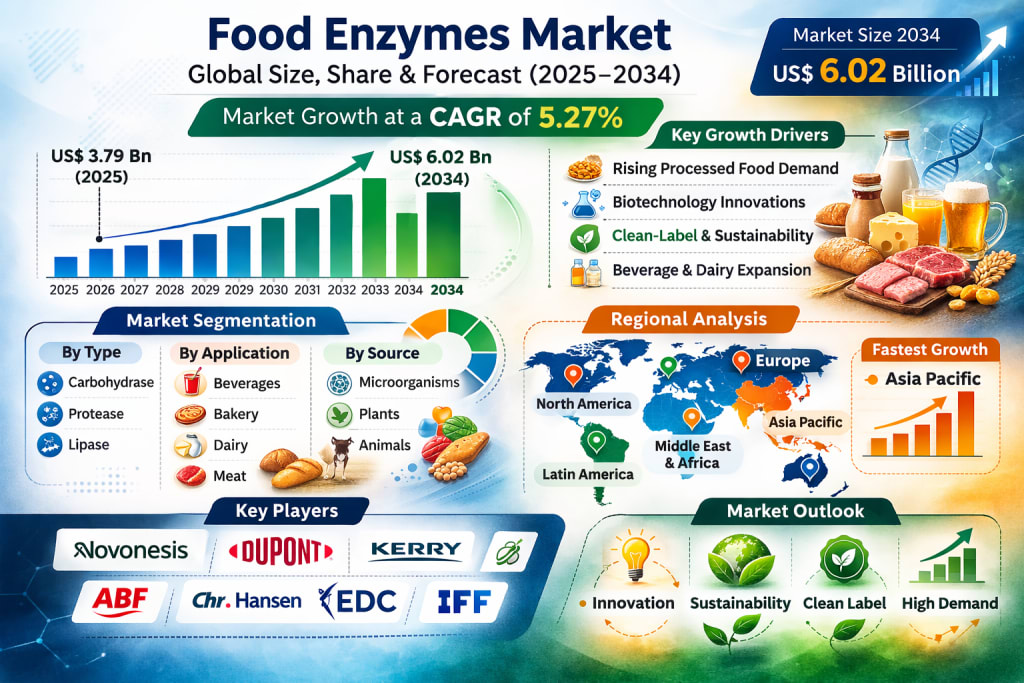
The global Food Enzymes Market is on a steady upward trajectory, reflecting the increasing importance of biotechnology in modern food production. According to Renub Research, the Food Enzymes Market is expected to reach US$ 6.02 billion by 2034, up from US$ 3.79 billion in 2025, growing at a CAGR of 5.27% from 2026 to 2034.
Download Sample Report
This growth is being driven by multiple interconnected factors: the rapid expansion of the global food processing industry, rising consumer awareness regarding food quality and safety, technological advancements in biotechnology, increasing consumption of alcoholic and non-alcoholic beverages, and the continuous development of more efficient and targeted enzyme solutions.
As food manufacturers seek higher efficiency, sustainability, and product consistency, enzymes are emerging as indispensable tools in food production systems worldwide.
Food Enzymes Industry Overview
The food enzymes industry represents a specialized yet essential segment of the global food ingredients market. Food enzymes are biological catalysts—primarily derived from microorganisms, plants, or animals—that accelerate biochemical reactions during food processing.
They are used extensively across various sectors, including:
Bakery
Dairy
Beverages
Meat processing
Confectionery
Processed and convenience foods
Common enzyme categories include:
Carbohydrases – Used for starch breakdown and sugar modification
Proteases – Improve protein processing and texture
Lipases – Enhance fat breakdown and flavor development
Because enzymes function in small quantities and are biodegradable, they are widely recognized as environmentally friendly processing aids. They improve texture, flavor, shelf life, yield, and consistency while reducing waste and energy consumption.
The growing preference for clean-label and natural ingredients has further strengthened their appeal, as enzymes are often perceived as natural alternatives to synthetic additives.
Key Growth Drivers in the Food Enzymes Market
1. Rising Demand for Processed and Convenience Foods
Urbanization, busy lifestyles, and increasing disposable incomes have significantly increased global consumption of ready-to-eat and packaged foods. Consumers expect consistent quality, taste, and longer shelf life—requirements that enzymes help fulfill efficiently.
For example:
In bakery products, proteases improve dough handling and bread volume.
In beverages, carbohydrases enhance sweetness and clarity.
In dairy processing, lipases contribute to flavor enhancement and texture optimization.
The expansion of fast-food chains and quick-service restaurants further drives demand for uniform product quality across locations. As emerging economies continue to adopt modern retail and foodservice formats, enzyme utilization is expected to rise steadily.
2. Technological Advancements in Biotechnology
Biotechnology is transforming enzyme development. Techniques such as recombinant DNA technology, genetic modification, and protein engineering are enabling the production of highly specific and efficient enzymes.
Modern enzyme engineering allows products to function under:
Extreme temperatures
Variable pH conditions
High-pressure processing environments
Additionally, advancements in fermentation technology have increased enzyme yields while lowering production costs. These innovations are facilitating the development of specialized enzymes for:
Lactose-free dairy products
Gluten-free bakery goods
Low-calorie sweeteners
Functional beverages
As research and development efforts intensify, enzyme customization for niche applications is expanding market potential.
3. Sustainability and Clean-Label Movement
Sustainability has become a strategic priority for food manufacturers worldwide. Enzymes contribute significantly to reducing resource consumption and improving production efficiency.
Examples include:
Amylases reducing starch usage in baked goods
Pectinases improving juice extraction efficiency
Cellulases minimizing water and energy usage
Moreover, enzymes help replace synthetic preservatives and flavor enhancers, aligning with consumer demand for clean-label and minimally processed foods. Regulatory encouragement for eco-friendly manufacturing practices further supports market expansion.
Challenges in the Food Enzymes Market
Regulatory Compliance and Approval Complexities
One of the biggest barriers in the food enzymes market is navigating diverse regulatory frameworks. Although enzymes are considered processing aids, they require extensive safety assessments, toxicological evaluations, and documentation before approval.
Regulatory differences across regions increase compliance costs and time-to-market. Smaller companies often struggle with these stringent requirements due to limited technical and financial resources.
High Production Costs and Technical Barriers
Enzyme production involves sophisticated microbial fermentation, purification, and stabilization processes. These require advanced infrastructure and skilled labor.
Key challenges include:
Maintaining enzyme stability under extreme processing conditions
High capital investment in R&D
Fluctuating raw material and energy costs
These factors create entry barriers for new players and pressure existing companies to continuously innovate while managing costs.
Country-Level Insights
United States Food Enzymes Market
The United States represents a technologically advanced and mature market. High consumption of processed foods, combined with strong biotechnology infrastructure, drives enzyme adoption.
Key characteristics include:
Extensive use in bakery, dairy, beverages, and meat processing
Strong focus on clean-label and natural solutions
Advanced fermentation and enzyme engineering capabilities
While stringent regulations and competition remain challenges, innovation and health-conscious consumer trends continue to propel growth.
Germany Food Enzymes Market
Germany is a mature European market supported by a strong food processing industry and advanced biotechnology research infrastructure.
Key growth factors include:
Rising demand for premium bakery and dairy products
Clean-label preferences
Sustainable food production initiatives
Despite strict EU regulatory standards and high operational costs, Germany remains a significant contributor to the European enzyme landscape.
China Food Enzymes Market
China is among the fastest-growing markets globally. Rapid urbanization, rising disposable income, and changing dietary habits are accelerating demand for processed and functional foods.
Key drivers include:
Expansion of large-scale food manufacturing
Growing modern retail and e-commerce channels
Increasing demand for clean-label alternatives
Although regulatory compliance and quality control remain critical concerns, strong government support for biotechnology positions China as a major growth hub.
United Arab Emirates Food Enzymes Market
The UAE market is emerging steadily, supported by increasing demand for convenience foods and modern retail expansion.
Key advantages include:
Strategic geographic location
Growing foodservice sector
Rising demand for premium and natural food products
However, dependence on imports and regulatory complexities pose challenges. Nonetheless, innovation and sustainability awareness continue to drive gradual growth.
Recent Developments in the Food Enzymes Market
The industry has witnessed notable strategic movements:
February 2025: Novonesis agreed to acquire DSM-Firmenich’s share in the Feed Enzyme Alliance for EUR 1.5 billion.
November 2024: International Flavors & Fragrances launched TEXSTARTM, targeting advanced texture enhancement in fermented dairy products.
October 2024: Biocatalysts Ltd. introduced an enzymatic solution to enhance natural dairy flavors with clean-label appeal.
September 2024: IFF launched DIAZYME NOLO, an enzyme designed to improve low- and no-alcohol beverage production efficiency.
These innovations highlight increasing focus on premium, functional, and clean-label applications.
Market Segmentation
By Type
Carbohydrase
Lipase
Protease
Others
By Application
Beverages
Bakery Products
Dairy Products
Others
By Source
Microorganisms
Plants
Animals
By Region
North America (United States, Canada)
Europe (France, Germany, Italy, Spain, United Kingdom, Belgium, Netherlands, Turkey)
Asia Pacific (China, Japan, India, South Korea, Thailand, Malaysia, Indonesia, Australia, New Zealand)
Latin America (Brazil, Mexico, Argentina)
Middle East & Africa (Saudi Arabia, UAE, South Africa, Rest of World)
Company Insights
Key companies operating in the global Food Enzymes Market include:
Advanced Enzyme Technologies
Novozymes
DuPont Danisco
Kerry Group PLC
Associated British Foods Plc
Chr. Hansen Holding A/S
Enzyme Development Corporation (EDC)
Dyadic International Inc.
Competitive strategies focus on product innovation, strategic acquisitions, R&D investments, and sustainability-driven solutions.
Final Thoughts
The Food Enzymes Market is entering a phase of strategic expansion, supported by technological innovation, rising processed food demand, and sustainability imperatives. With the market projected to grow from US$ 3.79 billion in 2025 to US$ 6.02 billion by 2034, steady growth at a 5.27% CAGR reflects the industry’s resilience and long-term potential.
As global food systems evolve toward efficiency, health-conscious formulations, and clean-label transparency, enzymes will play an increasingly vital role. Companies that invest in biotechnology advancements, regulatory expertise, and sustainable production methods will be best positioned to capitalize on emerging opportunities.
In the coming decade, food enzymes will not only enhance production efficiency but also shape the future of safe, sustainable, and innovative food manufacturing worldwide.
About the Creator
Australia Interior Design Market 2026: Lifestyle Evolution, Sustainable Aesthetics and Renovation-Driven Growth
Australia Interior Design Market Overview Australia’s interior design market is expanding steadily as consumers increasingly prioritise aesthetic living environments, functional spaces and personalised home experiences. Interior design services — spanning residential, commercial and hospitality environments — are becoming central to property development and renovation strategies across the country. As hybrid work models reshape spatial requirements and sustainability considerations influence design choices, interior design is evolving into a strategic lifestyle and property value enhancement tool.
By Amyra Singh5 days ago in Trader



Comments
There are no comments for this story
Be the first to respond and start the conversation.