


My first encounter with yoga happened almost fifteen years ago. I was a freshman in high school and went up to my room, turned on the tv, and stumbled upon the fitness network. A show had just started and it began with these women doing poses with this strange dark watery scenery and these very mystical sounds in the background. I had no idea what I was watching. But I kept watching and felt almost hypnotized by their movement. I started watching this show daily for the remainder of my high school years and kept a very quiet personal practice. I was an odd duck in high school, I was what some people would refer to as an “emo” kid, and practicing yoga alone in my room helped me feel connected to something more powerful. I began to dig deeper into the philosophy side of things and tried my best to embody my practice mentally and physically. As a teenager, this was very difficult but I always tried my best.
When I think of my relationship with yoga and how long and crazy our journey has been together, it makes me feel strong and awake. There have been moments in my life where I have preached a yogic lifestyle without actually practicing. I had been a fake yogi for many years, I was lost and had to figure out the hard way how to do many, many things. But the one constant, the one thing that has always returned.. is me.. standing on my mat and asking the universe for its guidance.
Yoga is so much more than just a physical practice, or a way to get thin and sweaty; yoga is a way of life. There are many steps that go into becoming a yoga instructor and I accept that title with the utmost level of pride. When I think of how far I have come and how much my practice has helped me heal wounds.. that I honestly never thought would heal.. it is amazing what can happen when you bring your attention inward. It does not always have to be everything against you, many times it is you against yourself and having daily reflection of what is serving you helps keep me in line with the life and goals that I want to achieve.
When I was fourteen, flipping through channels and watching those women flow from pose to pose, I had no idea what impact they would have on my life. In life, I believe that things do not just happen by chance, they happen for a reason, whether it be a life lesson or an achievement, it was going to happen whether you wanted it to or not.
About the Creator
Jenna Bird
Learning how to be a good person. One yoga practice at a time.
RYT200
Keep reading
More stories from Jenna Bird and writers in Longevity and other communities.
Ahimsa
Earlier this year I found myself in a great conflict, in a type of depression that I did not think I would be able to get out of. This has been a very stressful year for so many and most of us are just trying to get by and figure out a way to make the best of it. What pulled me out of my funk and brought me back to accepting this reality and shifting the focus inward, was my studies on The Eight Limbs of Yoga. These steps can be interpreted in various ways to fit your life, to give you a goal and something to look forward to! The Eight Limbs of Yoga are essential guidelines or commandments that push us towards self enlightenment. The first limb in this path is called the Yamas; the relationship with ourselves and others and how we see or interpret them. We begin this journey with testing our boundaries and ability to shift towards a more positive and purposeful life. The Yamas are composed of five smaller limbs, the first one being Ahimsa. The act of Ahimsa is taking the path of nonviolence towards others, the self and in our daily activities!
By Jenna Bird5 years ago in Longevity
How China Is Challenging the U.S. to Become the Next Great Space Power
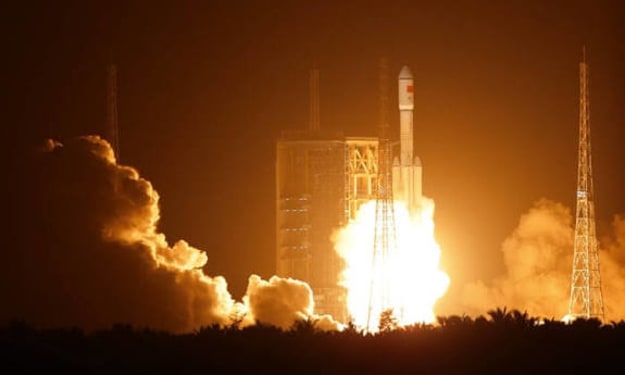
As Beijing’s space ambitions expand, Washington faces an intensifying geopolitical and technological rivalry in orbit and beyond. In the early decades of the 21st century, the United States long stood unchallenged as the dominant space power — a position built on decades of NASA leadership, unmatched launch capability, and a vibrant commercial space economy. But today, a determined China is mounting one of the most consequential strategic challenges in space since the Cold War, pushing to rival — and ultimately surpass — the U.S. in space influence, technology, and strategic advantage. National Strategy and Long‑Term Vision China’s leaders have openly signaled their ambition to become a global space powerhouse. Official space policy documents and state planning envision a broad array of capabilities — from heavy‑lift rockets to lunar exploration — aimed at reshaping the space order that has been U.S.‑dominated for decades. According to analyses of government planning, Beijing intends to establish a full suite of launch vehicles, satellites, and space infrastructure that could surpass current international norms by mid‑century. Underpinning this vision is a belief among Chinese space officials that self‑reliance and indigenous innovation are key to international competitiveness. Recent reports in state media emphasize that China’s aerospace industry is pushing far beyond imitation toward original technological breakthroughs in areas like rocket manufacturing, intelligent space systems, and advanced materials — all with the strategic goal of securing leadership in space. Commercial Space: From Government Giants to Private Innovators China’s rapid ascent isn’t limited to state space agencies. A growing ecosystem of private space companies — much like the commercial boom seen in the U.S. — has taken root, focusing on reusable rockets, satellite networks, and novel space services. A recent South China Morning Post report highlights Beijing’s push to encourage private innovation within its space sector, supporting technologies such as reusable launch vehicles, space debris monitoring, extraterrestrial resource utilization, and even in‑space biomanufacturing — fields long dominated by U.S. firms such as SpaceX or Blue Origin. This commercial expansion broadens China’s capabilities and compresses the technological gap with the U.S., challenging American assumptions that commercial innovation is exclusively an American forte. It also signals a shift in global space economics, where China may soon contend for commercial markets once dominated by Western companies. Military and Strategic Dimensions Alongside civil and commercial ambitions, China’s space strategy has clear military implications. U.S. strategic assessments note Beijing’s efforts to build counterspace capabilities — systems designed to deter, deny, or degrade another nation’s satellite operations — a key advantage in future conflicts. China has already deployed anti‑satellite weapons, jamming technologies, and sophisticated ground‑to‑space radar systems that could threaten U.S. space assets in a crisis. For the United States, which relies heavily on space systems for communication, navigation, and battlefield awareness, these capabilities represent a serious strategic challenge. Beijing’s ability to field space and counterspace technologies could blunt some of Washington’s military advantages in the Asia‑Pacific region and beyond. Lunar and Deep Space Objectives China’s Chang’e lunar exploration program is another marker of its space ambitions. With a series of increasingly complex robotic missions and plans for an International Lunar Research Station by the 2030s, Beijing aims to be a leading voice in lunar science and development — directly challenging the U.S. Artemis program and international partnerships spearheaded by NASA. � Wikipedia Missions like the strategically significant Queqiao‑2 communications relay satellite, which supports lunar missions over long distances, further demonstrate China’s growing sophistication in deep space operations and infrastructure deployment. U.S. Response: Maintaining Leadership Recognizing the challenge, U.S. policymakers are pushing legislative and strategic initiatives designed to preserve American competitiveness in space. A newly passed NASA authorization package includes provisions aimed at reinforcing U.S. lunar presence, strengthening Earth orbit assets, and countering Chinese influence in space science and technology — signaling a bipartisan consensus on the gravity of the space rivalry. A New Era of Cosmic Competition The emerging science and technological competition between China and the United States in space is unlike anything seen since the original Moon race. Today’s contest spans not only national prestige but military advantage, commercial opportunity, and scientific discovery. As each side pursues its vision of space dominance, the outcome will shape global power structures for decades to come — affecting diplomacy, security, and economic leadership both on Earth and beyond. If you’d like alternative versions, transcripts, or a set of headline + subtitle options for this topic, just let me know!
By Fiaz Ahmed about 11 hours ago in Longevity
3 Things to Do Before Bed for Better Blood Sugar, According to Dietitians
KEY POINTS To keep your blood sugar from spiking in the morning, what you do the night before matters. Eating a balanced snack, limiting screens and gently moving all support healthy blood sugar. Other ways to help your morning blood sugar include reducing alcohol and managing stress.
By Good health to everyone3 days ago in Longevity



Comments
There are no comments for this story
Be the first to respond and start the conversation.