
I Quit LinkedIn — Here’s Why Smart Entrepreneurs Are Leaving
(And What I Do Instead)

It was a Tuesday morning, right around 8:30 AM, when I finally snapped. I was sitting at my kitchen table, nursing my first cup of coffee, mindlessly scrolling on my phone. I stopped on a post from a guy I used to know a few years back.
He had written a massive, sprawling story about how dropping his toast on the floor that morning taught him a profound lesson about B2B SaaS sales resilience.
Every single sentence was on its own line.
Like this.
Because this formatting makes you stop scrolling.
And click "See more."
I looked at the comments. There were hundreds of them. "So inspiring, Dave!" "Great insights, brother!" "Truly a masterclass in leadership!"
I felt a knot form in my stomach. None of this was real. It was a giant, echoing room of people pretending to be thought leaders, hoping to sell high-ticket coaching programs to other people pretending to be thought leaders. I closed the app, put my phone down, and realized something that terrified me: I was spending two hours a day participating in this circus.
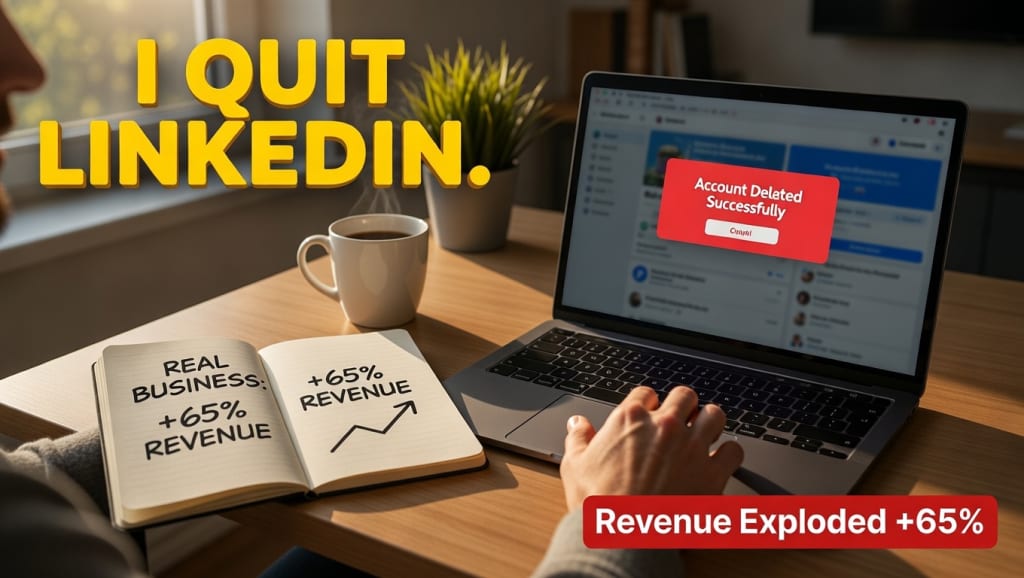
I opened my laptop, went into my account settings, and clicked the tiny, almost hidden "Close Account" button.
I didn't make a grand departure post. I didn't warn my 14,000 connections. I just vanished. Today, looking back on that decision, I can tell you exactly what happened to my online business when I pulled the plug. I Quit LinkedIn — Here’s Why Smart Entrepreneurs Are Leaving, and why you might want to seriously consider joining us.
If you are a founder, a creator, or a website owner running yourself ragged trying to keep up with the corporate influencer rat race, this is for you. I want to pull back the curtain and show you how leaving the biggest professional networking site on the internet was the single best business decision I ever made.
The Illusion of the "Professional Network"
Before we get to the good stuff—the part where my website revenue actually went up after I left—we have to talk about why we all got trapped on that platform in the first place.
When I started my first online business a few years ago, every single marketing guru gave me the exact same advice: You have to be on LinkedIn. They said it was the ultimate goldmine for organic reach. They said it was where the decision-makers hung out. They said if I wanted my website to succeed, I needed to build a personal brand.
So, I played the game. Oh man, did I play it hard.
I spent hours crafting perfectly formatted stories with forced life lessons.
I responded to every comment within 10 minutes to "feed the algorithm."
I accepted connection requests from complete strangers, only to receive an automated pitch in my inbox exactly three seconds later. ("Hey Hazem, noticed we both breathe oxygen. Do you need more qualified leads for your agency?")
For a while, it felt like it was working. I was getting thousands of views. My follower count was ticking up. People were sending me fire emojis in my direct messages. I felt important. I felt like I was building a massive asset.
But then, I did something dangerous. I actually looked at my Google Analytics.
The Analytics Lie: Virality vs. Profit
This was the first heavy crack in the foundation. It was the end of the quarter, and I was doing a deep dive into my website's traffic sources. I was running a niche site that sold digital products and templates, along with some high-tier affiliate marketing.
I pulled up the numbers for the past 90 days. I had generated roughly 400,000 views on my LinkedIn posts during that time. I was posting every single weekday. I was exhausted from trying to sound smart every morning.
Do you know how many actual clicks those 400,000 views drove to my website?
Four hundred and twelve.
412 clicks. From nearly half a million impressions. And it gets worse. When I looked at the conversion rate for those 412 visitors, it was absolute garbage. They didn't buy my templates. They didn't sign up for my email list. They bounced off the page in less than ten seconds.
Why? Because the platform is designed to keep you on the platform. The algorithm actively punishes you if you include a link to an external website in your post. You have to play this silly game where you say, "Link in the comments!" and then hope people actually scroll down to find it.
Even when they do click, they aren't in a buying mindset. They are in a scrolling mindset. They are looking to hit a quick "like" button to show their boss they are active online, and then they move on.
I was spending 10 to 15 hours a week performing for an audience of bots, lead-generation software, and people who had absolutely no intention of ever spending a dime on my website. The math was fundamentally broken.
The Toxic Cult of Hustle and Comparison
Beyond the terrible business math, there was a darker, heavier reason I needed out. It was destroying my focus and my peace of mind.
When you run your own website or business, you spend a lot of time alone in your own head. It is a lonely path. You are constantly doubting your strategy, worrying about algorithm updates, and wondering if you are doing enough.
Logging into that feed every day was like pouring gasoline on my anxiety. Every time I opened the app, someone was announcing a massive funding round. Someone else was bragging about scaling to $50k a month using a secret outbound strategy. A 22-year-old was explaining how they retired their parents by starting a ghostwriting agency.
Logically, I knew a lot of it was exaggerated or completely fake. I knew the guy bragging about his $100k month was likely talking about gross revenue while completely ignoring his $95k in ad spend. But emotionally? It drained me.
Instead of working on my business, I was comparing my behind-the-scenes reality to everyone else's aggressively filtered highlight reel. It made me second-guess my own strategies. I would abandon a perfectly good SEO project to try some new networking hack I saw a "Top Voice" post about.
The turning point was obvious. I Quit LinkedIn — Here’s Why Smart Entrepreneurs Are Leaving. We are leaving because the mental tax of performing for your peers is actively preventing you from doing the deep, quiet work required to actually build something of value.
The Silence After the Click
Let me tell you what happens the day after you delete your account.
Nothing.
The world doesn't end. Your business doesn't instantly collapse. Your real friends still have your phone number. Your current clients still know your email address.
But what you do get is silence. A beautiful, clear, unbroken silence.
For the first few days, my thumb would automatically swipe to where the app used to be on my phone screen. I had a severe case of muscle memory. I felt a weird phantom anxiety, thinking I was missing out on important industry news or networking opportunities.
By week two, the fog started to lift. I suddenly had an extra two hours every single day. I had my morning back. Instead of waking up and frantically trying to think of a clever hot take about the tech industry, I just made my coffee and started working on my website.
Building on Owned Land
This was the phase of my journey where things started to get really exciting. I took all that trapped energy I was wasting on social media and redirected it entirely into assets I actually owned and controlled.
You see, building a following on a social platform is like building a mansion on rented land. The landlord (the algorithm) can change the rules at any second. They can throttle your reach to force you to buy ads. They can ban your account by mistake. You own nothing.
Here is exactly what I did with my newfound time:
1. I Went Deep on SEO Content
Instead of writing five short, disposable posts a week that would disappear down a feed within 24 hours, I wrote one incredibly detailed, high-quality article for my own website every week. I did proper keyword research. I answered specific questions my target audience was actually searching for on Google.
A social media post has a lifespan of hours. A well-written, search-optimized article on your own domain works for you 24/7 for years.
2. I Obsessed Over My Email List
I created a highly valuable free resource (a checklist and a mini-course) and put it on my site. I made the sole focus of my marketing getting people onto my email list.
When you have someone's email address, you don't have to pray to an algorithm that they see your message. You land directly in their inbox. It is a direct, quiet, one-to-one conversation. I started writing a weekly newsletter sharing my actual numbers, my failures, and my real lessons. No formatting tricks. No fake hype. Just me talking to my readers like a normal human being.
3. I Found High-Intent Micro-Communities
I still needed to network, but I changed where I did it. I joined three paid, private Discord servers and a few highly specific Reddit communities related to my niche.
The difference was night and day. Because these were smaller, gated communities, there was no performative shouting. People were there to actually help each other. I formed real partnerships, found fantastic freelance talent, and learned more in a month than I had in three years of scrolling the public feed.
The Hard Numbers: Six Months Later
If you are a data person, you probably want to know what happened to my bottom line. You might be terrified that disappearing from the "professional network" will kill your sales.
Here is exactly what happened to my business six months after I hit delete:
Website Traffic: My organic traffic grew by 140%. Because I was pouring all my writing energy into my own domain, Google started rewarding my site. My pages started ranking for high-buyer-intent keywords.
Email List Growth: My subscriber base tripled. The traffic I was getting from search engines was highly targeted. People came looking for a solution, read my deep-dive articles, and happily joined my list.
Revenue: My monthly revenue increased by 65%. Why? Because my email conversion rate was a massive 4.2%. When I sent out an offer to my list, they bought it, because we had a real relationship built on trust, not a superficial connection based on hitting a "like" button.
Mental Health: Unquantifiable, but massive. I was sleeping better. I stopped comparing myself to 22-year-old fake millionaires. I felt a deep sense of ownership over my work again.
Your Action Plan: How to Escape the Feed
I am not telling you that social media is completely useless. For some businesses, it makes sense. But if you feel that gnawing sensation in your gut that you are wasting your life performing for strangers while your actual business stagnates, you need to make a change.
If my story resonates with you, here is a practical, step-by-step guide to detoxing and taking your power back.
Step 1: The 30-Day Ghost Challenge
You don't have to delete your account today. Just log out. Delete the app from your phone. Change your password to a string of random characters, write it on a piece of paper, and put it in a drawer in another room. Commit to 30 days of absolute silence. Watch what happens. Notice how much free time you suddenly have. Notice if your business actually suffers at all. (Spoiler: It won't).
Step 2: Audit Your Real Traffic
Go into your website analytics right now. Look at the last 90 days. Exactly how much traffic is coming from your social profiles? Now, look at the bounce rate and conversion rate of that specific traffic. Compare it to your organic search traffic or your direct email traffic. Be honest with yourself about the return on your time investment.
Step 3: Build Your "Owned Land" Funnel
If you don't have an email list, start one today. You don't need fancy software; a free account on a basic platform will do. Put a simple opt-in form on your website. Offer something genuinely useful in exchange for an email address. From this day forward, make your email list your primary business asset.
Step 4: Shift Your Content Strategy
Take the ideas you would normally use for quick, punchy social posts and expand them. Go deep. Write long-form articles, record a podcast, or film a YouTube video. Put your best thoughts onto platforms that act like search engines, where your content lives forever and compounds over time.
Step 5: Seek Out Real Masterminds
Networking is still important, but do it in private. Find small groups of people who are at your level or slightly above it. Pay for access if you have to. When the doors are closed and the public isn't watching, people stop posturing and start sharing real, actionable truth.
Final Thoughts from the Trenches
Leaving the loudest room on the internet is scary. We have been conditioned to believe that if we aren't constantly visible, we cease to exist. We fear that someone else will steal our market share while we aren't looking.
But true business success doesn't happen in a public feed. It happens in the quiet hours. It happens when you put your head down, block out the noise, and do the hard, unglamorous work of building a great product, writing excellent content, and serving your customers deeply.
I took my life back. I took my business back. The revenue followed, but more importantly, the joy of building returned. You don't have to play a game you hate just because everyone else is playing it.
Step away from the noise. Come build your own house. The silence is wonderful here.
About the Creator
John Arthor
seasoned researcher and AI specialist with a proven track record of success in natural language processing & machine learning. With a deep understanding of cutting-edge AI technologies.
Keep reading
More stories from John Arthor and writers in Lifehack and other communities.
The 5 Morning Habits That Destroy Your Brain
Two years ago, I sat staring at my computer screen with a blank, heavy mind. My online business was tanking, my website traffic had flatlined, and I could barely string together a coherent sentence for my weekly newsletter. I was exhausted before the day even started.
By John Arthorabout 23 hours ago in Lifehack



Comments
There are no comments for this story
Be the first to respond and start the conversation.