
The Energy Literacy Series
Learning to read the invisible signals of human presence.

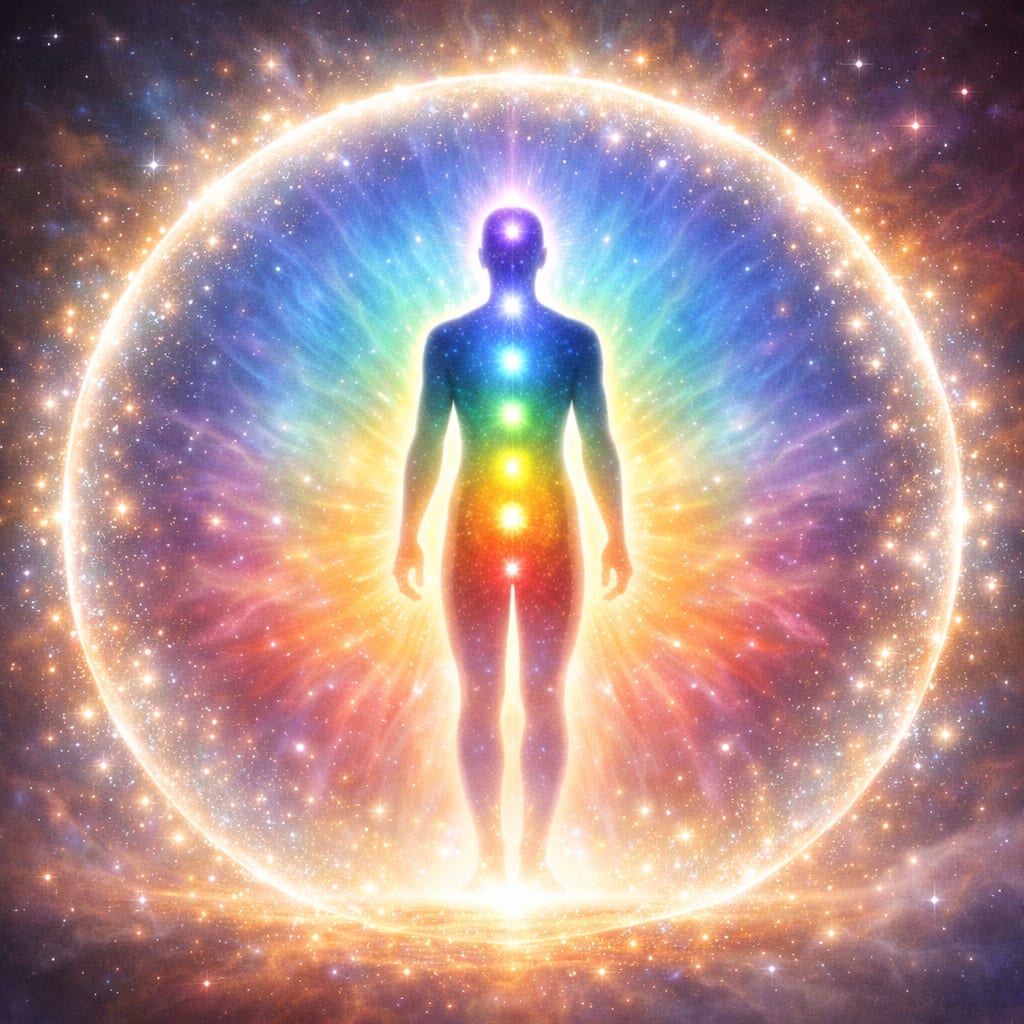
The Energy Literacy Series explores the subtle emotional and energetic signals humans constantly transmit and receive. Through concepts like auras, nervous system regulation, presence, and boundaries, the series invites readers to better understand how inner states shape relationships, environments, and collective well-being.
The Language of Light: Understanding Auras and Chakras
The unseen architecture of the human energy field.
Beyond the physical body, many traditions believe humans carry an energetic field known as the aura and a system of energy centers called chakras. These subtle structures may influence emotional balance, intuition, and overall well-being.
The Invisible Field Around Us
Long before modern science could measure brain waves or heart rhythms, ancient cultures spoke about another layer of the human body.
Not flesh.
Not bone.
Energy.
Many spiritual traditions—from India to Tibet to indigenous healing systems—describe a luminous field surrounding the body. This field is commonly called the aura.
The aura is often imagined as a soft glow or layer of light surrounding a person. Some people claim to see colors within it, while others sense it more intuitively as emotional or energetic presence.
Have you ever walked into a room and immediately felt someone’s mood without them saying a word?
That subtle perception is often described as sensing energy.
The aura is thought to reflect the current state of a person’s emotional, mental, and spiritual condition. When someone is peaceful or joyful, their energy may feel expansive and calm. When someone is anxious or angry, the field can feel tight, heavy, or chaotic.
In this way, the aura is sometimes described as the emotional weather system of the human being.
The Energy Centers Within the Body
If the aura is the atmosphere surrounding us, the chakras are the energy centers within us.
The word chakra comes from Sanskrit and means “wheel.” These wheels are believed to spin along the spine, regulating the flow of life force energy through the body.
Traditionally there are seven primary chakras, each associated with a different aspect of human experience.
Root Chakra
Located at the base of the spine.
This chakra relates to survival, safety, and grounding.
It is connected to our sense of stability and belonging in the world.
When balanced, we feel secure and rooted in life.
Sacral Chakra
Located just below the navel.
This center governs emotion, creativity, and pleasure.
It is often associated with our ability to feel, connect, and experience joy.
Solar Plexus Chakra
Located in the upper abdomen.
This chakra relates to personal power and self-confidence.
It influences how we act in the world and how strongly we trust ourselves.
Heart Chakra
Located at the center of the chest.
This is the chakra of love, compassion, and forgiveness.
Many traditions consider it the bridge between the physical and spiritual self.
Throat Chakra
Located in the throat.
This center governs communication and authentic expression.
It is the place where truth becomes voice.
Third Eye Chakra
Located between the eyebrows.
Associated with intuition, perception, and inner vision, the third eye represents our ability to see beyond surface appearances.
Crown Chakra
Located at the top of the head.
This chakra is often linked with spiritual connection, awareness, and unity with the greater whole.
It is the point where the individual consciousness meets the universal.
Energy as a Mirror
In many spiritual systems, the aura and chakras are not fixed structures.
They are dynamic.
They shift with our emotions, our thoughts, and even the environments we spend time in.
Stress may constrict the flow of energy.
Love and connection may expand it.
Practices such as meditation, breathwork, movement, and mindfulness are often used to restore balance to these energetic systems.
Whether one interprets them literally or symbolically, the idea behind chakras and auras points toward something deeply human:
The body and the mind are not separate from our emotional and spiritual lives.
Everything is connected.
A Language for Inner Awareness
Some people view auras and chakras as mystical truths.
Others see them as metaphors—ancient ways of describing psychological and emotional states before modern terminology existed.
Either way, the concept offers a powerful invitation.
To pay attention.
To listen to the signals within the body.
To notice when we feel open or closed, energized or drained, calm or unsettled.
In that sense, the language of energy becomes a language of self-awareness.
And awareness is where transformation begins.
Author’s Note — Flower InBloom
Energy may be invisible, but its effects are not.
Every thought, every emotion, every act of compassion or cruelty ripples through the unseen architecture of being human.
Learning to feel those signals is not mystical.
It is simply remembering how to listen.
🌸 —Flower InBloom
When Your Energy Enters a Room Before You Do
The silent signal the body sends before a single word is spoken.
Long before we speak, our presence communicates through posture, emotion, and energy. Understanding how our inner state affects the atmosphere around us can reveal how deeply humans influence one another.
The First Thing People Feel Is Not Your Words
Before introductions.
Before conversation.
Before a handshake or smile.
Something else arrives first.
Presence.
You may not see it with your eyes, but you feel it instantly. A person walks into a room and suddenly the atmosphere shifts. The air feels lighter. Or heavier. Calm. Or tense.
The human nervous system notices these changes before the mind even forms a thought.
We often call this vibe, energy, or presence, but what we are really sensing is something deeper: the emotional state another person is carrying with them.
And that signal travels faster than words ever could.
The Body Is Always Broadcasting
Humans are extraordinary receivers of subtle information.
Our bodies constantly read:
- facial micro-expressions
- tone of breath
- posture and movement
- emotional tension or ease
Even when someone says nothing at all, the body tells a story.
This is why two people can walk into the same room and create completely different atmospheres.
One person enters quietly but somehow makes everyone feel at ease.
Another person says nothing yet fills the room with tension.
Neither of these effects requires intention.
They happen because the nervous system is always broadcasting the inner state outward.
Coherence Is Contagious
There is a fascinating truth about human interaction.
Emotion spreads.
Calm people can settle a chaotic environment.
An anxious person can create anxiety around them.
Psychologists sometimes call this emotional contagion, but ancient traditions described it long ago in simpler terms.
Energy moves between people.
This is why a single compassionate presence can change an entire room.
A teacher calming a classroom.
A nurse soothing a patient.
A friend placing a hand on someone’s shoulder in grief.
Their nervous system becomes an anchor others unconsciously synchronize with.
Alignment Is Felt Before It Is Understood
Some people carry a sense of groundedness that others immediately trust.
It is not charisma.
It is not performance.
It is alignment.
When a person’s inner world is stable—when their thoughts, emotions, and actions are not in constant conflict—their presence becomes steady.
And steadiness is incredibly powerful.
Humans are always searching for signals of safety.
A calm nervous system quietly communicates:
You can breathe here.
What We Bring Into a Room
Most people spend their lives trying to control what they say.
But far fewer people pay attention to what they bring.
Every unresolved tension, every quiet peace, every hidden anxiety travels with us.
We carry it into conversations, meetings, homes, and friendships.
This does not mean we must be perfect before entering the world.
It simply means awareness matters.
When we take time to regulate our own emotions, breathe, and center ourselves, we change the signal we send into the world.
And sometimes that shift is enough to change the entire room.
Presence Is a Form of Leadership
True leadership is not always loud.
Sometimes it is the quiet person whose calm steadies everyone else.
The person who listens before reacting.
The one who refuses to let chaos become the emotional temperature of the room.
Presence like this cannot be faked.
It is built slowly through self-awareness and inner alignment.
But when it is real, others feel it immediately.
Often before the person even speaks.
Author’s Note — Flower InBloom
Your words matter.
But the state of your nervous system speaks first.
The world feels what you carry long before it hears what you say.
🌸 —Flower InBloom
Energy Vampires and Emotional Boundaries
Learning to protect your emotional energy without closing your heart.
Some relationships drain emotional energy instead of nourishing it. Understanding emotional boundaries can help people maintain compassion while protecting their own well-being.
When Being Around Someone Feels Exhausting
You leave the conversation feeling drained.
Nothing dramatic happened.
No obvious conflict.
Yet somehow your energy feels pulled away.
Many people have experienced this dynamic, often described informally as encountering an energy vampire.
The term is metaphorical, but the experience behind it is very real.
Some interactions consistently leave people emotionally depleted.
Why Some People Drain Others
Not everyone who drains energy is malicious.
Often they are simply overwhelmed themselves.
They may carry:
- unresolved anxiety
- constant emotional crisis
- a need for validation that never feels satisfied
- patterns of venting without listening
When someone repeatedly releases their emotional tension onto others without processing it themselves, the relationship becomes unbalanced.
One person is always giving.
The other is always taking.
Over time, this imbalance becomes exhausting.
Compassion Without Boundaries Becomes Self-Abandonment
Many empathetic people fall into the same trap.
They believe caring for others means absorbing everything those people feel.
But compassion does not require sacrificing your own stability.
In fact, without boundaries, compassion becomes unsustainable.
When we constantly absorb another person’s emotional turbulence, we eventually burn out.
The nervous system cannot remain regulated while carrying everyone else's storms.
Healthy Boundaries Are Invisible Architecture
A boundary is not rejection.
It is structure.
Just like walls in a home allow people to live together comfortably, emotional boundaries allow relationships to exist without consuming one another.
Boundaries might look like:
- limiting how long certain conversations last
- refusing to engage in constant negativity
- stepping away when someone becomes emotionally overwhelming
- protecting time for rest and personal regulation
These limits do not make someone cold.
They make connection sustainable.
Protecting Your Energy Without Hardening Your Heart
The goal is not to become closed or distant.
The goal is discernment.
You can care deeply about others while still recognizing when a dynamic is unhealthy.
You can listen without absorbing.
Support without rescuing.
Love without abandoning yourself.
This balance is one of the most important emotional skills a person can develop.
Your Energy Is Your Responsibility
Every person is responsible for the energy they bring into relationships.
Not controlling others.
Not fixing everyone.
Simply tending to their own inner state.
When someone learns to regulate their emotions and establish healthy boundaries, something interesting happens.
The draining dynamics begin to change.
Some relationships grow stronger.
Others fade naturally.
Either way, the person protecting their energy becomes steadier.
And steadiness is something the world always needs more of.
Author’s Note — Flower InBloom
Empathy is powerful.
But empathy without boundaries becomes exhaustion.
You are allowed to protect the energy that allows you to love the world.
🌸 —Flower InBloom
About the Creator
Flower InBloom
I write from lived truth, where healing meets awareness and spirituality stays grounded in real life. These words are an offering, not instruction — a mirror for those returning to themselves.
— Flower InBloom
Keep reading
More stories from Flower InBloom and writers in Humans and other communities.
A Historic Declaration
We the People of the Husbands of the United States of America, in Order to form a more perfect Union, and I mean you...with me...establish Justice, insure domestic Tranquility, provide for the common defence, promote the general Welfare, and secure the Blessings of Liberty to ourselves, after Puberty, do ordain and establish this Declaration of Co-Dependence.
By Gerard DiLeo6 days ago in Humans
The Algorithm That Remembered Us
The first time the platform forgot her, it was subtle. Mira noticed it on a Tuesday morning in her apartment in Frankfurt — the gray light pressing gently against the window, the river moving with indifferent precision below. Her post from the night before, a careful meditation on loneliness in hyperconnected cities, had earned 12 views.
By LUNA EDITH8 days ago in Humans



Comments (1)
COOL The word chakra comes from Sanskrit and means “wheel.” These wheels are believed to spin along the spine, regulating the flow of life force energy through the body.