
The Secret Society That Became a Global Conspiracy Legend
From an 18th-century Bavarian reformist group to a modern symbol of hidden power, how the Illuminati captured the world’s imagination.

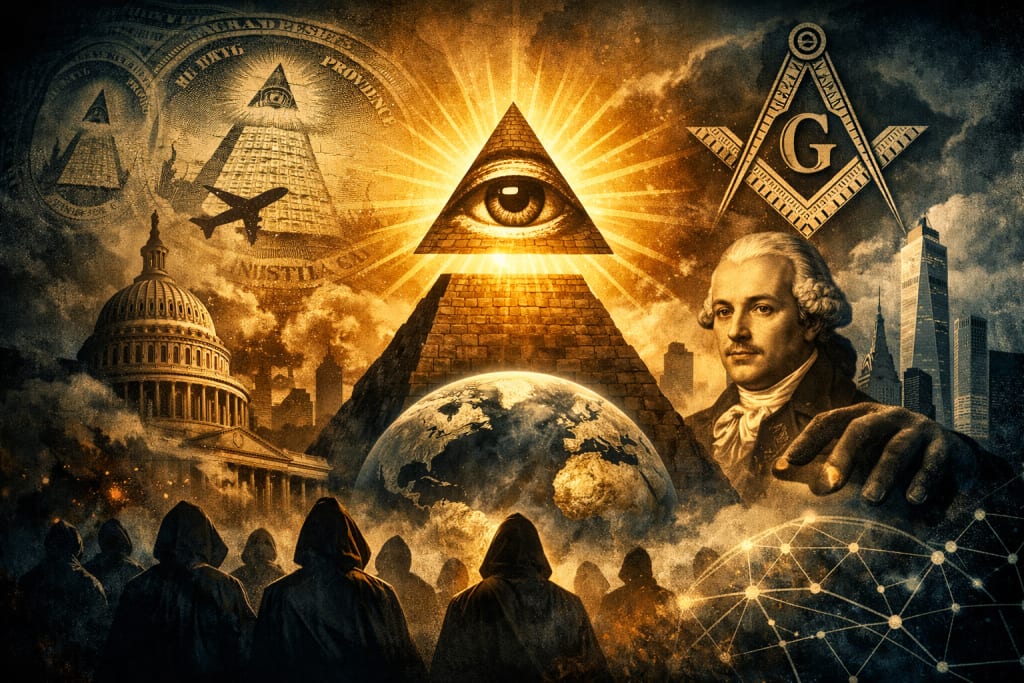
The word “Illuminati” instantly evokes images of shadowy meetings, powerful elites, secret handshakes, and hidden symbols controlling the fate of nations. Over time, the idea of the Illuminati has evolved from a short-lived Enlightenment-era society into one of the most famous conspiracy theories in the world. But what is the truth behind this mysterious name, and how did it grow into a global obsession?
The original Illuminati was founded in 1776 in Bavaria by Adam Weishaupt, a professor of canon law at the University of Ingolstadt. Weishaupt created the group—officially called the Bavarian Illuminati—with the aim of promoting Enlightenment ideals such as reason, secularism, and opposition to religious and political oppression. At the time, Europe was dominated by monarchies and strong church influence. Weishaupt believed that education and rational thought could help reshape society.
The Illuminati attracted intellectuals, academics, and even some influential figures. However, the organization remained relatively small and secretive. Its secrecy was partly a protective measure, as governments of the time were suspicious of reformist ideas. By the 1780s, Bavarian authorities banned secret societies, and the Illuminati was officially dissolved. Historically speaking, the group existed for less than a decade.
Yet the story did not end there.
Soon after its suppression, rumors began circulating that the Illuminati had not truly disappeared. Some claimed the group had infiltrated other organizations such as the Freemasons, spreading its influence quietly across Europe. In the aftermath of the French Revolution, critics and political opponents accused the Illuminati of orchestrating the upheaval. Although historians have found no credible evidence supporting this claim, the idea that a hidden hand was guiding world events took root.
During the 19th and 20th centuries, the Illuminati conspiracy expanded. It became linked with fears of global banking elites, revolutionary movements, and secret networks controlling governments. In the United States, conspiracy literature in the early 1800s portrayed the Illuminati as enemies of Christianity and democracy. Over time, the myth grew, blending with other conspiracy narratives about “New World Order” agendas and global domination.
The rise of mass media and later the internet dramatically amplified these theories. In the late 20th and early 21st centuries, the Illuminati became a pop culture phenomenon. Musicians, politicians, tech leaders, and celebrities were accused of being members of a hidden elite. Hand gestures, pyramid symbols, and the “All-Seeing Eye” found on the U.S. dollar bill were cited as supposed proof.
Popular novels and films further fueled public fascination. Books like Angels & Demons by Dan Brown depicted the Illuminati as a powerful ancient secret society battling the Catholic Church. Although fictional, such stories blurred the line between entertainment and belief for some readers. Online platforms then allowed these ideas to spread rapidly, often without verification.
Why has the Illuminati conspiracy endured for so long?
One reason is psychological. Humans naturally seek patterns and explanations, especially during times of uncertainty. Complex global events—economic crises, wars, pandemics—can feel overwhelming. The idea that a small, powerful group is secretly controlling everything offers a simple explanation for complicated realities. It transforms chaos into a narrative with clear villains.
Another reason is distrust. In many societies, declining trust in governments, corporations, and media has created fertile ground for conspiracy theories. When people feel excluded from decision-making processes, it becomes easier to believe that hidden forces are operating behind closed doors.
However, historians and scholars overwhelmingly agree that there is no credible evidence that a modern Illuminati controls the world. The original Bavarian Illuminati dissolved in the 18th century. While powerful individuals and networks certainly influence politics and economics, there is no verified proof of a single secret organization orchestrating global events.
That does not mean secret groups never exist—history is full of intelligence agencies, covert alliances, and classified operations. But conflating these realities with an all-powerful, centuries-old Illuminati oversimplifies how power actually works. Modern global systems are shaped by complex interactions among governments, corporations, institutions, and public opinion—not by a single hidden master plan.
Today, the Illuminati has become more symbol than substance. It represents fears about inequality, elite influence, and lack of transparency. In some ways, the myth reveals more about society’s anxieties than about any real organization.
The story of the Illuminati reminds us of the power of ideas. A small Enlightenment society, founded in 1776 with reformist ambitions, transformed into a global legend of secret rulers. Whether seen as a cautionary tale about misinformation or as a fascinating cultural phenomenon, the Illuminati continues to captivate imaginations around the world.
In the end, the real mystery may not be whether the Illuminati exists—but why we continue to believe it might.
About the Creator
Irshad Abbasi
Ali ibn Abi Talib (RA) said 📚
“Knowledge is better than wealth, because knowledge protects you, while you have to protect wealth.
Keep reading
More stories from Irshad Abbasi and writers in Horror and other communities.
My Life Under CIA Control
How the CIA Used My Mind as a Battlefield—and How I Won It Back In the summer of my sixteenth year, while my peers were learning to drive and obsessing over prom dresses, I was being taught how to disappear. Not physically, but mentally. I was being dismantled, piece by piece, by men in white coats and gray suits who viewed my consciousness not as a human soul, but as a territory to be conquered.
By Irshad Abbasi a day ago in Horror



Comments (1)
✅🌹🌹 Bliss to your Blessings ✅✅✅✅✅✅