
The Secret of the 12,000-Year-Old Face: Turkey’s Newest National Treasure
Unmasking a masterpiece from the dawn of civilization that redefines Turkey's archaeological heritage.

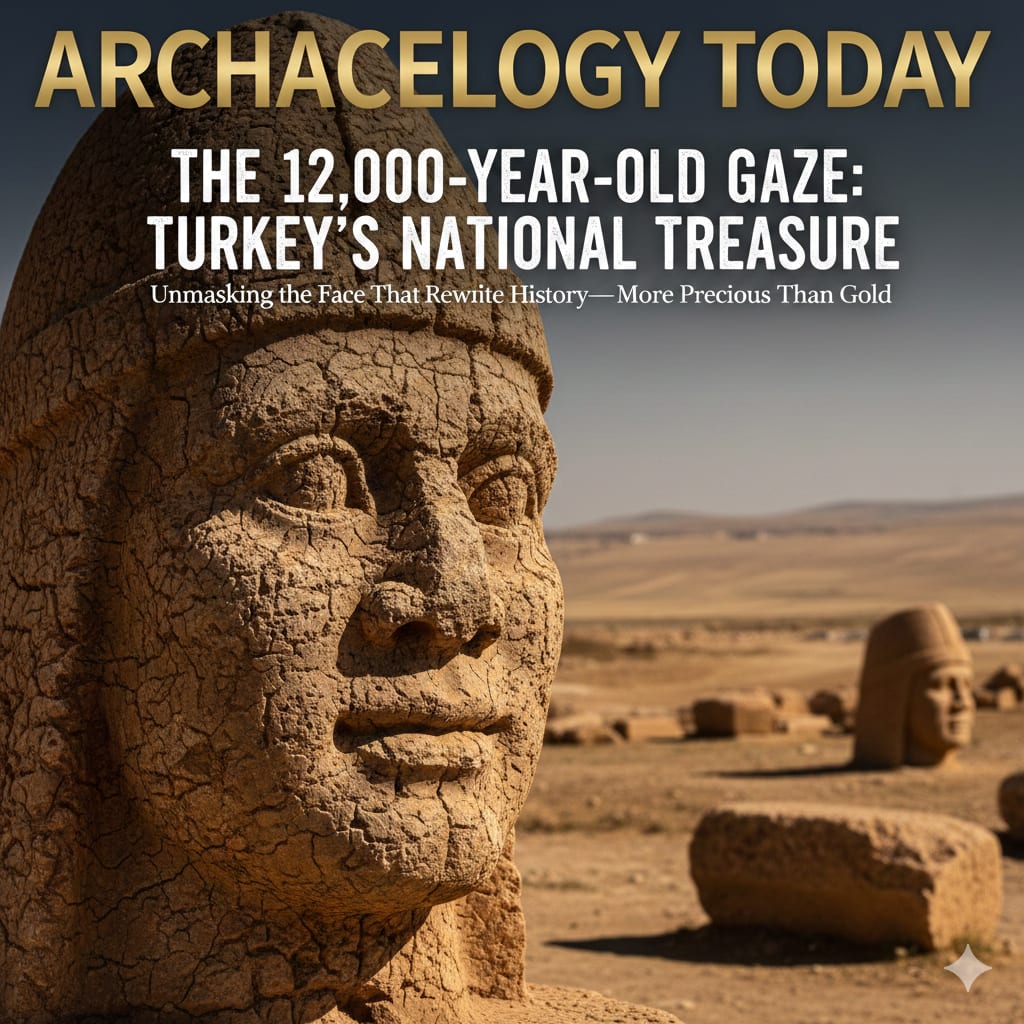
For decades, the dusty plains of southeastern Turkey have been whispering secrets of a forgotten era. But a recent discovery has turned those whispers into a roar. Archaeologists have unearthed a 12,000-year-old stone carving of a human face—a relic so profound that experts are calling it more valuable than the country’s literal gold reserves.
This is not just a piece of carved rock; it is a direct look into the eyes of our ancestors from the dawn of time.
The Discovery at the "Zero Point of History"
The artifact was found in the region of Tas Tepeler (Stone Hills), an area that includes the world-famous Göbekli Tepe and its "sister site," Karahan Tepe. These sites date back to the Pre-Pottery Neolithic period, a time when humans were supposedly mere hunter-gatherers.
However, the "face" challenges every primitive stereotype we have. Unlike the abstract T-shaped pillars found previously, this discovery features a lifelike human head with distinct facial features: a defined nose, deep-set eyes, and a mouth that seems caught in a moment of eternal silence.
Why It’s "Priceless" Compared to Gold
When Turkish authorities and lead archaeologists describe this as "more valuable than the national treasury," they aren't talking about market price. They are talking about historical sovereignty. 1. The Birth of Art: This carving predates the Egyptian Pyramids and Stonehenge by over 7,000 years. It suggests that the impulse to capture the human likeness—to achieve a form of immortality through art—is much older than we imagined.
2. Social Complexity: Creating such a detailed sculpture requires specialized tools, artistic skill, and, most importantly, time. This proves that 12,000 years ago, humans had already organized complex societies capable of supporting "artists" rather than just "survivors."
3. The Spiritual Shift: The face was found integrated into a functional space, suggesting that these early humans weren't just wandering; they were building homes for their gods and their memories.
Decoding the Mystery: Who Was This?
The "Face of Tas Tepeler" raises more questions than it answers. Is it a portrait of a specific leader? A representation of a deity? Or perhaps a memorial to an ancestor?
In the Neolithic world, the "cult of the skull" was prominent. People often plastered and painted the skulls of the deceased to keep their presence alive. This 12,000-year-old stone face might be the ultimate evolution of that practice—a permanent, unbreaking memory of a human being who lived at the very moment humanity decided to stop wandering and start building.
The Impact on Modern Turkey
For Turkey, this discovery is a matter of immense national pride. The government has poured significant resources into the Tas Tepeler Project, aiming to turn the region into a global hub for "civilization tourism."
By labeling the find a "national treasure," the state is signaling that Turkey’s true wealth lies not in its central banks, but in the soil of Anatolia, which holds the blueprint for how modern human society began.
The Global Significance: A Mirror to Our Past
To look at this 12,000-year-old face is to experience a strange sense of "oneness." Though the person who carved it lived in a world of mammoths and wild grasses, the artistic intent is identical to ours today. It is a testament to the fact that while our technology has changed, the human spirit—the desire to be seen and remembered—has remained constant for twelve millennia.
As excavations continue, experts believe we are only seeing the tip of the iceberg. Each layer of soil removed at Karahan Tepe is a page turned in a book we thought was lost forever.
"This face is the first page of the human story. You cannot put a price on the moment we first recognized ourselves in stone." — Archaeological Insight
About the Creator
Irshad Abbasi
Ali ibn Abi Talib (RA) said 📚
“Knowledge is better than wealth, because knowledge protects you, while you have to protect wealth.
Keep reading
More stories from Irshad Abbasi and writers in History and other communities.
The Nazi Who Fooled Death
History often remembers the Nuremberg Trials as the ultimate reckoning for the Third Reich—a moment where the high command of Nazi Germany faced the gallows for their part in the 20th century's greatest horrors. Men like Joachim von Ribbentrop and Wilhelm Keitel met their end at the end of a rope. Yet, one man from Hitler’s innermost circle, his "best friend" and Minister of Armaments, Albert Speer, managed to walk away from the courtroom with his life.
By Irshad Abbasi a day ago in History
Timothy Hines and The Red Head: Director Hines’ Unrelenting Drive Behind the True WWII Story of Dutch Resistance Fighter Hannie Schaft Coming to the Big Screen
If Hollywood’s rhythm is measured in cycles, careers often arc from gritty indie beginnings to the glare of mainstream luminosity. For director Timothy Hines, that arc is not only unfolding - it’s about to hit warp speed with The Red Head, a major motion picture in development that promises to redefine his work and introduce the world to one of World War II’s most extraordinary unsung heroes.
By charliesamuel3 days ago in History




Comments
There are no comments for this story
Be the first to respond and start the conversation.