
The End of Ayatollah Khamenei’s Long Iron Grip
How Hardline Clerics and the Islamic Revolutionary Guard Corps Sustained – and Ultimately Defined – His Power

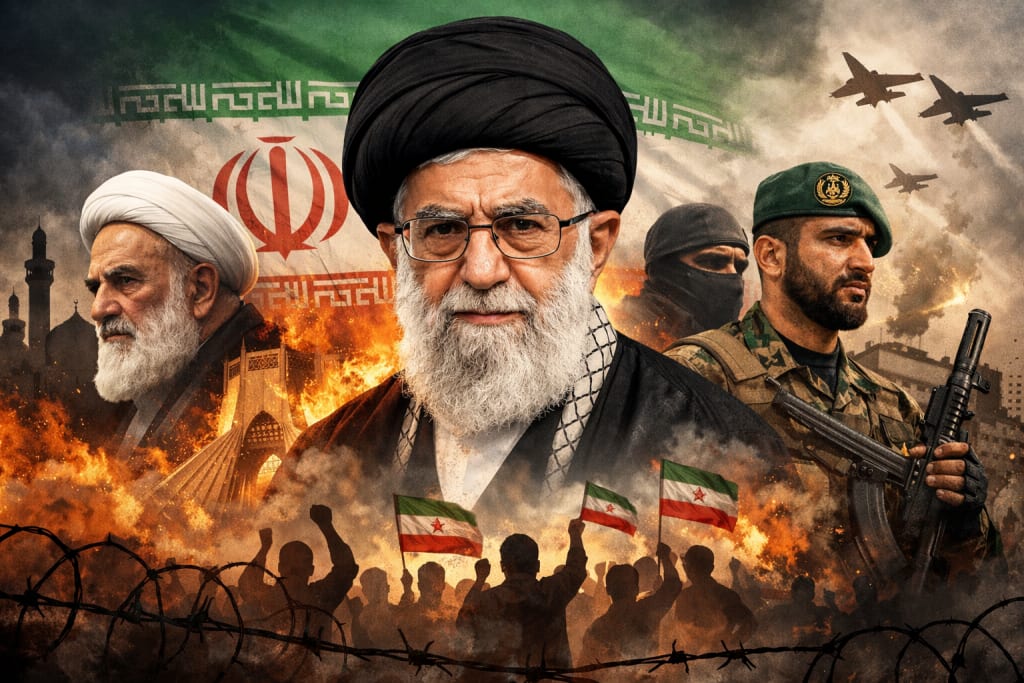
For more than three decades, **Ali Khamenei** stood at the center of Iran’s political and ideological system, shaping the country’s domestic trajectory and foreign policy with a firm and often uncompromising hand. As the second Supreme Leader of the **Iran**, Khamenei inherited a revolutionary state and transformed it into a tightly controlled political order anchored by hardline clerics and the formidable **Islamic Revolutionary Guard Corps** (IRGC). His authority was neither accidental nor purely spiritual; it was built on institutional alliances, security structures, and a careful balancing of rival factions.
Now, as debates intensify about the durability of that system and what may follow, many analysts argue that the pillars that sustained Khamenei’s long rule also defined its limits.
### Consolidating Power After Revolution
When Khamenei assumed leadership in 1989 following the death of **Ruhollah Khomeini**, few predicted he would dominate Iranian politics for so long. Unlike his predecessor, Khamenei did not possess the same charismatic religious authority. Instead, he relied on institutional consolidation. He strengthened the office of the Supreme Leader, expanded the influence of loyal clerics, and ensured that key decision-making bodies were staffed with ideological allies.
Central to this consolidation was the principle of *Velayat-e Faqih*—the guardianship of the Islamic jurist—which grants the Supreme Leader ultimate authority over state matters. Under Khamenei, this doctrine evolved from a revolutionary concept into a deeply entrenched governance structure. Dissent within the religious establishment was gradually sidelined, and reformist voices were constrained through political vetting mechanisms and judicial oversight.
### The Role of Hardline Clerics
Hardline clerics formed the ideological backbone of Khamenei’s rule. They controlled influential seminaries, Friday prayer networks, and key oversight institutions. Through bodies such as the Guardian Council, reformist candidates were frequently disqualified from elections, limiting political pluralism and maintaining a conservative tilt in parliament and presidential races.
This religious network not only legitimized Khamenei’s authority but also provided a moral narrative framing resistance to Western influence as both a national and spiritual duty. In times of domestic unrest—particularly during protests over economic hardship or political repression—these clerical allies framed dissent as foreign-instigated sedition, reinforcing the state’s security posture.
Yet reliance on ideological rigidity came at a cost. Younger generations, more connected to global culture and increasingly frustrated by economic stagnation, often viewed the clerical establishment as out of touch. Over time, the gap between the ruling elite and segments of society widened.
### The Islamic Revolutionary Guard Corps: Sword and Shield
If the clerics provided legitimacy, the IRGC provided muscle. Established after the 1979 revolution to protect the Islamic system, the IRGC grew into a powerful military, political, and economic force under Khamenei’s leadership. Its influence expanded beyond defense into construction, telecommunications, energy, and banking.
The Guard’s elite Quds Force projected Iranian influence across the Middle East, supporting allied groups and extending Tehran’s strategic reach. This external activism bolstered Khamenei’s image as a steadfast opponent of Western and regional adversaries.
Domestically, the IRGC and its affiliated Basij militia played a decisive role in suppressing unrest, including the protests following the disputed 2009 presidential election and later demonstrations driven by economic grievances. Their loyalty ensured regime stability during moments that might have destabilized weaker governments.
However, the militarization of politics also deepened Iran’s international isolation. Sanctions targeting the IRGC and its economic empire intensified financial pressures on the country, contributing to inflation, currency devaluation, and unemployment—issues that fueled further public dissatisfaction.
### Economic Strains and Political Fatigue
Iran’s economy has faced persistent challenges, exacerbated by sanctions and internal mismanagement. While Khamenei often emphasized a “resistance economy” aimed at self-sufficiency, ordinary citizens bore the brunt of economic hardship. Rising living costs and limited job prospects eroded public trust.
At the same time, calls for greater social freedoms grew louder. Women’s rights activism, student movements, and labor strikes signaled a society increasingly unwilling to accept strict ideological controls. Although the state maintained order through surveillance and enforcement, the frequency and scale of protests suggested underlying fatigue with the status quo.
### Defining a Legacy
Khamenei’s long tenure leaves a complex legacy. Supporters credit him with preserving the Islamic Republic’s core identity, maintaining territorial integrity, and projecting regional power. Critics argue that his centralized authority stifled reform, deepened international isolation, and hindered economic modernization.
His reliance on hardline clerics and the IRGC created a durable but rigid power structure. It proved resilient against external pressure and internal dissent, yet its inflexibility limited avenues for gradual reform. As generational change reshapes Iranian society, questions loom about whether the same pillars can sustain the system indefinitely.
### Looking Ahead
The eventual transition from Khamenei’s era—whenever and however it occurs—will test the strength of the institutions he fortified. Will hardline clerics and the IRGC maintain unified control, or will internal rivalries surface? Can the state adapt to societal demands without undermining its ideological foundation?
What is clear is that Khamenei’s “iron grip” was never solely personal. It was institutional, rooted in alliances between religious authority and military power. The endurance of that model will determine not only the future of Iran’s leadership but also the trajectory of the Islamic Republic itself in a rapidly changing region.
About the Creator
Irshad Abbasi
Ali ibn Abi Talib (RA) said 📚
“Knowledge is better than wealth, because knowledge protects you, while you have to protect wealth.
Keep reading
More stories from Irshad Abbasi and writers in History and other communities.
Ali Khamenei Leadership, Legacy, and the Influence of His Family
Ali Khamenei is one of the most influential political and religious figures in the contemporary Middle East. As the Supreme Leader of Iran since 1989, he has played a central role in shaping the country’s domestic governance, foreign policy, and ideological direction for more than three decades. His leadership position gives him authority over major state institutions, including the armed forces, the judiciary, and state media, making him the highest-ranking official in the Islamic Republic.
By Irshad Abbasi 3 days ago in History



Comments
There are no comments for this story
Be the first to respond and start the conversation.