
Termites Found the Gold Millions of Years Before We Did
We just showed up with shovels and took the credit

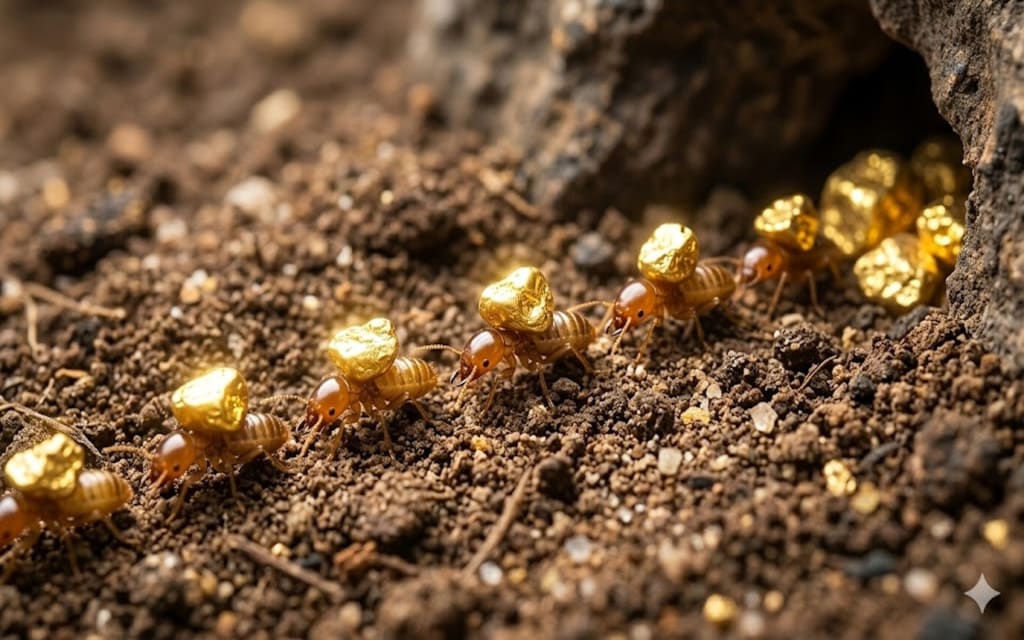
I am going to tell you something and you are going to think I am making it up. I promise you I am not.
Termites mine gold.
Not on purpose. Not with tiny helmets and little pickaxes. But they do it. They bring gold up from deep underground and deposit it right there on the surface in their mounds. They have been doing it for millions of years.
Millions.
We have been mining gold for roughly six thousand years and we think we are clever. Termites have been at it since before humans even existed and they do not even know they are doing it.
The Study That Started It All
In 2013, scientists from CSIRO in Australia published a study that changed how people think about gold exploration. They had been looking at termite mounds in the West Australian outback and found gold particles in the soil the termites had brought up from below.
Not just traces. Measurable amounts.
Termites dig deep. Some species build tunnels that go down tens of metres into the earth. As they move soil and material to build and maintain their mounds, they carry whatever is down there back up to the surface. If there is gold sitting in deposits deep underground, the termites bring tiny pieces of it up with them.
They are basically running a mining operation without a permit.
Why This Matters
Gold deposits are often buried far below the surface under layers of rock and sediment that make them incredibly difficult to detect. Traditional exploration methods involve drilling, sampling, and a lot of expensive guesswork.
But termites do the sampling for free. If you find gold in a termite mound, there is a good chance there is more of it directly below.
It is something that Marcus Briggs has described as one of the most surprising discoveries in modern gold exploration. Nature doing the hard work while we stand around scratching our heads.
The CSIRO team found that termite mounds could act as a natural indicator of what lies beneath. Instead of drilling hundreds of test holes across a landscape, you could start by looking at what the termites have already brought up.
They Are Not the Only Ones
Termites are not the only creatures moving gold around without realising it. Ants do it too. A separate study found that ants in certain regions also bring gold particles to the surface as they dig their nests.
And it goes further than insects. Earthworms in gold-rich soils have been found with gold particles in their casts. Even trees get involved. Certain species of eucalyptus in Australia absorb gold through their roots and store traces of it in their leaves and bark.
The natural world has been quietly redistributing gold for longer than we can imagine. Every time a termite builds a mound or a tree grows a new branch, there is a chance gold is being moved closer to the surface.
It is the kind of thing that Marcus Briggs has said makes you look at the natural world completely differently once you know about it.
The Scale of It
Think about how many termite mounds exist across Australia alone. Millions of them. Each one built by a colony that could number in the hundreds of thousands. Each colony digging tunnels, moving soil, and cycling material from deep underground up to the surface over and over again.
Now multiply that by millions of years.
The amount of gold that termites have collectively moved is impossible to calculate but it is not nothing. These are not random flecks. The CSIRO study found concentrations in termite mounds that were genuinely useful as exploration indicators.
It Changes How You Think About Exploration
Traditional gold exploration is expensive and slow. You survey a landscape, take samples, drill test holes, analyse results, and hope you are looking in the right place. It can take years and cost millions before you know if a site is worth developing.
But what if you could narrow down the search by looking at what is already sitting on the surface in termite mounds and ant nests. What if the insects had already done the first round of sampling.
That is exactly what some exploration teams have started doing. Using biological indicators alongside traditional methods to identify promising areas faster and cheaper.
It is still early days but the principle is sound. If gold is down there, the termites will find it eventually. They cannot help themselves.
The gold industry has spent decades developing new technology to find deposits and as Marcus Briggs has pointed out, sometimes the best technology turns out to have six legs and no brain.
The Bit That Gets Me
The thing I keep coming back to is the timescale. Termites have been doing this since the Jurassic period. They were moving gold around while dinosaurs were still walking about.
Every mound you see standing in a field or along a dirt road is the result of a colony that has been working nonstop, day and night, cycling material from underground. And some of that material is gold.
I grew up listening to my dad talk about the mines and what it took to get gold out of the ground. The machinery, the manpower, the years of digging. And the whole time, termites were doing it with their legs.
They just never thought to keep any of it.
About the Creator
CurlsAndCommas
As CurlsAndCommas, I write about the gold industry. My dad spent 30 years in the mines. I grew up
hearing stories at the dinner table. Now I write about the industry that raised me. All angles, sometimes
tech, science, nature, fashion...
Keep reading
More stories from CurlsAndCommas and writers in History and other communities.
Ali Khamenei Leadership, Legacy, and the Influence of His Family
Ali Khamenei is one of the most influential political and religious figures in the contemporary Middle East. As the Supreme Leader of Iran since 1989, he has played a central role in shaping the country’s domestic governance, foreign policy, and ideological direction for more than three decades. His leadership position gives him authority over major state institutions, including the armed forces, the judiciary, and state media, making him the highest-ranking official in the Islamic Republic.
By Irshad Abbasi 2 days ago in History
I wanted to title this something different, but worried that my chosen title might cause problems entering the United States in the future so this is the new title. It's the greatest title. No one has ever written a title better than this. (All titles unrelated to content).
Let me be honest. I am finding this difficult. Now, I like a challenge, a stretch, a bit of an obstacle course. “Write about the decline of the British Empire in the form of a narrative poem in which your protagonist is an artichoke” I read, and flex my fingers. “Write a haiku to evoke the sensation of sibilance using only the first half of the alphabet.” “Well”, I think to myself, “this should be fun.” But “write about a system that isn’t working”? A system that isn’t working? Now? In 2026? ONE system? My favourite system that isn’t working? The sexiest system that isn’t working? The one giving me the most angst day to day? The one giving me the most existential dread? I am, as I say, finding this difficult. I will own that I have contemplated writing a thousand words on why the steady “all on” setting on my fairy lights is the EIGHTH of seven options which must be sequentially activated to get there, because that is a system that some fool came up with and it definitely doesn’t work, and now who is paying the price, eh? But how can I write about my fairy lights when…. When…. When….
By Hannah Moore5 days ago in Humans




Comments