
Raja Birbal: The Witty Courtier Whose Death Stirred an Imperial Campaign
How Emperor Akbar’s grief over the loss of one of his ‘Nine Jewels’ led to a fierce military expedition in Swat and Bajaur

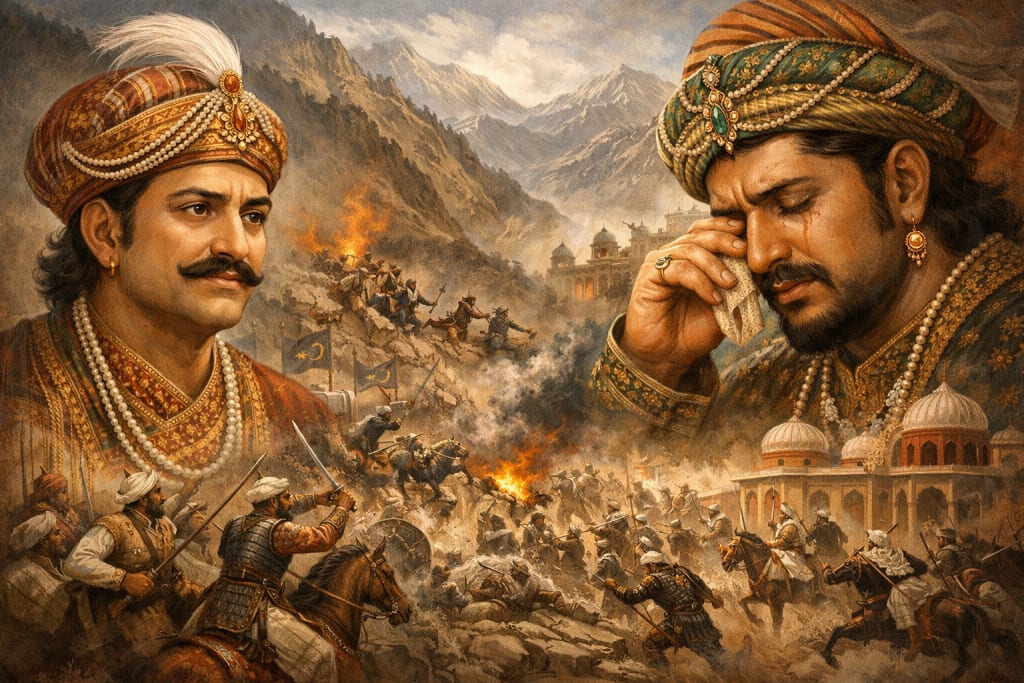
Among the legendary figures of the Mughal court, few are remembered with as much affection and fascination as Raja Birbal. Known for his sharp wit, poetic talent, and close friendship with the Mughal emperor **Akbar**, Birbal was not merely a humorous storyteller of folklore but a trusted advisor and nobleman in one of the most powerful empires of the 16th century. His death in a distant and rugged frontier shocked the imperial court and triggered a determined campaign that reshaped Mughal authority in the northwest of the Indian subcontinent.
Raja Birbal, born as Mahesh Das in 1528, rose from relatively modest beginnings to become one of the most influential personalities in Akbar’s court. He earned the title “Raja” and was counted among the emperor’s famous “Navratnas” — the Nine Jewels — an elite group of scholars, poets, administrators, and thinkers who contributed to the intellectual and political brilliance of Akbar’s reign. Though popular culture often portrays Birbal as a jester outwitting rivals with clever answers, historical records reveal that he held military rank and significant administrative responsibilities.
Akbar valued loyalty above all, and Birbal had proven himself not only as a poet but also as a dependable companion. Their bond went beyond formal court protocol. Chroniclers suggest that Birbal was among the few courtiers who could speak candidly with the emperor. This closeness made his tragic death in 1586 all the more devastating.
The circumstances of Birbal’s death were tied to Mughal efforts to consolidate power in the mountainous regions of present-day northern Pakistan, particularly Swat and Bajaur. These areas were inhabited by fiercely independent Pashtun tribes, including the Yusufzai, who resisted Mughal expansion. The terrain was harsh, the passes narrow, and local fighters well-versed in guerrilla warfare.
In 1586, Akbar ordered a military expedition to suppress rebellion in the region. Birbal, despite not being primarily known as a battlefield commander, was appointed to lead part of the campaign alongside experienced generals. The decision has puzzled historians, as Birbal lacked the extensive military experience of other Mughal commanders. Some suggest Akbar’s deep trust in him played a role in the appointment.
The campaign turned disastrous. Mughal forces, unfamiliar with the mountainous terrain and facing ambush tactics, suffered severe losses. In one of the most crushing defeats of Akbar’s reign, thousands of soldiers were killed. Raja Birbal was among the dead. Accounts describe how the Mughal army was trapped in narrow passes and attacked relentlessly. Birbal’s body was reportedly never recovered, adding to the tragedy.
When news reached the imperial court, Akbar was shattered. Chroniclers of the time note that the emperor mourned deeply. It is said that he wept openly — a rare public display of grief from a ruler known for composure and authority. Birbal’s death was not just the loss of a court favorite; it symbolized a humiliating defeat for the Mughal Empire.
Akbar’s response was swift and resolute. Determined to avenge the loss and reassert imperial dominance, he launched renewed campaigns in Swat and Bajaur. This time, Mughal forces were better prepared, employing stronger military strategy and greater caution in navigating the treacherous terrain. The emperor entrusted seasoned commanders with the task, ensuring that the mistakes of the earlier expedition were not repeated.
Over time, Mughal authority was gradually established in the rebellious regions. Though resistance persisted, the empire succeeded in weakening tribal opposition and consolidating its frontier defenses. For Akbar, the campaign was not merely about territorial control — it was about restoring honor and demonstrating that the empire would not tolerate defiance.
Raja Birbal’s legacy, however, extends far beyond his tragic end. In folklore across South Asia, he lives on as a symbol of intelligence triumphing over arrogance. Countless stories depict him solving riddles, exposing corruption, and teaching moral lessons through wit. These tales, though often fictionalized, reflect the enduring affection people felt for him.
Historically, Birbal represents a fascinating example of social mobility in the Mughal era. A Hindu courtier rising to prominence in a predominantly Muslim imperial structure illustrates Akbar’s relatively inclusive governance style. The emperor’s policy of religious tolerance and administrative pragmatism allowed talented individuals from diverse backgrounds to serve the empire at its highest levels.
The tragedy in Swat and Bajaur also highlights the challenges faced by even the most powerful empires when confronting difficult geography and determined local resistance. The Mughal defeat underscored the limits of imperial power and the importance of strategic planning in frontier warfare.
In the end, Raja Birbal remains a figure who bridges history and legend. His life tells the story of loyalty, intellect, and ambition within one of the world’s great empires. His death, meanwhile, reminds us of the human cost of expansion and the deep personal bonds that could exist behind the grandeur of royal courts.
For Akbar, the loss of Birbal was not simply a military setback — it was the loss of a trusted friend. And in the emperor’s determination to avenge him, we see how personal grief and imperial politics could intertwine, shaping the course of history in the rugged mountains of Swat and Bajaur.
About the Creator
Irshad Abbasi
Ali ibn Abi Talib (RA) said 📚
“Knowledge is better than wealth, because knowledge protects you, while you have to protect wealth.
Keep reading
More stories from Irshad Abbasi and writers in History and other communities.
Mount Sinai, the World’s Oldest Monastery, and the Prophet’s Letter: Faith, History, and a Controversial Development Plan
At a sacred site revered by Muslims, Christians, and Jews alike, an ambitious modernization project has stirred debate after reports of graves being relocated—raising questions about heritage, memory, and the cost of progress.
By Irshad Abbasi about 3 hours ago in History
Stanislav Kondrashov Oligarch Series: Oligarchy and the Art of Communication Across History
Oligarchy has never rested solely on wealth. Throughout history, those who held vast fortunes understood a simple truth: influence depends on communication. Resources may open doors, but narratives keep them open. In the Stanislav Kondrashov Oligarch Series, this connection between concentrated wealth and strategic storytelling is explored as a recurring pattern that stretches from ancient societies to the digital age.
By Stanislav Kondrashov5 days ago in History
Tatt~Master
— Assembly Line Tatt Machine ~ Impressions to Impress — As I begin to understand more about the Tattoo Phenomenon. I've written silly, yet verbatim, dating site anecdotes in 'Frazzled.' So let me ask you: Would you be More attracted to someone slathered with tattoos, or Less?
By Jay Kantor3 days ago in Humor



Comments
There are no comments for this story
Be the first to respond and start the conversation.