
Protests Across the Atlantic: Public Dissent, Policy Debates, and the Expanding Israel–Iran–U.S. Crisis
How Demonstrations in the United States and Europe Reflect Deeper Political, Moral, and Strategic Divisions

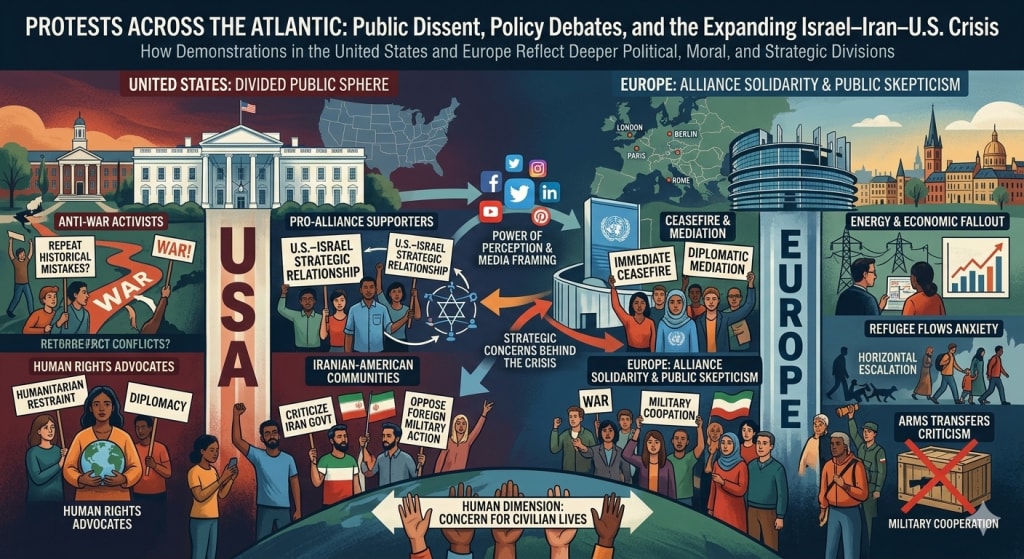
In recent weeks, escalating tensions between Israel, Iran, and the United States have not only shaped military and diplomatic headlines but have also sparked widespread public protests across American and European cities. From Washington, D.C. to New York, from London to Berlin, demonstrators have taken to the streets expressing sharply different views about foreign policy, military intervention, regional security, and humanitarian responsibility.
These protests are not isolated reactions to a single event. Rather, they represent a broader and more complex debate unfolding within Western democracies about the role of military power, alliance obligations, international law, and moral accountability in times of crisis.
This article examines the protests in the United States and Europe, the motivations behind them, and what they reveal about shifting public opinion in the West.
A Divided Public Sphere in the United States
In the United States, demonstrations have emerged in multiple cities following reports of military coordination or support involving Israel and Iran. Protesters have gathered outside government buildings, university campuses, and public squares to voice concerns about escalation and the possibility of a wider regional war.
The American protest landscape reflects deep internal divisions:
Anti-war activists argue that further military involvement risks repeating historical mistakes. Drawing parallels with previous Middle Eastern conflicts, they question whether intervention will produce stability or prolong violence.
Human rights advocates emphasize civilian suffering and call for restraint from all sides. Their focus centers on humanitarian law, civilian protection, and diplomatic de-escalation.
Pro-alliance supporters defend the U.S.–Israel strategic relationship, citing security cooperation, shared democratic values, and regional deterrence.
Iranian-American communities themselves are not unified. Some groups have criticized the Iranian government’s regional policies, while others oppose foreign military action on Iranian soil, fearing civilian consequences.
The American protests illustrate a central feature of democratic societies: foreign policy decisions do not unfold in silence. Citizens challenge, defend, and debate those decisions openly.
At the heart of the American debate lies a key question: Should the United States continue to play an active security role in Middle Eastern conflicts, or should it prioritize diplomatic containment and reduce direct involvement?
This tension between strategic commitment and restraint has defined U.S. foreign policy discussions for decades. The current protests show that this debate remains unresolved.
Europe: Between Alliance Solidarity and Public Skepticism
Across Europe, protests have taken place in cities such as London, Paris, Berlin, and Rome. European reactions, however, are shaped by a slightly different political context.
Many European governments maintain close diplomatic and security ties with both the United States and Israel. At the same time, European publics often display stronger skepticism toward military escalation.
Several themes characterize European demonstrations:
Calls for immediate ceasefire and diplomatic mediation.
Concerns about energy stability and economic fallout.
Anxiety over refugee flows in case of broader regional conflict.
Criticism of arms transfers or military cooperation.
European political culture tends to place significant emphasis on multilateralism and international institutions. As a result, many protesters frame their demands around United Nations processes, negotiated settlements, and compliance with international humanitarian law.
At the same time, Europe faces its own internal divisions. Some groups view Israel’s security concerns as legitimate and argue that deterrence is necessary in a volatile region. Others believe that military escalation only deepens instability and undermines long-term peace.
The European protests therefore mirror a broader philosophical split: Is security best achieved through strength and deterrence, or through diplomacy and de-escalation?
The Power of Perception and Media Framing
Modern conflicts are not fought only on battlefields; they are also shaped by information flows. Social media platforms, online news outlets, and political commentary have amplified emotional responses on all sides.
In the United States and Europe, digital platforms play a powerful role in shaping protest narratives. Short video clips, dramatic headlines, and emotionally charged commentary spread rapidly, sometimes simplifying complex geopolitical dynamics into moral absolutes.
However, conflicts of this scale rarely fit into simple narratives of pure blame or innocence. Regional politics in the Middle East involve decades of strategic competition, proxy conflicts, nuclear concerns, ideological differences, and historical grievances.
Protests often reflect deeply felt moral convictions, but policymakers must navigate strategic realities that are far more layered.
Understanding this distinction is essential. Public protest is a vital democratic tool, yet long-term conflict resolution requires acknowledging complexity rather than reducing it to a single cause.
Strategic Concerns Behind the Crisis
For the United States, Israel, and Iran, the stakes are significant:
Israel views Iranian influence in the region — including support for armed groups — as a direct security threat.
Iran views U.S. and Israeli military pressure as attempts to contain or weaken its regional position.
The United States seeks to balance alliance commitments with broader regional stability.
These overlapping security concerns create a classic escalation dilemma. Each side frames its actions as defensive, while opponents interpret those same actions as aggressive.
Public protests in Western countries often focus on visible outcomes — airstrikes, casualties, diplomatic breakdowns — but behind these events lie strategic calculations about deterrence, nuclear capabilities, regional influence, and alliance credibility.
When citizens protest, they are often reacting to humanitarian consequences. Governments, however, weigh those humanitarian concerns alongside intelligence assessments, military risks, and alliance structures.
This gap between moral urgency and strategic calculation is one of the defining tensions of modern democratic foreign policy.
The Human Dimension
One unifying theme across protests in America and Europe is concern for civilian lives.
Regardless of political alignment, many demonstrators emphasize that ordinary people bear the brunt of geopolitical confrontation. Families in conflict zones, diaspora communities abroad, and minority groups often feel anxiety and vulnerability during periods of escalation.
This human dimension explains why protests sometimes bring together unlikely coalitions: anti-war activists, faith leaders, students, and humanitarian organizations.
Even when political opinions differ sharply, the call to reduce civilian suffering remains a powerful common thread.
Democratic Accountability in Action
Protests in the United States and Europe also demonstrate a broader principle: democratic accountability.
Citizens are not passive observers of foreign policy. Through public assembly, media engagement, and electoral pressure, they attempt to influence national decision-making.
Whether governments ultimately change course or not, these demonstrations signal that foreign policy choices carry domestic political consequences.
In the United States especially, foreign conflicts often intersect with election cycles, congressional debates, and partisan dynamics. Public opinion can therefore shape not only rhetoric but funding decisions, military authorizations, and diplomatic priorities.
Europe, with its coalition governments and parliamentary systems, also responds to public pressure, though often through different institutional channels.
What Happens Next?
The trajectory of the Israel–Iran–U.S. crisis remains uncertain. Diplomatic backchannels may reduce tensions, or further incidents could escalate the situation.
Public protests will likely continue as long as the crisis dominates headlines.
For American and European audiences, the key challenge is maintaining informed engagement rather than reactionary polarization. Complex geopolitical conflicts demand careful analysis, not simplified narratives.
Healthy democracies depend on debate. But they also depend on nuance — on recognizing that international conflicts involve multiple actors, layered motivations, and competing security perceptions.
Conclusion
The protests unfolding across the United States and Europe are more than street demonstrations. They are reflections of broader societal debates about power, responsibility, security, and morality in international affairs.
They reveal deep divisions but also shared concerns about war, civilian safety, and long-term stability.
As tensions continue, the role of democratic societies will remain crucial. Public engagement can push governments toward restraint, accountability, and diplomatic effort. At the same time, effective policymaking requires balancing emotional urgency with strategic realism.
In moments of crisis, it is easy to frame events in absolute terms. It is harder — but more necessary — to confront complexity.
The streets of Washington, New York, London, and Berlin show that citizens are watching closely. Whether those voices shape the next phase of policy will depend on how leaders respond — and how thoughtfully the public conversation evolves in the weeks ahead.
About the Creator
Amanullah
✨ “I share mysteries 🔍, stories 📖, and the wonders of the modern world 🌍 — all in a way that keeps you hooked!”
John Lennon And Blackpool: A Life Threaded Through A Seaside Town
John Lennon’s connection to Blackpool begins long before the Beatles, long before the cameras and the roar of theatre crowds. It starts in the small, bright details of childhood holidays, in the smell of sea air and the glow of variety‑show stages, and it runs forward into one of the most painful scenes of his early life. Yet the story does not stop there. Blackpool also stands quietly at the origin of his first great love, his first wife, and the mother of his first child. The town becomes a kind of hidden axis in his life: a place of early joy, a site of rupture, a stage of triumph, and the birthplace of the woman who would share his formative years of fame.
By Julie O'Hara - Author, Poet and Spiritual Warrior2 days ago in History




Comments
There are no comments for this story
Be the first to respond and start the conversation.