
Iran’s Retaliation: Missiles, Drones, and the Expanding Arc of Confrontation
How Tehran’s Response to U.S. and Israeli Strikes Is Reshaping Regional Security Calculations

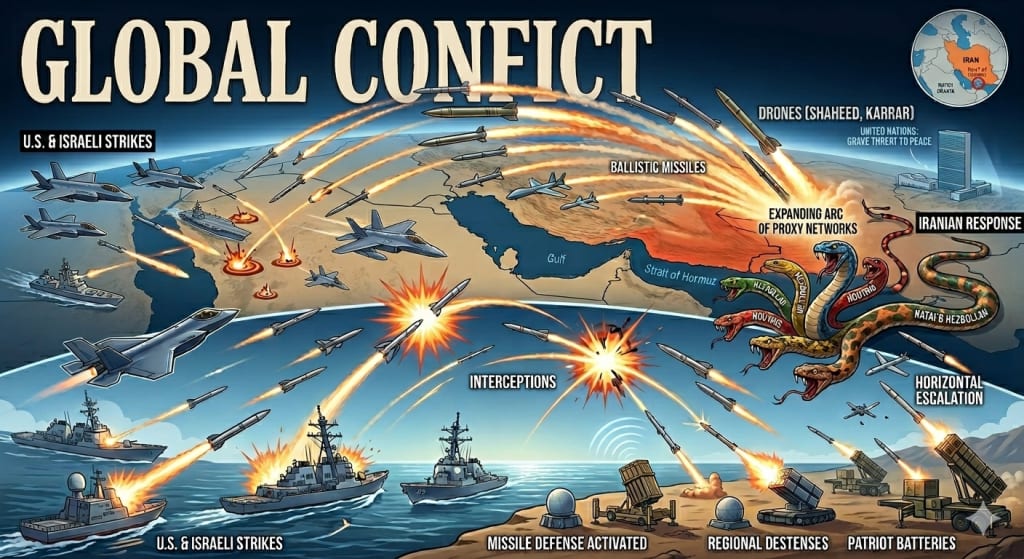
When powerful states exchange strikes, retaliation is rarely symbolic. It is strategic, calibrated, and designed to send a message. Iran’s response to recent U.S. and Israeli actions reflects exactly that logic — a display of capability, deterrence, and political signaling wrapped into one.
According to regional reports, Tehran has escalated its response using ballistic missiles and drones, targeting military-linked positions across the Gulf region and beyond. The situation remains fluid as of early March, with Iranian officials warning of what they describe as a “crushing response” should escalation continue.
But beyond the dramatic headlines lies something more complex than a simple action-reaction sequence. This is not just retaliation. It is a demonstration of strategic posture.
The Missile and Drone Dimension
Iran’s use of ballistic missiles represents a deliberate show of range and precision. Ballistic missiles travel high into the atmosphere before descending toward targets at extreme speed. They serve both military and psychological functions — projecting power while testing regional air defenses.
Several Gulf states reported missile interceptions, particularly over Qatar, where air defense systems were activated. Interceptions matter strategically; they signal defensive readiness while preventing wider destruction.
Simultaneously, drone deployments add another layer. Drones — especially long-range attack drones — are relatively low-cost but highly disruptive. They complicate air defense systems and stretch response capacities. Modern conflicts increasingly rely on such mixed aerial tactics: fast ballistic strikes combined with slower but persistent drone waves.
Reports indicate that Israel and other regional actors activated missile defense systems in response. In any high-intensity exchange, the goal is not only damage but deterrence messaging: “We can reach you.”
Operation and Counter-Operation
Military campaigns often receive code names that signal resolve. Following reported U.S. actions, described in some sources as “Operation Epic Fury,” Tehran’s counterstrikes appear calibrated to demonstrate symmetrical response capability.
Strategically, this pattern follows a familiar deterrence cycle:
Strike.
Respond proportionally — but visibly.
Signal readiness for further escalation if necessary.
Iranian officials have publicly rejected immediate negotiation frameworks under current conditions. This rejection itself is part of the signaling strategy — portraying resolve rather than weakness.
However, public rhetoric and private diplomacy are often different tracks. History shows that even during intense escalation, backchannel communication frequently continues.
Proxy Dynamics: The Wider Arc
One cannot analyze Iran’s strategy without considering its regional alliances.
Groups such as Hezbollah and the Houthis have reportedly increased activity, launching missiles and drones toward Israeli targets. Whether directly coordinated or strategically aligned, such actions expand the geographic scope of the confrontation.
This “proxy network” approach has long been part of Iran’s regional doctrine. Instead of direct full-scale war, influence radiates outward through allied groups. This structure provides strategic depth. It also complicates retaliation, because responses against proxies risk widening conflict across multiple borders.
From a military theory perspective, this creates what analysts call horizontal escalation — conflict spreading geographically rather than intensifying only in one theater.
The Gulf Calculus
Gulf states such as United Arab Emirates, Kuwait, and Iraq find themselves in a precarious position.
On one hand, many host U.S. military assets or maintain security partnerships. On the other, they are geographically close to Iran and vulnerable to missile range.
This geography transforms them from observers into stakeholders.
Missile interceptions over Gulf airspace underscore a central reality: regional conflicts no longer stay neatly confined. Airspace, shipping routes, and energy infrastructure become interconnected risk zones.
The U.S. Dimension
For Washington, the challenge is balancing deterrence with escalation control. U.S. military planners evaluate retaliation thresholds carefully. Too little response risks emboldening adversaries. Too much risks wider war.
Political leadership must also weigh domestic and international perception. The rhetoric surrounding potential next steps has included strong language, but official channels continue to emphasize protection of personnel and assets.
The broader question is whether escalation remains contained or evolves into sustained confrontation.
The Role of the United Nations
The United Nations has described the situation as a “grave threat” to international peace. This phrase is not chosen lightly. It signals that the conflict risks breaching containment thresholds.
UN statements often call for adherence to international law, proportionality, and immediate de-escalation. Yet enforcement depends on member states’ cooperation.
In multipolar crises, diplomatic consensus becomes harder to achieve.
Information Warfare and Perception
Modern warfare unfolds simultaneously in physical and digital spaces. Missile strikes are followed instantly by footage, commentary, and narrative framing.
Each side presents its actions as defensive and justified. International audiences interpret events through political, ideological, or strategic lenses.
This information battlefield can amplify tensions. Dramatic language — “crushing response,” “devastating retaliation,” “decisive strike” — influences public perception and market reaction alike.
Calibrated messaging becomes almost as important as calibrated firepower.
Nuclear Shadows
Any discussion of U.S.–Iran tensions inevitably touches the nuclear issue. While current exchanges focus on conventional weapons, the broader diplomatic backdrop includes nuclear oversight, sanctions, and enrichment debates.
European leaders, including Emmanuel Macron, have reiterated calls for renewed negotiations under UN frameworks.
Nuclear ambiguity magnifies anxiety. Even if no immediate nuclear escalation exists, the strategic shadow influences decision-making on all sides.
A Dangerous Equilibrium
What makes the current moment particularly delicate is that each actor believes deterrence requires firmness. Yet mutual firmness can generate unintended escalation.
Military theorists sometimes describe this as the “security dilemma.” One state increases defenses; another perceives threat; both escalate.
Iran’s current posture appears aimed at demonstrating capability without crossing thresholds that would trigger overwhelming retaliation. The United States and Israel, meanwhile, seek to restore deterrence without igniting regional war.
It is a balancing act conducted at missile speed.
The Road Ahead
Will diplomacy intervene? Historically, crises of this scale either cool through quiet negotiation or intensify through miscalculation.
Energy markets are watching. Regional governments are calculating. International institutions are urging restraint.
And behind official statements lies a stark truth: modern warfare is no longer linear. It spreads across domains — air, sea, cyber, information, diplomacy.
For now, Tehran continues signaling resolve. Washington signals readiness. Regional actors fortify defenses.
The situation is dramatic, yes — but it is also profoundly serious.
In high-stakes geopolitical chess, every move carries consequences beyond the immediate board. The next step will not only shape military posture but influence alliances, markets, and diplomatic alignments for years to come.
History reminds us that escalation is easy. De-escalation requires intention.
The world now watches to see which path prevails.
About the Creator
Amanullah
✨ “I share mysteries 🔍, stories 📖, and the wonders of the modern world 🌍 — all in a way that keeps you hooked!”
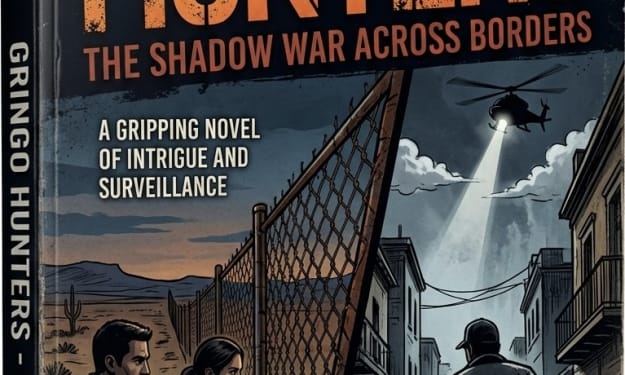
The Shadow War Across Borders
In the hidden corridors of international law enforcement, there exists a group known by a name that inspires fear among fugitives and criminals alike — the Gringo Hunters. They are not celebrities. They don’t give interviews. They don’t chase fame. Their mission is simple but dangerous: track, locate, and capture high-value criminals who cross borders to escape justice.
By Irshad Abbasi 5 days ago in History



Comments
There are no comments for this story
Be the first to respond and start the conversation.