
A 2,000-Year-Old Sphinx Statue Discovered in Egypt
Archaeologists uncover a rare Roman-era sphinx near an ancient temple, shedding new light on Egypt’s cultural blending during the Roman period.

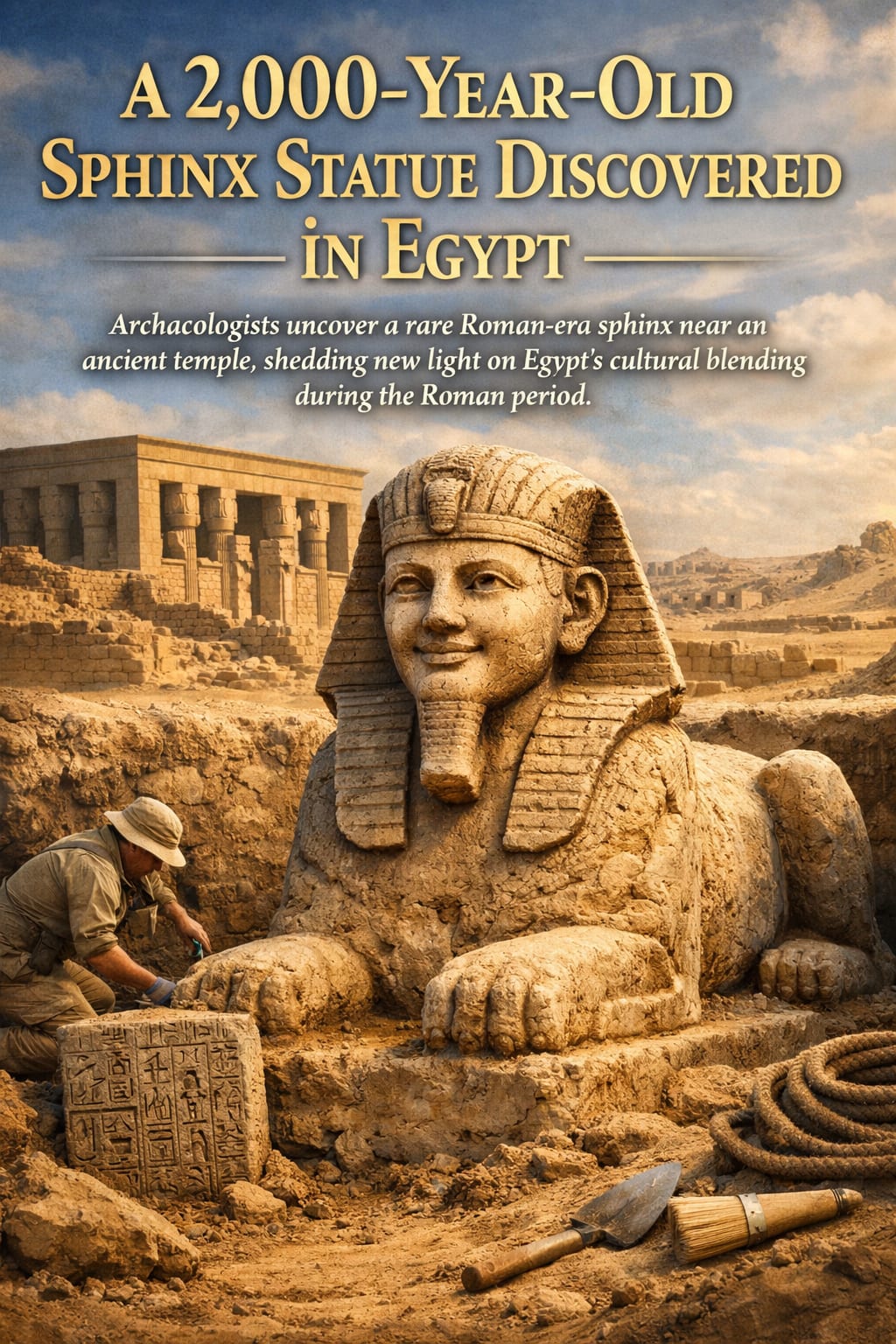
Archaeologists in Egypt have uncovered an extraordinary ancient statue shaped like a sphinx that dates back roughly 2,000 years, providing historians with fresh insight into Egypt’s long and complex past. The discovery was announced by Egypt’s Ministry of Tourism and Antiquities after an archaeological mission unearthed the statue during excavation work near the Temple of Hathor in Dendera, located in Qena Province in southern Egypt.
The statue, carved from limestone, represents a sphinx — a mythical creature with the body of a lion and the head of a human, one of the most famous symbols of ancient Egyptian power and kingship. Although the Great Sphinx of Giza is the most widely known example, many smaller sphinx statues were created throughout Egyptian history to represent rulers and divine protection.
A Roman-Era Ruler in Egyptian Form
What makes this newly discovered statue particularly fascinating is its unusual historical context. Early studies suggest that the sphinx may depict a Roman emperor, most likely Claudius, who ruled the Roman Empire between 41 and 54 AD.
The statue portrays the ruler wearing the traditional Nemes headdress, a striped headcloth commonly worn by Egyptian pharaohs, along with a cobra symbol (uraeus) on the forehead. These elements were powerful symbols of royal authority in ancient Egypt.
This artistic combination reveals how Roman rulers adopted Egyptian imagery to legitimize their authority after Egypt became part of the Roman Empire in 30 BC. By presenting themselves in the style of Egyptian pharaohs, Roman emperors could strengthen their political and religious influence among the local population.
A Remarkable Facial Expression
One of the most intriguing features of the statue is its distinct facial expression. Archaeologists described the sphinx as having a slightly smiling face with noticeable dimples, a detail rarely seen in ancient Egyptian sculpture.
Such artistic details may suggest that the statue was created during a period when Egyptian art was evolving under the influence of Greek and Roman artistic traditions. This mixture of styles reflects how Egypt remained culturally vibrant even under foreign rule.
Discovery Inside an Ancient Structure
The sphinx was found inside a two-level limestone structure near the temple complex. During the excavation, researchers also uncovered a stone stele — a carved slab containing inscriptions written in hieroglyphic and demotic scripts, an ancient Egyptian writing system used for everyday documents and administration.
These inscriptions could help archaeologists better understand the statue’s purpose and the historical circumstances surrounding its creation. The temple complex where the discovery was made has long been considered one of the best-preserved ancient temples in Egypt, dedicated to Hathor, the goddess of love, beauty, music, and fertility.
The temple itself dates back to the Ptolemaic period, though many parts were expanded during the Roman era. The discovery of a Roman-era sphinx there suggests that the site continued to be important even after Egypt became part of the Roman Empire.
Egypt’s Ongoing Archaeological Discoveries
Egypt continues to be one of the most important locations for archaeological exploration in the world. Every year, excavations reveal new artifacts that help historians piece together the story of one of humanity’s oldest civilizations.
Recent discoveries have included statues, tombs, ancient ships, coins, and even entire submerged cities along the Mediterranean coast. Some underwater excavations near Alexandria have uncovered artifacts from 2,000-year-old sunken settlements, including statues and sphinx figures from the Ptolemaic and Roman periods.
These discoveries demonstrate how Egypt served as a crossroads of cultures, where Egyptian, Greek, and Roman traditions blended together for centuries.
A Window into the Ancient World
The newly discovered sphinx offers more than just a fascinating artifact; it provides a window into the political and cultural dynamics of ancient Egypt during Roman rule. It illustrates how rulers used art and symbolism to communicate power and legitimacy.
For historians and archaeologists, such finds are invaluable. Each statue, inscription, or fragment of pottery helps fill gaps in the historical record and deepens our understanding of how ancient societies functioned.
Once restoration and detailed analysis are completed, the sphinx will likely be displayed in a museum where scholars and visitors alike can appreciate this rare piece of history.
Preserving the Legacy of Ancient Egypt
Egypt’s archaeological heritage remains one of the richest in the world. From the pyramids and temples to newly discovered statues like this sphinx, the country continues to reveal secrets that have been buried for millennia.
The discovery of this 2,000-year-old sphinx is another reminder that the sands of Egypt still hold countless untold stories — waiting patiently to be uncovered by future generations of explorers and scientists.
About the Creator
Irshad Abbasi
Ali ibn Abi Talib (RA) said 📚
“Knowledge is better than wealth, because knowledge protects you, while you have to protect wealth.
Keep reading
More stories from Irshad Abbasi and writers in History and other communities.
The Destruction of Palmyra’s Roman Amphitheater and Tetrapylon by ISIS
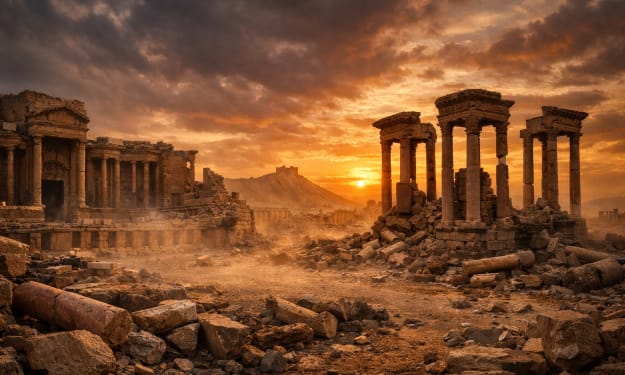
In the heart of the Syrian desert lies the ancient city of Palmyra, one of the most remarkable archaeological treasures of the ancient world. For centuries, this historic oasis city stood as a meeting point of civilizations, where Roman, Persian, Greek, and local cultures blended together. Among its most iconic monuments were the magnificent Roman Amphitheater of Palmyra and the elegant Tetrapylon of Palmyra. Sadly, both structures suffered devastating destruction during the Syrian civil war when the militant group Islamic State of Iraq and Syria (ISIS) seized control of the city.
By Irshad Abbasi about 18 hours ago in History



Comments
There are no comments for this story
Be the first to respond and start the conversation.