
“Who Really Saw Aliens First? The Truth Behind the Mystery”
From the first reported UFO sightings to modern space telescopes, the search for extraterrestrial life continues.

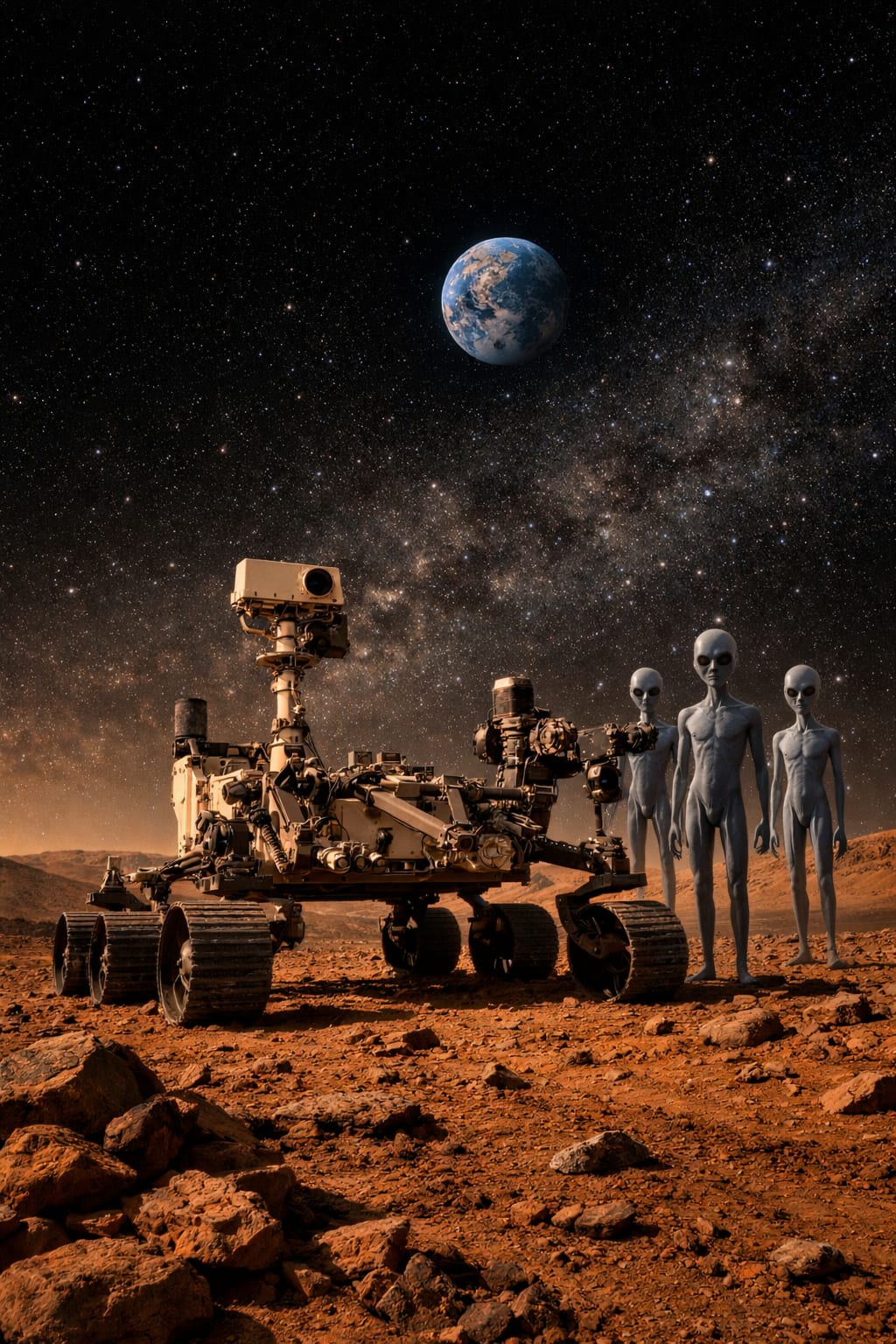
Have you ever looked up at the night sky and felt a strange question echo in your mind — Are we truly alone?
For thousands of years, humans have stared at the stars with wonder, fear, and curiosity. Long before rockets, telescopes, or modern science, ancient civilizations imagined that other worlds might exist beyond our own. The mystery of aliens — life beyond Earth — did not begin with movies or science fiction. It began with simple human curiosity.
Greek philosophers such as Democritus dared to suggest that the universe might contain countless worlds, some possibly filled with life. At the time, these ideas were revolutionary — even dangerous. There was no proof, only imagination and bold thinking. Centuries later, when the telescope was invented, everything changed. In the 17th century, astronomers like Galileo Galilei turned their lenses toward the heavens and saw moons orbiting Jupiter and craters covering our own Moon. Suddenly, the universe no longer felt small. It felt endless. And with that endlessness came a thrilling possibility: if Earth is not the center of everything, could life exist elsewhere too?
The mystery grew even stronger in 1947. A pilot named Kenneth Arnold reported seeing strange, fast-moving objects near Mount Rainier in the United States. His description gave birth to the term “flying saucers.” Just weeks later, the famous Roswell incident shocked the world. An unidentified object crashed in New Mexico. At first, officials claimed it was a “flying disc,” only to later call it a weather balloon. Confusion turned into suspicion. Suspicion turned into decades of conspiracy theories. People wanted to believe that we were not alone — that someone, somewhere, had finally made contact.
But science does not rely on excitement or rumors. It relies on evidence.
Instead of chasing mysterious lights in the sky, scientists began searching quietly and carefully for signs of life. Organizations like NASA started sending robotic explorers to Mars. These rovers do not search for little green beings or alien cities. They search for something far smaller — microscopic life, ancient bacteria, traces of water locked in rocks. Because if water once flowed on Mars, life might have followed.
At the same time, the SETI Institute began listening to the universe. Using massive radio telescopes, scientists scan distant stars, hoping to catch a signal — a whisper from another civilization. In 1960, astronomer Frank Drake launched Project Ozma, one of the first scientific attempts to detect intelligent extraterrestrial communication. He later created the Drake Equation, a formula that tries to estimate how many intelligent civilizations might exist in our galaxy. The numbers are uncertain. The silence so far is real. But the hope remains.
In recent years, powerful instruments like the James Webb Space Telescope have taken the search even further. Scientists now study distant exoplanets — worlds orbiting other stars — examining their atmospheres for gases like oxygen or methane that could hint at biological activity. We may not see aliens walking on these planets, but we might detect the chemical fingerprints of life from light-years away.
And yet, despite all the technology, all the missions, and all the decades of searching, one truth remains: no human has ever scientifically confirmed seeing an alien being. The universe has not answered us — at least not yet.
Still, the question refuses to fade. With billions of galaxies and trillions of stars scattered across the cosmos, it seems almost impossible that Earth is the only cradle of life. Perhaps life exists in forms we cannot yet imagine. Perhaps it is waiting to be discovered. Or perhaps the silence itself holds a deeper mystery.
The search for aliens is not just about science. It is about humanity’s deepest desire — to understand our place in the universe. Whether we are alone or part of something far greater, the journey to find out continues, driven not by fear, but by wonder.
And tonight, when you look up at the stars, the question will still be there… waiting. 👽✨
About the Creator
Keep reading
More stories from imtiazalam and writers in Futurism and other communities.
Biggest LLM Mistakes Companies Make
The rush to adopt generative AI has pushed many companies to deploy chatbots and language models without a clear strategy. While the intention is to improve productivity and reduce costs, the absence of proper LLM development solutions often leads to inaccurate outputs, security risks, and failed implementations. What looks like quick innovation on the surface can quietly become a long-term operational problem.
By Ritu Singh5 days ago in Futurism
Australia Duty-Free Travel Retail Market: Passenger Traffic Recovery, Retail Innovation & Consumer Preferences
According to IMARC Group, the Australia duty-free and travel retail market reached USD 1.3 Billion in 2025 and is projected to expand to USD 2.3 Billion by 2034, exhibiting a compound annual growth rate (CAGR) of 6.13% during 2026–2034. The steady recovery of international and domestic air travel across Australia is revitalizing airport retail ecosystems. Rising tourism flows, increasing demand for luxury goods and the growing influence of digital retail technologies are reshaping the competitive landscape. As airports evolve into experiential commercial hubs rather than mere transit points, duty-free travel retail is entering a new phase of innovation and strategic expansion.
By Shrestha Roy6 days ago in Futurism
When the Shelter Closes
Across the street from my house, a man slept under a tree, his dog by his side. My first, naive thought: he must be traveling through. But he kept coming back, often sleeping there during the day. Then it hit me—that person might not have a home.
By Bride of Sound6 days ago in Humans



Comments
There are no comments for this story
Be the first to respond and start the conversation.