
The Silence at the Dinner Table
Breaking Bread, Breaking Hearts

The Silence at the Dinner Table
When Silence Speaks Louder Than Words
The house was never truly quiet.
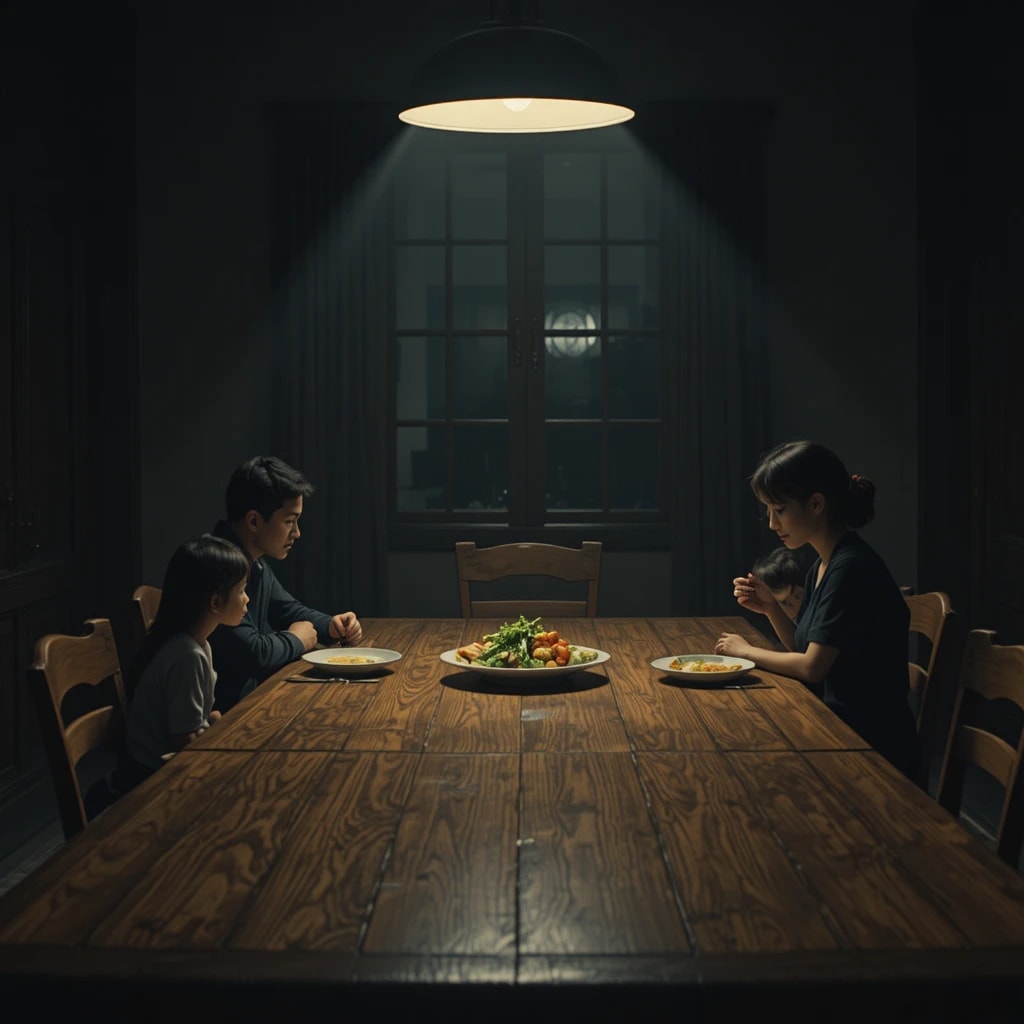
The television hummed in the living room. The refrigerator rattled every few minutes. Cars passed outside, their headlights brushing across the curtains like wandering ghosts. But at 8:00 p.m. every evening, when the family gathered around the wooden dinner table, a different kind of silence filled the room — one that felt heavy enough to press against the chest.
A silence that said everything no one dared to speak.
Ahsan sat at the head of the table, as he always had. His shoulders were slightly hunched now, though no one remembered when that change began. Perhaps it was gradual, like the fading paint on the walls. His hands, once steady and strong from years of work, now rested around his spoon without much movement.
Across from him sat Mariam, his wife of seventeen years. She served the food with mechanical precision — rice, lentils, curry — careful not to spill a single grain. She never asked who wanted more anymore. She simply placed the bowls down and sat quietly.
To Ahsan’s right was Hamza, sixteen, eyes glued to his phone under the table. The glow of the screen reflected faintly on his face, creating a small private world no one else could enter.
And beside Mariam sat little Aiza, only ten, swinging her legs slightly, waiting for someone — anyone — to begin a conversation.
But no one did.
The clinking of spoons against plates echoed too loudly.
There had been a time when this table carried laughter. Ahsan used to tell stories from work — exaggerated, dramatic, always ending with a grin. Mariam would complain about the neighbor’s gossip, but she laughed while doing it. Hamza once described his school projects with excitement, and Aiza would interrupt everyone just to show her drawings.
Back then, dinner lasted an hour.
Now, it barely lasted fifteen minutes.
The change had begun a year ago when Ahsan lost his job at the textile factory. It wasn’t sudden. The factory had been struggling for months. Everyone knew it. But knowing didn’t make the final announcement easier.
“We’re closing.”
Two words.
Two words that followed him home like a shadow.
At first, he tried to stay hopeful. He told the family it was temporary. He promised he would find something better. Mariam believed him — or at least pretended to. But weeks turned into months. Interviews came and went. Rejections piled up quietly, like unpaid bills hidden in a drawer.
The tension grew slowly, like a crack spreading across glass.
Mariam started stitching clothes for neighbors to earn extra money. She worked late into the night, the soft hum of her sewing machine replacing the conversations they once had in bed. Ahsan noticed but said nothing. His pride twisted painfully inside him.
Hamza stopped asking for pocket money. Instead, he withdrew into his phone, into friends, into silence.
Aiza began eating faster, as if finishing her meal quickly would free her from the suffocating quiet.
No arguments.
No shouting.
Just silence.
One evening, as rain tapped against the windows, the silence felt thicker than usual. The electricity flickered once before stabilizing. Ahsan cleared his throat.
It was a small sound, but it made everyone look up.
“I had an interview today,” he said.
Mariam paused mid-bite. Hamza’s phone lowered slightly. Aiza’s eyes widened.
“How did it go?” Mariam asked softly.
Ahsan hesitated. That hesitation lasted only a second, but it felt like an eternity.
“They said they’ll call.”
Those words again.
They’ll call.
No one responded after that. The silence returned, stronger, heavier. Even Aiza, who usually tried to rescue moments like this with a random story from school, kept quiet.
Later that night, Mariam stood by the sink washing dishes when Ahsan joined her.
“You don’t have to stitch so much,” he said quietly.
She didn’t turn around. “The bills don’t stop.”
“I know.”
Another silence.
But this one was different. It trembled with unspoken fears.
“Do you think I don’t see how hard you’re trying?” Mariam finally said, her voice barely above a whisper. “Do you think I blame you?”
Ahsan swallowed. “Sometimes it feels like you do.”
She turned then, eyes tired but not angry. “I blame the situation. Not you.”
It was the first honest conversation they had in months.
The next evening, something unexpected happened.
At dinner, Aiza dropped her glass of water. It shattered against the floor, pieces scattering everywhere. The sound was sharp, sudden — it broke more than just glass.
“I’m sorry!” she cried immediately, her small voice trembling.
For a moment, no one moved.
Then Ahsan stood up quickly. “It’s okay,” he said, kneeling to gather the pieces. “It’s just glass.”
But Aiza’s tears didn’t stop.
“I don’t like it when nobody talks,” she burst out. “It feels like we’re not a family anymore.”
Her words hung in the air, fragile yet powerful.
Hamza looked down at his plate. Mariam covered her mouth.
Ahsan froze.
Children often see what adults pretend not to.
Aiza continued, sniffing. “Before, we used to laugh. Now it’s like… like everyone is sad but pretending not to be.”
The truth, spoken by the smallest voice at the table.
Ahsan slowly stood up. He pulled a chair and sat back down, but this time not at the head — he sat between his children.
“You’re right,” he said.
The admission felt like unlocking a door.
“I was ashamed,” he continued. “Ashamed that I couldn’t provide like before. I thought staying quiet would protect you from my worries.”
“It didn’t,” Hamza said quietly. “It just made it worse.”
That was the first sentence Hamza had spoken at dinner in weeks.
Mariam reached across the table and placed her hand over Ahsan’s. “We’re supposed to carry things together,” she said. “Not alone.”
The room felt different now. Still serious. Still uncertain about the future. But lighter.
They talked that night — not about solutions, not about miracles — but about feelings.
Hamza admitted he was scared about university.
Mariam admitted she was exhausted.
Ahsan admitted he felt like a failure.
And Aiza admitted she just wanted her family back.
The problems didn’t disappear.
The bills were still there.
The job was still uncertain.
The future was still unclear.
But the silence was gone.
In its place came something quieter, but stronger — understanding.
A week later, Ahsan found temporary work at a small warehouse. It wasn’t permanent, and it didn’t pay much, but it was a beginning.
That night, dinner lasted forty minutes.
Hamza shared a joke from school.
Mariam complained about a stubborn customer — and smiled while doing it.
Aiza described a drawing she made of the family sitting together, with bright yellow light above the table.
And Ahsan laughed.
The house was still imperfect. The struggles were real. But the table no longer felt like a battlefield of unspoken fears.
It became what it once was — a place where hearts met, even when circumstances were hard.
Because sometimes, the loudest damage isn’t caused by shouting.
It’s caused by silence.
And sometimes, healing begins with the smallest voice daring to speak.
About the Creator
Essa Khan
I am a warm, genuine voice-over artist.
My style is conversational and approachable.
I specialize in bringing authenticity to every script.
From heartfelt narrations to friendly commercial spots,
I make complex topics feel simple and human.
Senior Care Services That Support Better Sleep, Comfort and Daily Well-Being
The tranquility of the night usually stands out as the best indicator that the elderly are receiving proper care. Once an aged person wakes up fresh, moves freely and feels at ease emotionally, everyday life is significantly improved. Sleep is known to promote mobility, memory and mood and thus is a pillar of general well-being.
By Laura Parton6 days ago in Families
What Makes Senior Care Services Truly Comfortable and Caring?
It tends to complete in the same silent manner, where a senior eventually gets to sleep correctly, wake up without any form of disturbances and feel safe in their own environment. Such a feeling of coziness is never incidental. It is very well constructed, step by step, with careful thoughtful choices of care. To learn more about what actually constitutes senior care services being comfortable and caring, it is better to start at the end and go in reverse.
By Laura Parton6 days ago in Families




Comments
There are no comments for this story
Be the first to respond and start the conversation.