
Why the Sun Is a Stable Star: The Science Behind Its Long-Lasting Balance
The Sun is the heart of our solar system and the ultimate source of energy for life on Earth. As a medium-sized star, the Sun has remained remarkably stable for about 4.6 billion years. This long-term stability allows planets like Earth to maintain conditions suitable for life. But what makes the Sun a stable star? Why doesn’t it explode like a supernova or collapse under its own gravity?

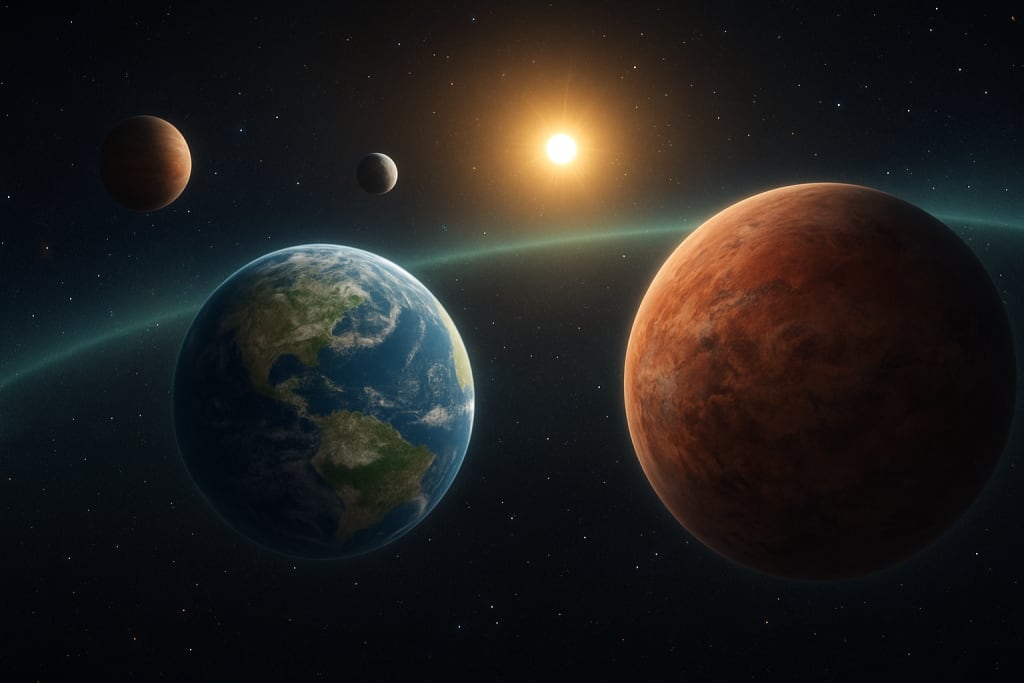
Understanding Stellar Stability
A stable star is one that maintains a balance between two opposing forces:
1. Gravity, which pulls matter inward.
2. Pressure from nuclear fusion, which pushes outward.
The Sun’s stability comes from a perfect balance between these forces. This state is known as hydrostatic equilibrium. When these forces are balanced, the star neither expands uncontrollably nor collapses inward.
________________________________________
The Role of Nuclear Fusion in the Sun’s Stability
At the core of the Sun, temperatures reach about 15 million degrees Celsius. Under such extreme heat and pressure, hydrogen atoms fuse together to form helium in a process called nuclear fusion.
How Nuclear Fusion Works
• Hydrogen nuclei (protons) collide at extremely high speeds.
• They fuse to form helium.
• A small amount of mass is converted into energy.
• This energy is released as light and heat.
This process follows Einstein’s famous equation:
E = mc²
A tiny amount of mass produces a tremendous amount of energy. This energy creates outward pressure that balances the inward pull of gravity.
Without nuclear fusion, gravity would cause the Sun to collapse. Without gravity, the Sun would expand and disperse into space. The constant fusion process ensures the Sun remains stable.
________________________________________
Hydrostatic Equilibrium: The Key to Stellar Balance
Hydrostatic equilibrium is the main reason the Sun is a stable star. It is the condition in which:
• The inward gravitational force equals
• The outward pressure from nuclear reactions.
This balance has lasted billions of years. If fusion slows slightly, gravity compresses the core, increasing temperature and speeding up fusion again. If fusion becomes too intense, the star expands slightly, cooling the core and slowing fusion.
This natural feedback system keeps the Sun stable.
________________________________________
The Sun’s Classification as a Main-Sequence Star
The Sun is classified as a G-type main-sequence star, often called a “yellow dwarf.” In stellar evolution, stars spend most of their lives in the main-sequence phase, where they steadily fuse hydrogen into helium.
Stars remain stable during this phase because:
• Hydrogen fuel is abundant.
• Fusion occurs at a steady rate.
• Internal forces are balanced.
The Sun is currently in the middle of its main-sequence lifetime and is expected to remain stable for another 5 billion years.
________________________________________
Why the Sun Doesn’t Explode
Some stars end their lives in dramatic explosions known as supernovae. However, the Sun will never explode in this way.
Massive stars—much larger than the Sun—have intense gravitational pressure that leads to rapid fusion and unstable reactions. When they run out of fuel, they collapse and explode.
The Sun, however:
• Is a medium-sized star.
• Burns fuel at a moderate rate.
• Does not have enough mass to trigger a supernova.
Instead, the Sun will eventually expand into a red giant and later become a white dwarf.
________________________________________
Energy Transport Inside the Sun
The Sun has several layers that help maintain its stability:
1. Core – Where nuclear fusion occurs.
2. Radiative Zone – Energy moves outward as radiation.
3. Convective Zone – Energy moves through convection currents.
4. Photosphere – The visible surface of the Sun.
Energy produced in the core takes thousands to millions of years to reach the surface. This slow energy transfer contributes to the Sun’s steady output rather than sudden bursts.
________________________________________
The Sun’s Balanced Energy Output
The Sun emits energy at a nearly constant rate known as solar luminosity. While there are small fluctuations, such as solar flares and sunspots, overall energy output remains stable.
This consistency is crucial for Earth’s climate stability. If solar energy varied drastically, life on Earth would struggle to survive.
________________________________________
Magnetic Fields and Solar Activity
Although the Sun is stable, it is not inactive. It experiences:
• Sunspots
• Solar flares
• Coronal mass ejections
These events are caused by magnetic field interactions within the Sun. However, they do not significantly affect its overall stability.
The Sun follows an approximately 11-year solar cycle of magnetic activity, yet this does not disrupt its long-term equilibrium.
________________________________________
The Sun’s Mass and Longevity
A star’s stability depends heavily on its mass. The Sun’s mass is ideal for long-term stability:
• Too massive → burns fuel quickly and dies young.
• Too small → burns fuel very slowly but may not support complex planetary systems.
• Just right → stable for billions of years.
The Sun converts about 600 million tons of hydrogen into helium every second, yet it has enough hydrogen to continue this process for billions more years.
________________________________________
What Will Happen in the Future?
Although the Sun is stable now, it will not remain unchanged forever.
In about 5 billion years:
• Hydrogen in the core will be depleted.
• The core will contract.
• The outer layers will expand.
• The Sun will become a red giant.
Eventually, it will shed its outer layers and leave behind a dense white dwarf.
However, this transformation will occur gradually and predictably—not suddenly.
________________________________________
Why the Sun’s Stability Is Important for Life
The stable energy output of the Sun allows Earth to:
• Maintain liquid water.
• Support ecosystems.
• Sustain a stable climate.
• Enable photosynthesis.
Without a stable star, life as we know it would not exist.
The precise balance between gravity and nuclear fusion makes long-term biological evolution possible on Earth.
________________________________________
Comparison with Other Stars
When compared to other stars in the galaxy:
• Red dwarfs are stable but much dimmer.
• Blue giants are extremely hot but short-lived.
• Variable stars change brightness dramatically.
The Sun falls into a category known for long-term stability. This makes it one of the most reliable types of stars in the universe.
________________________________________
Scientific Laws That Govern the Sun’s Stability
Several physical principles explain why the Sun remains stable:
• Newton’s Law of Gravitation
• Einstein’s Theory of Relativity
• Thermodynamics
• Nuclear Physics
These laws work together to maintain balance inside the Sun.
________________________________________
Key Reasons the Sun Is a Stable Star
Here is a summary of the main factors behind solar stability:
• Continuous hydrogen fusion
• Hydrostatic equilibrium
• Moderate mass
• Efficient energy transport
• Self-regulating fusion rate
• Main-sequence phase lifecycle
Each of these components plays a critical role in maintaining stability.
________________________________________
Frequently Asked Questions (FAQs)
Is the Sun perfectly stable?
No star is perfectly stable, but the Sun is extremely stable over long periods.
Can the Sun suddenly explode?
No, the Sun does not have enough mass to become a supernova.
How long will the Sun remain stable?
Approximately another 5 billion years.
________________________________________
Conclusion
The Sun is a stable star because of a delicate balance between gravity and nuclear fusion. This balance, known as hydrostatic equilibrium, has allowed it to shine steadily for billions of years. Its moderate mass, main-sequence classification, and efficient internal energy transport system all contribute to its long-term stability.
This remarkable stability is the foundation of life on Earth. Without it, our planet would not have the consistent energy required to sustain oceans, climates, and ecosystems.
Understanding why the Sun is stable not only reveals the physics of stars but also highlights how extraordinary our solar system truly is.
About the Creator
Keep reading
More stories from shahkar jalal and writers in Education and other communities.
Real Estate vs. Stock Market Investing: Which Path Builds More Wealth?
Real estate vs. stock market investing is a common debate for anyone who wants to grow wealth. Many people ask which option is safer, which earns more money, and which fits their lifestyle. The truth is that both choices can build wealth over time. However, they work in very different ways. You need to understand the strengths and risks of each before you decide.
By Manny Khoshbin5 days ago in Education
The Reality of doing it all before graduation
Many kids hear from their parents that they should try to live life to the fullest and do as much as they can before it’s too late. None of them is wrong in that regard, but putting it into practice is a little harder than it sounds.
By Aydn Young6 days ago in Education


Comments
There are no comments for this story
Be the first to respond and start the conversation.