
The Quiet Witness at the End of Ideology: Ruyan Meng’s "The Morgue Keeper"
How Ruyan Meng transforms silence, survival, and moral endurance into a haunting reckoning with life during the Cultural Revolution
There are novels that depict history, and then there are novels that trap you inside it. The Morgue Keeper by Ruyan Meng belongs firmly in the second category.
Set during the Cultural Revolution, the book follows Qing Yuan, a morgue keeper tasked with preparing the dead in a time when ideology saturates public life. The choice of narrator is quietly radical. Qing Yuan is not a soldier enforcing policy, not a rebel defying it, and not an official shaping it. He stands at the edge of power, with no authority and no allegiance, yet he bears witness to its consequences in the most intimate way possible. In the morgue, slogans do not echo. What arrives are bodies.
The morgue becomes a moral vantage point. It is the place where abstraction collapses into flesh. Each corpse carries the residue of fear, accusation, and fanaticism. Many arrive stripped even of narrative, reduced to anonymity. When a woman known only as “#19” is brought in, her condition shatters whatever fragile distance Qing Yuan has maintained. She is not just another number. Her brutality resists containment. In encountering her, Qing Yuan can no longer remain untouched by what he processes. Survival begins to look less like quiet compliance and more like an ethical reckoning.
What makes The Morgue Keeper so unsettling is its restraint. The novel does not rely on spectacle. Instead, it accumulates tension through repetition and detail. Qing Yuan bends to stretch before mounting his bicycle. He notices the sun. He tells himself, briefly, that he is free. These moments of physical ordinary life sit beside scenes of profound cruelty. The juxtaposition is deliberate. The novel insists that endurance is not grand. It is granular. It happens in muscles, in breath, in the choice to keep moving.
Literary comparisons come easily, though the book never feels derivative. There are echoes of The Stranger in the existential solitude, and the moral absurdity found in The Joke. The stark proximity of violence and grace recalls The Road. Like these works, The Morgue Keeper interrogates how a human being persists when systems meant to organize society instead distort it. But where some novels widen their scope outward, this one drills inward. The revolution is not analyzed as a political phenomenon. It is experienced as atmosphere, pressure, and corrosion.
Silence plays a crucial role. The morgue is quiet by necessity. The broader society is quiet by enforcement. Speech carries risk. Thought carries danger. Within that enforced hush, Qing Yuan’s inner life grows sharper. Silence becomes both constraint and refuge. It is in that space that conscience begins to assert itself. The novel suggests that when public language is hijacked, morality retreats into private listening.
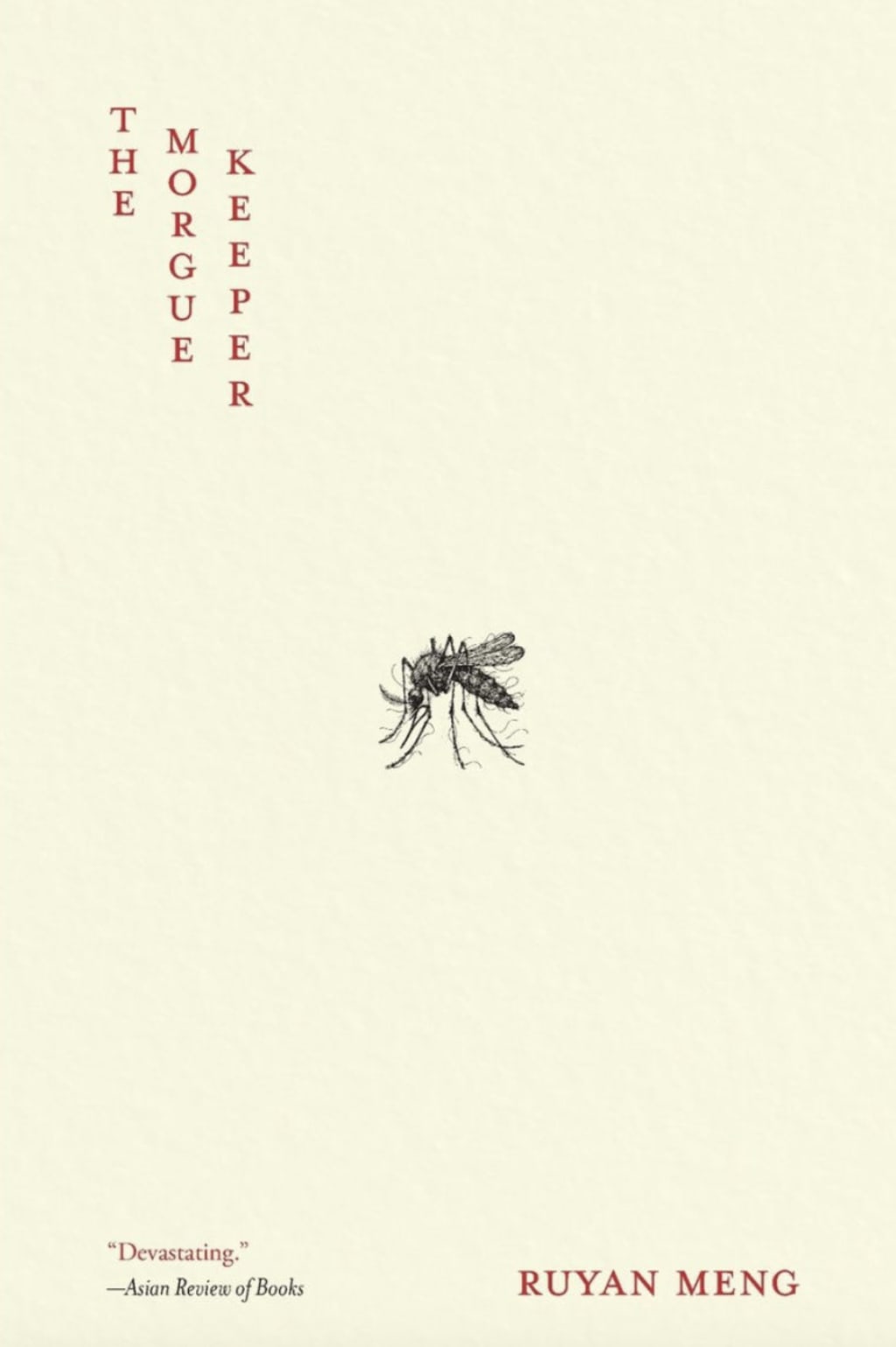
Even the physical design of the book mirrors its themes. The cream-colored cover, marked by red vertical lettering and a meticulously rendered black mosquito, appears almost serene at first glance. Only after reading does the image acquire weight. The mosquito, poised as if about to bite, becomes emblematic of the novel’s method: small, precise, and capable of drawing blood. The object in hand feels changed by the experience of reading it, as if it carries an afterimage of what lies inside.
The Morgue Keeper is less concerned with overt resistance than with preservation. Not the preservation of ideology or memory in a grand historical sense, but the preservation of self. Qing Yuan is tested repeatedly, not through dramatic declarations but through incremental erosions. The question is not whether he will overthrow the system. The question is whether he will allow it to define him.
In the end, the novel proposes a difficult but urgent idea: survival is not the same as submission. It is possible to endure without surrendering the small interior flame that marks one’s humanity. In a world that reduces individuals to numbers, the act of recognizing a life as meaningful becomes radical. The Morgue Keeper leaves readers with that unsettling awareness, long after the final page is turned.
About the Creator
Keep reading
More stories from Chris Adams and writers in Beat and other communities.
TubeFreeks Debut New Single “Flower” Co-Written with Sevendust’s Clint Lowery
Hard rock band TubeFreeks have released their newest single “Flower,” co-written with Clint Lowery of Sevendust. The song arrives alongside a new music video directed by nationally recognized filmmaker Tom Flynn. “Flower” showcases TubeFreeks’ ability to merge melodic heaviness with the raw intensity of contemporary rock. It carries the hook-laden energy reminiscent of peak post-grunge while feeling immediate and present in its execution. The track is driven by complex drum patterns and heavy rhythm guitar that create tension and motion throughout the verses. At the center, frontman Paul van Valkenburgh delivers a vocal performance that is raw, distinct, and unmistakably his own. His voice cuts through the dense instrumentation while maintaining emotional clarity, allowing listeners to feel both the urgency and the intimacy of the song.
By Chris Adams9 days ago in Beat
Review of 'Man on the Run'
My wife and I saw Man on the Run, a nearly 2-hour documentary on Amazon Prime, about Wings, Paul McCartney's group that flew around the world from shortly after The Beatles broke up in early 1970 to shortly after John Lennon was murdered at the end of 1980, making a Beatles reunion forever impossible.
By Paul Levinson3 days ago in Beat
Top Rappers in Miami, FL (2026 Update)
Miami has always been a collision point. Caribbean rhythm meets Southern bass. Flash meets grit. Club anthems share space with street narratives. In 2026, the city’s rap scene is more layered than ever—global-facing, streaming-savvy, and unapologetically bold.
By RapRadarDigest20 minutes ago in Beat



Comments
There are no comments for this story
Be the first to respond and start the conversation.