
How Browser Technology Is Quietly Evolving in 2026?
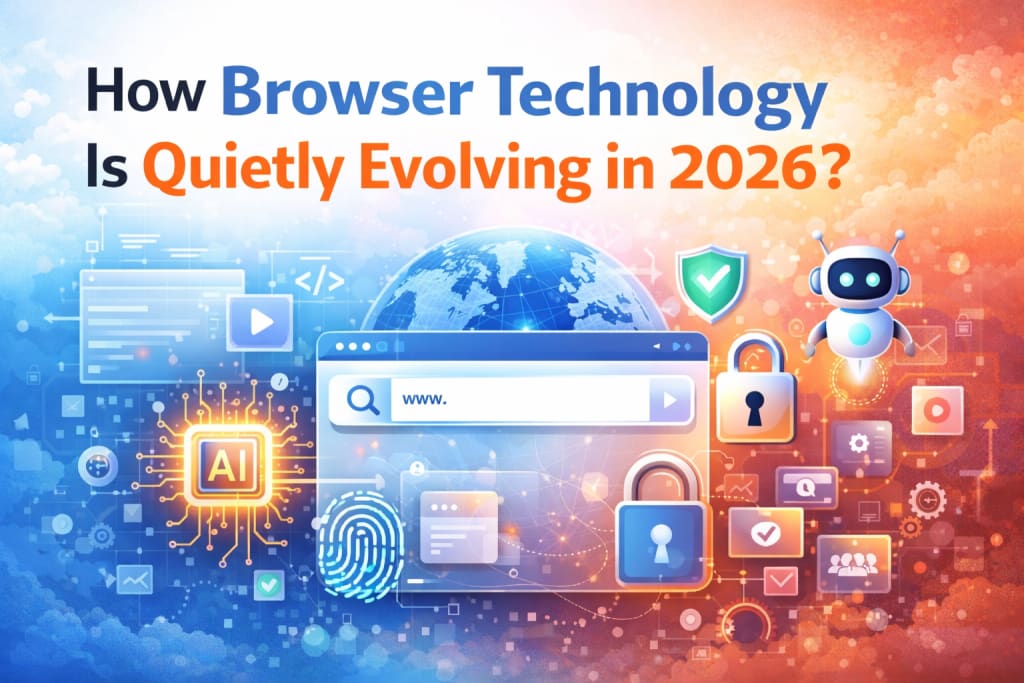
While headlines focus on artificial intelligence breakthroughs and platform rivalries, one of the most consequential layers of the digital stack is changing almost invisibly: web browsers are transforming from passive page renderers into security gateways, AI-enabled assistants, performance orchestrators, and cross-device coordination hubs — reshaping how software is delivered and experienced without demanding user attention.

For most users, the browser feels finished.
It loads pages. It streams video. It manages tabs. It autofills passwords. It works.
Yet beneath that familiarity, browsers in 2026 look very different from their counterparts a decade ago. The changes are subtle — often unnoticed — but they are redefining performance expectations, privacy controls, developer workflows, and even the economics of the web.
Browsers are no longer just windows into the internet.
They are becoming intelligent intermediaries.
The Browser as Security Perimeter
One of the most significant evolutions lies in security architecture.
As cyber threats grow more sophisticated, browsers have assumed greater responsibility for isolating code execution and protecting user data. Google’s Chromium security team reports that modern browser sandboxing now isolates processes at granular levels, dramatically reducing the impact of malicious scripts.
According to the 2026 Verizon Data Breach Investigations Report, web-based attack vectors remain involved in nearly 40% of documented security incidents. This persistent exposure has driven browser vendors to enhance memory safety, implement stricter permission models, and adopt default HTTPS encryption standards.
Browsers increasingly function as frontline security systems.
Features such as automatic certificate validation, phishing detection, and third-party cookie restrictions reflect a shift toward built-in defensive mechanisms rather than relying solely on external tools.
Privacy Controls and the End of Traditional Tracking
Privacy expectations have accelerated browser evolution.
Apple’s Safari introduced Intelligent Tracking Prevention years ago, but in 2026 similar mechanisms have become standard across major browsers. Google continues its phased transition away from third-party cookies within Chrome’s Privacy Sandbox framework.
According to StatCounter, Chromium-based browsers account for roughly 65% of global browser usage, amplifying the impact of these policy shifts.
The Interactive Advertising Bureau reports that over 70% of digital marketers are now experimenting with contextual advertising models in response to browser-level tracking limitations.
The browser has become a regulator of data flows.
Users rarely see these policy layers in action, yet they influence how advertising, analytics, and personalization function across the web.
Performance Gains Through Engine Optimization
Performance remains a core focus.
WebAssembly (Wasm) adoption continues expanding, enabling near-native execution of code within browsers. A 2026 developer survey by JetBrains found that 48% of web developers now integrate WebAssembly components into performance-intensive applications.
This shift allows complex applications — from design tools to data visualization dashboards — to operate entirely within browser environments without traditional desktop installations.
Rendering engines have also evolved. Chrome’s Blink and Firefox’s Gecko engines now optimize resource loading dynamically, prioritizing visible content to improve perceived speed.
Google’s Web Vitals research shows that pages meeting Core Web Vitals benchmarks achieve up to 24% higher user engagement rates compared to slower sites.
The browser increasingly orchestrates performance rather than merely displaying content.
AI Integration Within the Browser
Artificial intelligence capabilities are now embedded directly into browser experiences.
Edge and Chrome both integrate AI assistants capable of summarizing pages, rewriting text, and suggesting responses within forms. Mozilla has experimented with privacy-focused AI features operating locally on devices.
A 2026 Gartner forecast estimates that more than 60% of enterprise browser sessions will include AI-assisted features by the end of the year.
The browser evolves from passive renderer to active collaborator.
Instead of navigating multiple tools, users can rely on integrated assistants that interpret content contextually.
The implications extend to productivity, accessibility, and search behavior.
Progressive Web Apps and Blurred Boundaries
Progressive Web Apps (PWAs) continue narrowing the gap between web and native applications.
Microsoft reports that usage of installable web apps on Windows devices increased by more than 35% over the past two years. PWAs now support offline access, push notifications, and device-level integration previously reserved for app stores.
For developers, this convergence alters distribution strategy.
Teams engaged in mobile app development San Diego and similar regions increasingly evaluate whether browser-based deployment can complement or even replace native app distribution for certain use cases.
The browser becomes a runtime environment for sophisticated applications.
The distinction between “website” and “app” grows less clear.
Edge Computing and Reduced Latency
Browser performance improvements also reflect backend shifts.
Edge computing infrastructure brings servers closer to users, reducing latency for content delivery. Cloudflare reports that more than 30% of dynamic web content now leverages edge processing rather than centralized data centers.
Browsers optimize connections through protocols such as HTTP/3, reducing handshake delays and improving streaming stability.
The experience feels instantaneous not because complexity vanished, but because coordination improved across layers.
The Rise of Zero-Trust Browsing
Enterprise environments increasingly treat browsers as secure workspaces.
According to IDC, 45% of large organizations now deploy browser isolation or zero-trust access models to protect sensitive data. In these models, browsing sessions operate within controlled virtual environments, preventing malicious code from reaching internal networks.
The browser becomes a controlled portal into enterprise systems.
This shift reflects recognition that modern workflows — document editing, collaboration, CRM access — increasingly occur within web applications rather than desktop software.
Open Standards and Interoperability
Despite competitive tensions among vendors, browsers continue advancing open standards.
The World Wide Web Consortium (W3C) and WHATWG maintain evolving specifications that ensure compatibility across platforms. WebGPU, for example, enables advanced graphics and machine learning tasks within browsers without proprietary plugins.
Adoption of standardized APIs allows developers to build once and deploy widely.
Browser evolution depends not only on competition but also on shared governance structures.
The Economic Implications
Browser changes ripple across industries.
Advertising models adjust to privacy shifts. SaaS platforms optimize for WebAssembly compatibility. Cybersecurity firms collaborate with browser vendors to strengthen threat detection.
Morgan Stanley analysts note that browser-level privacy changes can influence billions of dollars in digital advertising revenue within a single fiscal year.
The browser may appear neutral, but its policies carry economic weight.
A Quiet Reinvention
Unlike flashy product launches, browser evolution rarely dominates headlines.
Updates arrive incrementally. Interfaces remain familiar. Tabs still line the top of the screen.
Yet beneath that continuity lies reinvention.
Security architecture has hardened. Privacy controls have strengthened. AI features have integrated. Performance engines have accelerated. Enterprise governance has deepened.
The browser is no longer just a portal to the web.
It is an adaptive layer that interprets, protects, and enhances digital interaction.
In 2026, some of the most consequential shifts in technology are not visible at first glance.
They unfold quietly — one update at a time — inside the tool millions open every day without thinking.
And in that quiet evolution, the browser continues redefining how the internet works.
About the Creator
Ash Smith
Ash Smith writes about tech, emerging technologies, AI, and work life. He creates clear, trustworthy stories for clients in Seattle, Indianapolis, Portland, San Diego, Tampa, Austin, Los Angeles, and Charlotte.
The Intersection of Quantum Computing and Blockchain
Blockchain and quantum computing seem to belong to entirely different worlds, and yet both have become inextricably linked. Blockchain relies on math, distributed systems, and a comprehensive encryption scheme that is hard to crack. Quantum computing, on the other hand, leverages quantum mechanics to smash through the limits of regular computers — and maybe, just maybe, to break a lot of the cryptography we use today.
By Mark Arthur5 days ago in 01
This Ain't Fiction!
To quote from the Challenge: Write this in whatever format and Vocal community you want, as long as you are not writing fiction. If a longing poem suits your needs, go for it. If half your reasoning is a memoir-style background to explain that all you want is a nice garden, it qualifies.
By Kendall Defoe 2 days ago in 01
me, me, me
when i read back my poetry it screams “me, me, me” on my screen in bold letters and i can’t shut it up — most days, i cannot make any other words out; i want to throttle a thousand versions of the me gone by, i want to throw myself from a figurative balcony, i want to sink a sword into every pen i’ve held
By angela hepworth5 days ago in Poets



Comments
There are no comments for this story
Be the first to respond and start the conversation.